Introduction: Why should we care about whole-child support?
Every child grows in many ways at once. When we support the whole child, we help children learn to move, talk, think, and get along with others. This matters because early help makes a big difference in a child’s life. See Supporting Whole-Child Development in Early Learning Settings for ideas you can use today.
Why it matters:
- 1. Babies and young children build skills fast in the early years, so small supports help a lot (social-emotional research).
- 2. When classrooms plan for every child, learning and friendships grow for everyone (read about inclusion ideas at Florida Center for Inclusive Communities).
Across this article you will see simple steps, tools, and links that help you support #development and #inclusion through everyday work with children, families, and staff. Also remember: state requirements vary - check your state licensing agency.
What are the main areas of development we should watch?
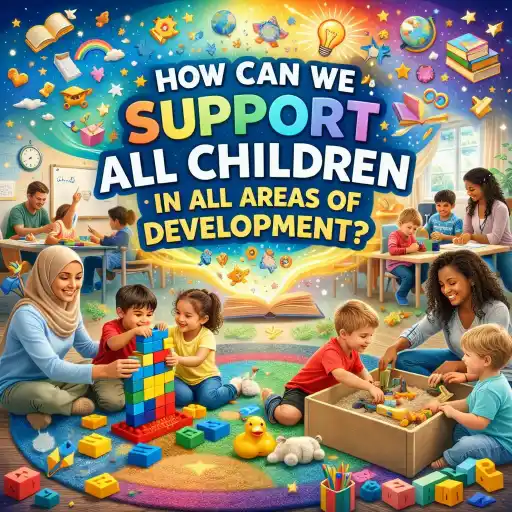
Children grow in several connected ways. Watching each area helps you notice strengths and needs early. Here are the main areas to watch, with short examples and quick classroom tips:
- 😊 Social-Emotional: How children play with others, handle feelings, and calm down. Tip: Teach feeling words and give children a calm space to settle. See ideas at Supporting Social and Emotional Development.
- 🗣️ Language & Communication: How children speak, listen, and follow directions. Tip: Read aloud, sing, and repeat words in longer sentences to grow vocabulary (see ChildCareEd language supports at How Can Teachers Support Every Part of a Child’s Development?).
- 🧠 Cognitive (Thinking): Problem solving, counting, and remembering. Tip: Ask open-ended questions and include simple counting games.
- 🏃 Physical (Gross & Fine Motor): Jumping, running, holding crayons, using scissors. Tip: Offer outdoor play and fine-motor tools like large crayons or beads.
- 🍽️ Adaptive & Self-Help: Dressing, feeding, and following routines. Tip: Teach steps and let children try being independent.
For concrete milestone checklists, use the CDC milestone pages such as CDC's Developmental Milestones. Tracking these areas helps you plan activities and spot when someone may need extra support. Use #play daily as a learning tool—play builds skills in every area.
How do we assess and screen so every child gets help when needed?
Assessment and screening help us know if a child needs extra support. These steps are simple and practical for busy programs. Start with watching (monitoring) and use formal screening tools when you or families are concerned.
- 🔍 Watch often: Use short checklists or observation notes during routines and play. ChildCareEd explains observation ideas in Observations in Childcare.
- 📋 Screen at key times: The American Academy of Pediatrics recommends screenings at certain ages; CDC explains how monitoring and screening work together (CDC Screening & Monitoring).
- 🧾 Use trusted tools: Choose validated tools for social-emotional and development screening (see tool list at CECMHC screening guide).
- 📞 If you see concerns: Talk with families, document specific examples, ask the child’s health provider for guidance, and refer to early intervention if needed. The CDC recommends early referral and offers steps at Learn the Signs. Act Early.
State rules and referral paths differ—state requirements vary - check your state licensing agency. For program training on screening steps, ChildCareEd’s Developmental Screening in Early Childhood  Buy Now $16.00 course is a helpful staff resource.
How can we adapt activities and classrooms so every child can join?
Creating an inclusive classroom means changing how activities are done so every child can take part. Small changes often make the biggest difference. Here are practical classroom adaptations and steps you can use right away.
- 🎨 Adapt materials: Use large crayons, fewer puzzle pieces, or non-slip mats. Example: for art offer thick crayons or adaptive scissors so hands can work comfortably (Adapting Activities).
- 🪑 Arrange the room: Make clear learning areas, low shelves, and calm corners so children know where to go and feel safe.
- 🧩 Break tasks into steps: Give one or two simple steps and show with pictures or gestures. This helps children who need extra time or who have language differences.
- 🤝 Use peer supports: Pair children for games, let friends model tasks, and create small groups so every child can practice skills.
- 📑 Individualize without isolation: Keep the activity goal the same but change the way a child gets there—this is inclusion (see research-backed practices at OECD inclusion chapter).
Training supports these skills. ChildCareEd courses like Supporting Skill Development: Children with Special Needs Buy Now $24.00 and Building Equity: Inclusionary Practices Buy Now $10.00 give practical ideas for daily planning.
How can we partner with families and staff to keep progress steady and avoid common mistakes?
Families and staff working together create the strongest supports for children. Partnering means listening, sharing simple information, and making plans together. Here are steps to build strong partnerships and some common mistakes to avoid.
- 👋 Welcome and listen: Greet families, ask what works at home, and record routines. The Pyramid Model family-engagement resources offer good strategies (Family Engagement - NCPMI).
- 🗣️ Communicate clearly: Share brief notes, photos, or short calls about progress. Use interpreters or translated materials for multilingual families (see Partnering with Multilingual Families).
- 📅 Make a small plan: Set 2–3 simple steps families can do at home and classroom steps to practice together. Celebrate small wins.
- 📚 Train and coach staff: Use practice-based coaching and team planning so all staff use the same strategies (Indiana University preschool inclusion webinars are helpful: Preschool Inclusion Resources).
Common mistakes and how to avoid them:
- ❌ Mistake: Waiting too long to act. ✅ Fix: Use routine observation and ask for screening when concerns emerge.
- ❌ Mistake: One person doing all planning. ✅ Fix: Involve families, teachers, and specialists so supports fit the child’s life.
- ❌ Mistake: Using one-size-fits-all activities. ✅ Fix: Offer choices and small adaptations so each child can participate.
Conclusion: What can you start doing tomorrow?
Quick action plan (do these 3 things):
- ✨ Observe and note one child’s strength and one area to support today (use tools from ChildCareEd Observations).
- ✨ Try one small adaptation during group time (e.g., picture steps or larger materials) and watch for progress.
- ✨ Call or message one family with a positive note and one idea to try at home.
Resources to learn more: ChildCareEd articles and courses (linked above), CDC milestone and screening pages (CDC milestones and CDC monitoring & screening), and local early intervention contacts.
Remember that supporting every child is a team effort. Use small steps, track progress, and keep families and staff involved. With kindness, patience, and planning you can make your program a place where every child can grow. Keep focusing on #screening, #families, and everyday #play to help children succeed.
FAQ
- Q: When should we refer a child for early intervention? A: If you or a family notices a missed milestone or loss of skills, talk to the child’s doctor and refer to your state early intervention program. State requirements vary - check your state licensing agency.
- Q: How often should we screen? A: Follow recommended ages and screen when concerns arise; see the CDC guidance at Developmental Monitoring and Screening.
- Q: What if a family disagrees with my observations? A: Listen, share specific examples, ask about home routines, and invite them to partner in a small plan with clear, simple steps.
- Q: How can we support multilingual children? A: Use visuals, gestures, books in multiple languages, and interpreters when needed. See partnering tools.
- Watch Me Grow: School Age Development ONLINE
- 45 Hour Child Growth and Development
- Positive Attention: Interactions & Supervision of Infants & Toddlers
- CDA Home Visitor Subject Area 3 Part 3 Birth to 5
- CDA: Special Needs: Understanding the Whole Child
- Texas Director Credential
- Growing the Whole Child: Health, Emotions & Early Learning
- Let’s Talk: Effective Communication
- Technology as a Classroom Tool
- Theories on How I Grow
- Managing Behaviors in the Early Childhood Education Classroom
- Maximizing Efficiency with ChildCareEd's Group Admin Account
- CDA Certification en Español: Recursos y Consejos para Educadores Bilingües
- Daycare Training 101: Building a Safe, Fun, and Educational Environment
- Staying Compliant in the Lone Star State: Avoiding Common Licensing Pitfalls
- 🔍 ¿Qué ves cuando observas a un niño aprender?
- Developmental Disabilities Awareness Month Activities for Kids: Inclusion Ideas That Work
- Cómo Ser Maestra de Preescolar en Illinois
- Online CDA Classes: A Flexible Path Toward Your CDA Credential
- CDA Practice Test by Competency Area: What Should You Study?
- Where Can You Get Your CDA Online? Start Your Credential with ChildCareEd
- CDA Subject Areas: How to Know Which Training Hours You’re Missing
- Fast Track CDA: The Smartest Order to Complete Your Requirements
- How Do You Start Your CDA Credential?
