A large pumpkin can look like the obvious heavyweight—until a balance scale tells a different story. Use this playful comparison to help preschoolers estimate, measure, explain, and revise their ideas, while building practical early-math strategies through Math Foundations in Early Childhood  Buy Now $16.00. The course explores hands-on ways to make math engaging and accessible, giving you a deeper foundation for turning classroom curiosity into intentional learning.
Why does “bigger” not always mean “heavier” matter in preschool math?
Preschoolers often use what they can see to make a reasonable first guess: a pumpkin that takes up more space must weigh more. That intuitive prediction is a valuable starting point, not a misconception to correct immediately. When children compare a tall, lightweight pumpkin with a smaller, denser one, they encounter a useful distinction between visible size and measurable weight.
This kind of investigation gives concrete meaning to comparison words such as larger, smaller, heavier, and lighter. Children practice making a claim, testing it with evidence, and explaining what changed their thinking. They also see that mathematics is not only about naming numerals: it includes estimating, comparing, using tools, and communicating reasoning.
For providers and directors, this activity is a manageable way to connect math with science and language. It can be planned as a short small-group experience, revisited at a learning center, or extended over several days. The approach reflects the hands-on comparison and measurement ideas in pumpkin math without worksheets.
How can you set up a fair pumpkin size-and-weight investigation?
Choose two or three pumpkins that vary in both appearance and weight. A particularly useful pair includes a visibly large pumpkin that is relatively light and a smaller one that feels surprisingly heavy. Before the activity, check that the pumpkins are stable, clean, and appropriate for children to handle. Set out a balance scale or suitable classroom scale, a recording surface, and picture or word cards for big, small, heavy, and light.
Begin with time to look closely. Invite children to describe shape, height, width, color, and stems, then ask them to predict which pumpkin will weigh more. Accept spoken answers, pointing, gestures, drawings, or home-language responses. Record each prediction without marking it right or wrong; the purpose is to make thinking visible before testing.
- Ask one focused question: “Which pumpkin do you think is heavier?”
- Let children compare by looking and, when safe and manageable, lifting each pumpkin with adult support.
- Use the same scale and procedure for every pumpkin so the comparison is consistent.
- Model how to place each pumpkin carefully and wait for the scale to settle.
- 🟠 Celebrate careful predictions and thoughtful explanations, not only correct guesses.
For ready-to-use classroom support, consider the Math Foundations in Early Childhood resource collection and adapt its materials to your group’s needs.
What should children notice when a larger pumpkin weighs less?
After making predictions, compare the pumpkins on the scale. With a balance scale, children can observe which side moves down; with a digital scale, an adult can read the display and connect the result to the group’s comparison. Keep the central question concrete: “Which one weighs more?” At this age, children do not need a technical explanation of mass or density to recognize that appearance alone did not settle the question.
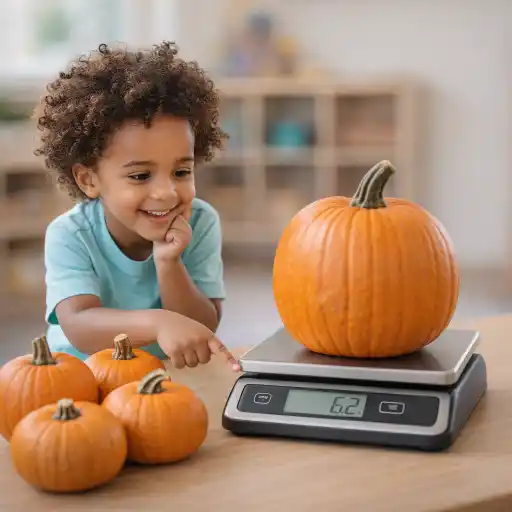
Pause after the test and invite children to describe what they see. A child might say, “The big one is lighter,” or “The little one made the scale go down.” Reflect the observation and ask a follow-up: “What surprised you?” or “How could we check?” If children want to test another pumpkin, make that next investigation part of the learning rather than treating the first result as the end.
Use an “Our prediction / What we found” chart. Children can add a picture, sticker, mark, or dictated sentence. The chart helps them compare their original ideas with evidence and makes the investigation available for later conversations. Pumpkin measurement activities also encourage estimating before measuring, as described in this preschool pumpkin measurement example.
- “What did the scale show?”
- “Was the pumpkin that looked bigger also heavier?”
- “What evidence changed—or supported—your prediction?”
How can you extend the activity without losing the math focus?
Once children have compared weight, add one extension at a time. Measuring height with linking cubes or wrapping yarn around the pumpkins introduces a second attribute. Children may discover that the tallest pumpkin is not the heaviest, or that a pumpkin with a greater circumference does not necessarily weigh more. Emphasize that each tool answers a different question: a scale compares weight, cubes can compare height, and string can compare distance around.
You can also invite children to order three pumpkins by estimated weight and then check the order on the scale. Encourage them to explain how they decided where each pumpkin belongs. If the scale results are close or difficult to interpret, compare a different pair or use a scale designed for clear classroom demonstrations rather than asking children to infer more than the tool can show.
- Make a class graph of predictions: “Which pumpkin will be heavier?”
- Compare two pumpkin measurements, such as height and weight, without assuming they will match.
- Revisit the question with gourds, apples, or classroom objects to see whether the same visual shortcut works.
- Use the words estimate, compare, measure, heavier, and lighter naturally during play.
These extensions support #math, #measurement, #reasoning, #preschoolers, and #curiosity through active exploration. Keep the experience focused and responsive: children’s questions can guide the next comparison, while you help them attend to the evidence.
How can educators make the experience inclusive, safe, and useful to document?
Offer more than one way to participate. A child who prefers not to lift a pumpkin can predict by pointing to a picture, observe the scale, place a marker on the chart, or describe what a peer notices. For children with motor differences, provide a stable surface, lightweight tools, and partner roles. Use clear visual steps and allow extra processing time. Participation does not depend on touching every material or writing a numeral.
Plan safety before inviting exploration. Adult staff should handle cutting, and children should use the scale with close supervision. Check family information for allergies or sensory concerns if the activity will involve pumpkin flesh or seeds; offer clean, dry, or pretend alternatives when appropriate. Keep small items away from children who may mouth them, and follow your program’s hygiene and cleanup procedures. State requirements vary - check your state licensing agency.
Documentation can be brief and meaningful. Record one exact child comment, a photograph of the scale or chart, and a note about the strategy used. For example: “Maya predicted the largest pumpkin would be heaviest; after comparing them, she pointed to the smaller pumpkin and said, ‘That side went down.’” This captures the child’s reasoning and gives staff a useful starting point for future planning.
What are the key takeaways for pumpkin size-and-weight predictions?
Pumpkin comparisons make an engaging early-math investigation because children can see, handle, predict, test, and discuss real objects. The central lesson is not that size never relates to weight; it is that appearance alone cannot reliably answer a weight question. A scale gives children evidence they can use to reconsider an initial idea and explain what they observed.
Start with a clear question, invite predictions without judgment, use a consistent comparison method, and give children time to reflect. Offer flexible ways to participate, attend to supervision and sensory needs, and document a small piece of children’s thinking rather than turning exploration into paperwork. To strengthen your broader approach to playful counting, comparison, measurement, and reasoning, explore ChildCareEd’s Math Foundations in Early Childhood Buy Now $16.00. With an inviting pumpkin and a thoughtful question, everyday classroom math can become a memorable investigation.
- CDA Preschool Credential with Portfolio Review
- CDA Home Visitor Subject Area 3 Part 3 Birth to 5
- The ABCs of Behavior: Turning Challenges into Learning Opportunities
- Birth to Five CDA Credential with Portfolio Review
- Children at the Wheel: Emergent Curriculum
- CDA Bridge Bundle: Preschool without Portfolio Review
- Lesson Planning for Preschoolers
- Texas Director Credential
- Pumpkins, Pinecones, and Leaves: Autumn-themed STEM Projects
- Proporciones de Cuidado Infantil y Tamaños de Grupo por Edad en Maryland (Guía Rápida para Centros y Hogares)
- Proporciones de Cuidado Infantil y Tamaños de Grupo por Edad en Virginia (Guía Rápida para Centros y Hogares)
- Actividades de Otoño Fáciles para Preescolares esta Temporada
- Ejemplos de Crianza Respetuosa vs. Crianza Permisiva
- Calabazas, hojas y manzanas: actividades de otoño para preescolares
- Celebrando la amistad en el cuidado infantil durante el Día de los Mejores Amigos
- How can pumpkin science create meaningful, hands-on fall learning for preschool classrooms?
- Pumpkin Math Without the Worksheets: Hands-On Pre-K Learning
- Fall Detectives: 10 Questions Pre-K Kids Can Investigate This Season
- What Can Float vs. Sink Sorting Teach Preschoolers About Science?
- How Do Light vs. Heavy Activities Build Early Measurement Skills?
- Why Does Big Not Always Mean Heavy in Preschool?
- How Can You Adapt Fall Learning Activities for Children of Different Ages?
- How Can You Create a Pumpkin Patch Pretend-Play Experience Without a Field Trip?
- How Can Pumpkin Predictions Help Preschoolers Think Like Scientists?
- How Can You Observe Persistence While Children Build Pumpkin Ramps?
- How Can a Pumpkin Delivery Game Turn Fall Movement Into Real Problem-Solving?
- How Can Pumpkin Weight Predictions Challenge Preschoolers’ Assumptions?
- How Can a Fall Repair Shop Turn Broken Pretend Props Into Preschool Problem-Solving?
