Two toddlers can share a pile of autumn leaves without sharing the same game—and that is a meaningful beginning. Thoughtful side-by-side planning helps providers encourage connection while respecting toddlers’ pace, space, and developing skills; DAP for Family Child Care Buy Now $25.00 offers focused learning on developmentally appropriate planning for mixed-age settings. Explore the course as a practical next step for strengthening your classroom decisions, then use the ideas below to shape a welcoming fall play station.
Why is parallel play a valuable goal for toddlers?
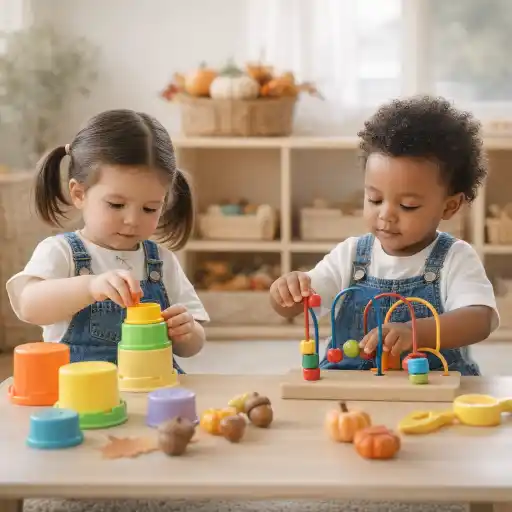
Parallel play occurs when children play near one another, often with similar materials, while pursuing separate ideas rather than coordinating a shared activity. A toddler may fill a basket with leaves while a peer lines leaves along a path, glancing over or copying a movement now and then. These brief looks and imitations count: children are noticing peers, becoming comfortable in shared space, and gathering ideas without the demands of a group plan.
Play stages overlap; they are useful ways to observe, not deadlines every child must meet. As ZERO TO THREE explains in its guide to parallel play, children learn through observation and proximity as well as direct interaction. NAEYC’s guidance on developmentally appropriate practice with infants and toddlers likewise emphasizes tuning in to each child and family.
For providers, honoring parallel play prevents the well-meant pressure to “play together” before children are ready. A carefully arranged station can support #belonging, early #communication, and growing #confidence, while giving adults a chance to observe interests and emerging skills.
- Notice peer awareness, imitation, gestures, and brief exchanges.
- Protect each child’s independent play idea while supporting safe shared use of space.
- Think of parallel play as a valid social experience—not a problem to fix.
How can a fall station make side-by-side play inviting?
Begin with a small, purposeful setup rather than a crowded collection of seasonal objects. Place two trays or work areas beside one another, with similar materials in each: a few large, clean leaves, sturdy baskets, scoops, and child-safe containers. Add a shared feature—perhaps a wide path where children can place leaves—without requiring them to combine their play. The goal is proximity with choice, not a finished group project.
Open-ended materials invite varied uses. One child might sort leaves by color; the other may scoop them into a basket or arrange them in a line. Head Start’s nature-play ideas illustrate how ordinary natural materials can prompt exploration. NAEYC also describes how following toddlers’ interests and offering accessible loose parts can deepen engagement in creative learning environments.
Set the station where children have room to approach, move, and leave comfortably. Keep materials visible and within reach, and consider children’s mobility, sensory preferences, communication styles, and need for a quieter area. A useful planning tool is the Side-by-Side Autumn Play Station Planner: use it to record the learning invitation, materials, access options, supervision positions, and what you want to observe.
- Offer duplicates or close alternatives to reduce unnecessary competition.
- Leave open space between the stations so toddlers can choose their distance.
- Use a few #autumn materials and rotate them in response to children’s interest.
What materials and activities work well side by side?
Choose materials that are safe for the age group and invite multiple actions. Large leaves can be carried, placed, compared, or used in pretend play. Baskets and wide scoops can support filling and emptying; a magnifier may invite close observation. Keep small objects that could pose choking risks out of toddlers’ reach, and inspect natural materials for sharp edges, dirt, mold, or other hazards. Follow program procedures for cleaning and handling materials.
- Two trays for sorting large leaves by color, shape, or size.
- Separate baskets for collecting and carrying leaves along a simple route.
- Two play-dough mats with leaf-shaped impressions, if appropriate for the children and supervision plan.
- Picture cards or gestures for choosing “look,” “scoop,” or “carry.”
- 🍂 A large sheet of paper where children may place leaves near each other, each contributing at their own pace.
Outdoor play offers room to move and discover, but it calls for active supervision and attention to the environment. The CDC’s outdoor play and safety guidance recommends considering age-appropriate spaces and hazards such as trip risks. Head Start also notes that outdoor play spaces should accommodate toddlers’ varying interests and abilities in its safe, stimulating outdoor space considerations. State requirements vary - check your state licensing agency.
How should adults support play without taking it over?
Start by watching. Notice what each child chooses, how close they prefer to be, what captures their attention, and whether either child watches or imitates the other. Narrate neutrally and briefly: “You’re filling your basket. Eli is placing leaves on the path.” This puts language around the shared setting without demanding a response or assigning a common storyline.
Offer a light scaffold when it could extend play: “There are more leaves in the basket,” or “You both found red ones.” Then pause. Toddlers need time to process, act, and decide what to do next. Gestures, sounds, pointing, and watching can all communicate interest. If a child reaches for a peer’s materials, move close, calmly set a limit, and offer a concrete alternative: “I won’t let you pull the basket. You can use this one, or wait while Sam is using it.”
Adults can support connection while respecting each child’s agency:
- Model short, useful phrases such as “My turn,” “More leaves,” or “Can I have one?”
- Use visual choices or adapted tools when these help children participate.
- Step in promptly for safety, but avoid settling every minor difference for children.
- Describe effort specifically: “You watched your friend and tried the same scooping motion.”
This responsive balance reflects Head Start’s description of playful environments: attentive adults can guide learning with light support while children retain autonomy. In a family child care home, developmentally appropriate practice also means considering the range of ages, strengths, and interests sharing the environment.
How can providers adapt the station and learn from observation?
A welcoming invitation offers more than one way to take part. Some toddlers may want to handle leaves; others may prefer a tool, watch first, or choose a nearby alternative. Do not treat reluctance as defiance or a diagnosis. Offer choices without pressure, and adapt the materials, position, pace, or sensory experience based on the child’s cues. For example, a child can point to a leaf color, use a scoop instead of touching, or sit beside the station and observe.
After play, jot down brief, objective observations. Record what happened and what supported engagement: “Mina watched Kai fill a basket, then used her own scoop for several minutes.” Avoid labels such as “not social” or “wouldn’t participate.” Share meaningful patterns with families as a conversation, asking what the child enjoys and which approaches feel comfortable. Work with families and relevant specialists when an individualized support plan may be useful; providers observe and adapt, but do not diagnose.
Common pitfalls are easy to avoid when the team shares a clear purpose:
- Do not require sharing or a joint product; parallel play can remain separate.
- Do not overload the area with too many materials or adult directions.
- Do not assume every child enjoys the same textures, proximity, or outdoor conditions.
- Do inspect materials, maintain supervision, and follow program policies and licensing guidance.
Directors can support consistent practice by reviewing the station plan with staff, clarifying supervision roles, and discussing observations during team reflection. For additional learning, explore The Best Promotion is Play Buy Now $35.00, Playful Spaces for Infants & Toddlers  Buy Now $24.00, You’re Not My Friend Anymore: Learning Conflict Resolution Buy Now $16.00, and Family Child Care: Building, Premises, and Outdoor Safety Buy Now $16.00.
Conclusion: How can a fall play space support parallel play?
A fall play space supports parallel play when toddlers can explore near one another without being required to share a plan. Offer duplicate, open-ended materials; arrange comfortable side-by-side areas; provide choices for access; and stay close enough to keep play safe while leaving children room to lead. Observe peer awareness, imitation, communication, and individual interests as meaningful signs of learning.
The practical goal is not to make two children play identically, but to create a shared environment where each can participate with comfort and agency. Use the Side-by-Side Autumn Play Station Planner to prepare, observe, and adjust—and remember that patient, responsive support turns a simple autumn invitation into a rich opportunity for connection and development.
- From Play to Planning: Building Culturally Competent, Child-Centered Curriculum
- Baby Play: Planning Infant and Toddler Activities
- What Makes Me Special: An Overview of Autism and ADHD
- Spaces that Support Discovery
- CDA Bridge Bundle: Infant/Toddler without Portfolio Review
- CDA Bridge Bundle: Infant/Toddler
- Creating Engaging and Meaningful Learning Experiences
- Playful Spaces for Infants & Toddlers
- 45-Hour Infant and Toddler Curriculum
- Supporting Families and Caregivers in Language and Literacy
- Terrible Two's Can Be Terribly Fun!
- CDA Certification en Español: Recursos y Consejos para Educadores Bilingües
- ❄️ ¿Qué actividades al aire libre funcionan bien para los niños de Illinois en cada estación? 🌷🍂
- Actividades de Motricidad Gruesa que Desarrollan el Equilibrio, la Coordinación y la Fuerza
- 10 Ejemplos de Cómo la Cultura Influye en el Desarrollo Infantil
- Actividades de Otoño Fáciles para Preescolares esta Temporada
- Celebrando la amistad en el cuidado infantil durante el Día de los Mejores Amigos
- Canciones, juegos y preguntas de círculo para niños
- Cooperative Play vs. Parallel Play: What’s the Difference?
- Too Wiggly to Sit? Fall Movement Activities Toddlers Will Love
- How Can Child Care Providers Support Healthy Toddler Development?
- How Do Parallel Play, Associative Play, and Cooperative Play Differ?
- At What Age Do Children Start Playing Together?
- What Is the Difference Between Parallel Play and Cooperative Play?
- How Can Teachers Help Children Move From Parallel Play to Cooperative Play?
- How Can You Support a Toddler When an Older Sibling Takes Over a Project?
- When Leaves Become “Mine”: How Can We Teach Sharing During Fall Nature Play?
- How Can Fall Movement Games Rescue Rainy Recess in a Small Child Care Classroom?
- How Can Providers Respond to “You Have to Play My Way” in Fall Dramatic Play?
- How Can Providers Support Parallel Play in a Toddler Fall Play Space?
