A child’s carefully built leaf house can collapse in a moment—and the hurt behind “They ruined it!” can feel just as real. Learn how to keep children safe while coaching them to name feelings, hear another idea, and repair the play together. For a deeper look at what behavior may be communicating and how to respond with positive guidance, explore The ABCs of Behavior: Turning Challenges into Learning Opportunities  Buy Now
$55.00$45.00; providers seeking dedicated conflict-resolution learning can also explore You’re Not My Friend Anymore: Learning Conflict Resolution Buy Now $16.00.
Outdoor play is rich with open-ended materials and child-generated stories. A pile of leaves may become a house, a nest, or a trail, so disagreement can be about competing ideas as much as access to materials. A study of preschoolers in a nature-based setting found play ideas were a primary catalyst for outdoor peer conflict, suggesting that these moments offer valuable practice in perspective-taking and negotiation (Pic and Han’s study of peer conflict in a nature preschool).
Why is a leaf-house conflict worth coaching?
When a child says, “They ruined my leaf house,” the adult may feel pressure to identify the culprit and restore the structure immediately. Yet the moment can teach children to express what mattered to them, listen to another child’s intention, and decide what happens next. Conflict is not automatically a failure of supervision or play. It is a common social experience, and children often need adult support to navigate it safely.
Young children are still developing language, impulse control, emotional regulation, and the ability to imagine another person’s perspective. One child may have flattened the leaves to make a road, not to destroy a peer’s house. That difference does not erase the impact, but it gives children a way to understand that intentions and effects can differ.
- Children practice explaining an idea and hearing a peer’s idea.
- They develop #empathy and #communication as they notice feelings and needs.
- They learn that a damaged play plan can lead to #repair and a new shared story.
Research in a nature preschool found that outdoor disputes often centered on play ideas, whereas indoor conflicts more often involved distribution of resources. This finding is specific to the study setting, but it reminds educators to coach the imaginative plans beneath an outdoor disagreement—not only turns or ownership.
How can educators prepare children before outdoor play?
Preparation helps children access useful language when emotions rise. Before going outside, use a puppet, story, or quick role-play: one character builds a leaf house while another wants leaves for a path. Ask what each character might say and what safe solutions they could try. Keep practice playful and brief; the purpose is to make a few phrases familiar, not to expect children to recite a script perfectly.
- “I’m making a house. Please ask before changing it.”
- “I have an idea. Can I show you?”
- “Can we make a house and a path?”
- “I need help,” or “I need space.”
Pair spoken language with gestures, picture cards, signs, or communication devices when helpful. Some children need additional processing time or an adult to model words; pointing to a picture is also meaningful participation. Make the play area accessible, and establish clear boundaries for gathering or moving natural materials. Offer baskets, containers, or loose parts when appropriate, while protecting plants and respecting living things.
Consider inviting children to brainstorm possible uses for leaves during a calm group moment. Rehearsal gives them options before a real disagreement tests their flexibility. Adults can also agree on a few shared phrases so children encounter predictable guidance from the team.
What should an adult do when children disagree?
Begin with safety and calm, rather than deciding who is right. Move close enough to prevent throwing, pushing, or unsafe use of tools. Use a steady voice and describe what you see without assigning motives: “You both have your hands in the leaf pile. You want to use it in different ways.” If a child is highly upset, pause problem-solving and support regulation first.
NAEYC’s three-step approach recommends stating the behavior, explaining its implications, and guiding children toward an appropriate alternative. Keep each step short and concrete: “You pulled leaves from the house. Your friend looks upset. Pulling can knock it down. Let’s find a safe plan.” Acknowledge feelings without approving unsafe actions.
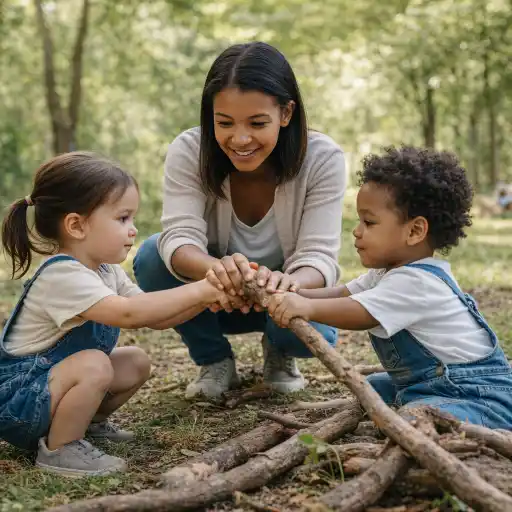
- Stop unsafe actions: “I won’t let you throw leaves at a friend.”
- Name the situation neutrally: “You want a house, and you want a path.”
- Acknowledge feelings and allow time for children to settle.
- Prompt communication: “What could you say about your idea?”
- Stay nearby as children try a safe next step.
Ask one question at a time and allow children to answer in their own way. If needed, model a phrase, offer two choices, or invite them to point to a solution card. Avoid a long lecture while emotions are high; children are more likely to reflect when they feel safe and regulated.
How can children create a solution and repair the play?
When children are ready, help them state the two ideas fairly: “You made a house; you wanted a road through the leaves.” Then invite them to consider more than one possibility. A solution does not have to match an adult’s preferred design. If it is safe and acceptable to the children, give their plan a chance.
- Identify: What were you each trying to make?
- Brainstorm: Could the pile have two sections, could the ideas join, or could children take turns changing it?
- Choose: Is the plan safe, and does each child understand what happens next?
- Try and revisit: “Let’s see if it works. We can change the plan if we need to.”
If the house has been flattened, repair might mean rebuilding together, gathering more leaves, or giving the child who built it a little space before returning to play. A forced apology or hug is not necessary. Ask what would be helpful, respect a peer’s boundaries, and reinforce the process specifically: “You listened to each other and made a new plan.”
A repair can restore materials, address hurt, or make a safe re-entry possible; it does not require the children to resume the same game immediately. One child may watch first or choose another activity. Keep the focus on learning and connection rather than securing a quick performance of friendship.
How can the environment and staff team prevent repeated friction?
Observe where and when disagreements happen. Is the play area crowded? Are leaves or tools difficult to access? Do children have enough uninterrupted time to develop a story? These patterns can point to a change in the environment, routine, or adult support—not simply a need to correct a child.
- Offer enough safe, open-ended materials and containers for children’s play ideas.
- Define where materials may be gathered and which natural areas are off limits.
- Allow time to build, revise, and extend play without unnecessary interruption.
- Position adults for active supervision while leaving space for child-led exploration.
- Use consistent staff language and adapt it for children’s communication needs.
Repeated exclusion, intense distress, or unsafe behavior deserves closer observation and a coordinated response. Brief, objective notes about what happened before, the behavior, and what followed may help the team recognize patterns. Share observations respectfully with families and colleagues, maintaining confidentiality and following program procedures. State requirements vary - check your state licensing agency.
🌿 After outdoor play, invite the team to reflect: “What helped children stay engaged, and what could make the next negotiation easier?” This question supports prevention without blaming children or educators.
Conclusion: How can providers coach a leaf-house conflict?
When a child’s leaf house is changed or knocked down, providers can protect safety and make room for a meaningful learning moment. Prepare children with accessible language, step in calmly to stop unsafe actions, describe the problem without blame, and wait until children are ready to brainstorm. Then support a workable solution and a respectful repair—whether that means rebuilding, combining ideas, taking turns, or giving a peer space.
The goal is not to prevent every outdoor disagreement. It is to help children practice #problem-solving, cooperation, and communication while learning that their ideas and feelings matter. Reflect on the environment and team routines when the same conflict keeps recurring. For a fuller professional learning experience, review the linked ChildCareEd courses and check course details and training-hour relevance for your own needs.
- You're Not My Friend Anymore: Learning Conflict Resolution
- Administering Basic Health and Safety ONLINE
- Birth to Five CDA Credential with Portfolio Review
- CDA Bridge Bundle: Family Child Care without Portfolio Review
- CDA Bridge Bundle: Infant/Toddler without Portfolio Review
- The Best Promotion is Play
- CDA Bridge Bundle: Preschool without Portfolio Review
- Texas Director Credential
- Bienvenido! Welcoming All Families
- Effective Coaching & Mentoring in ECE
- ❄️ ¿Qué actividades al aire libre funcionan bien para los niños de Illinois en cada estación? 🌷🍂
- 10 Ejemplos de Cómo la Cultura Influye en el Desarrollo Infantil
- Proporciones de Cuidado Infantil y Tamaños de Grupo por Edad en Virginia (Guía Rápida para Centros y Hogares)
- Celebrando la amistad en el cuidado infantil durante el Día de los Mejores Amigos
- Canciones, juegos y preguntas de círculo para niños
- How Can We Teach the Forgotten Skill of Being a Good Friend to Young Children?
- Team-Building Games for Preschoolers That Teach Cooperation
- How Can Child Care Providers Teach Children to Share and Take Turns Without Forcing Them?
- How Can Child Care Providers Help Children Build Healthy Friendship Skills?
- How Can Child Care Providers Teach Children What to Say During Conflict Beyond “Use Your Words”?
- How Can Child Care Providers Teach Children to Solve Conflicts With Each Other?
- How Can Child Care Providers Teach Sharing Without Forcing It?
- How Can Child Care Providers Teach Conflict Resolution to Preschoolers?
- Why Do Young Children Tattle, and How Should Teachers Respond?
- What Are the Best Ways to Support Cooperative Play in Preschool?
- How Can Educators Teach Respectful Disagreement in a Montessori Classroom?
- How Can Preschool Teachers Encourage Sharing and Cooperation During Halloween?
- How Can Child Care Providers Help Children Negotiate Shared Outdoor Play?
- How Can Providers Coach Conflict Resolution During Nature Play?
