When children disagree over a material, a turn, or an idea, the moment can become practice in listening, expressing needs, and finding a workable next step. Introduce the How Do They Feel? Feelings Sorting Worksheet Buy Now $1.49 during a calm moment to explore emotional vocabulary, then invite discussion about how people might feel differently during a disagreement. ChildCareEd Buy Now $1.49 ChildCareEd’s Raising Peaceful Learners: The Montessori Advantage  Buy Now $16.00 explores peace education, grace and courtesy, and conflict-resolution skills; for a complementary focus on respectful adult modeling, consider Teach with Respect! Buy Now $35.00. Read on for practical ways to help children express their preferences, hear another perspective, and disagree without diminishing one another.
Why is respectful disagreement an essential Montessori skill?
Young children are learning to manage strong emotions, communicate needs, and understand perspectives beyond their own. Disagreement is therefore expected, especially when children share materials, space, or control over a play plan. Treating every disagreement as misbehavior can miss an opportunity to teach the skills children are still developing.
A Montessori classroom values independence alongside responsibility to the community. Children may choose their work and express different ideas, while learning that their choices affect others. Peace education and grace-and-courtesy lessons give children practical ways to ask for a turn, decline an invitation, express discomfort, listen, and repair harm. These experiences nurture #empathy, communication, and problem-solving while protecting children’s dignity.
Conflict is not automatically harmful; the adult response matters. NAEYC’s guidance on peacemaking in early childhood classrooms emphasizes modeling, careful listening, creating space for peace, and noticing children’s peacemaking efforts. In a Montessori setting, that means pausing to observe before taking over when safety allows, then offering enough support for children to participate in resolving the issue.
Why it matters in daily practice: children who feel heard are better positioned to return to work and relationships. A calm, consistent approach also gives staff a shared framework, making peer conflict a predictable learning opportunity rather than a recurring power struggle.
How can educators prepare children before a disagreement happens?
Teach the language of disagreement during calm moments, when children can attend, imitate, and practice without the pressure of an active conflict. Keep phrases brief and concrete. A toddler may use a gesture or “My turn,” while an older preschooler may manage “I have a different idea” or “I don’t like that. Please stop.” Development and communication differ, so provide visuals, gestures, home-language words, or assistive communication when useful.
Grace-and-courtesy presentations work best as short demonstrations followed by practice in familiar routines. Show how to approach someone’s work without disturbing it, ask to join play, wait for a response, or say no respectfully. Puppet scenarios and role-play let children rehearse everyday tensions—such as two children wanting the same block—without placing a child on the spot.
- Choose a small set of shared phrases and use them consistently across the staff team.
- Model disagreement between adults respectfully: “I see that differently. Let’s compare our ideas.”
- Use stories and brief discussions to explore what characters might feel, want, or need.
- Offer access to visual emotion and solution cues for children who benefit from concrete supports.
- 🗣️ Practice listening turns with a talking object, then gradually reduce adult prompting.
Preparation includes the physical environment. Clearly defined work areas, accessible materials, predictable transitions, and duplicates of high-demand items when feasible can reduce unnecessary competition. A peace table or quiet reflection area may support regulation, but it should be introduced as a voluntary resource—not a punishment or a place of forced reconciliation. These preparations align with Montessori grace-and-courtesy lessons, which describe explicit modeling and repeated practice as foundations for social interaction.
What should adults do when children disagree in the moment?
Start with safety, then decide how much support is needed. If children are safe and beginning to negotiate, observe briefly; immediate adult direction can interrupt their effort to solve a problem. If there is grabbing, hitting, distress, or an imbalance of power, intervene promptly and calmly. Move close, block unsafe actions, attend to anyone hurt, and use a clear boundary: “I won’t let you hit. Hitting hurts.”
Once immediate safety is addressed, describe what you can observe without assigning character or blame: “You are both reaching for the same work.” Acknowledge each child’s perspective without deciding whose feelings are more valid: “You want to keep building, and you want to use those blocks.” Naming what is happening can reduce confusion and helps children feel seen.
Children may not be ready to reason while highly upset. Offer a pause, a breath, or a calm space if helpful, and return to the conversation when they can participate. Keep adult language concise. The NAEYC three-step approach to navigating conflict suggests stating the behavior, explaining its implications, and addressing it with an appropriate alternative. In practice, educators can adapt those steps to the moment:
- State the behavior neutrally: “You pulled the book from Sam’s hands.”
- Connect it to impact or a shared limit: “Sam was reading it, and pulling can hurt.”
- Coach a replacement: “You can ask, ‘May I read it when you’re finished?’”
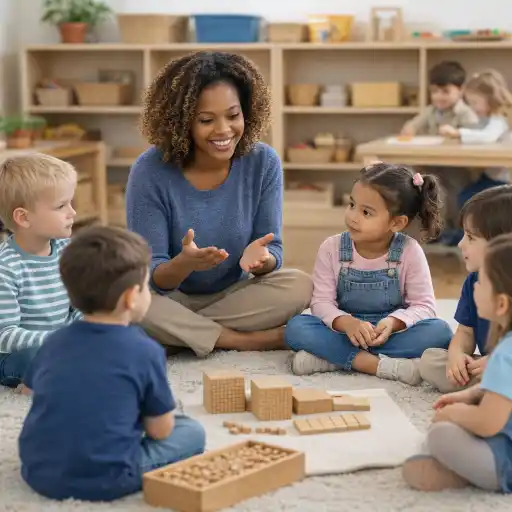
Support should be matched to children’s current abilities. One child may need words supplied; another may respond to two safe choices; a child who is ready may suggest a solution independently. Adult guidance is a bridge to agency, not a demand that children handle every conflict alone.
How can children express different views and find a solution?
When children are calm enough to take part, invite each to communicate in a way that works for them: speaking, pointing, using a picture, or demonstrating with materials. Listen without turning the conversation into a trial. Reflect each perspective briefly: “You wanted to finish the tower. You wanted the long block for your road.” Children do not have to agree about what happened in order to make a safe plan for what happens next.
Then clarify the shared problem and invite possible solutions. Short prompts are more useful than a lecture: “What could we try?” “Could both ideas fit?” or “Would you like a timer, a trade, or separate materials?” Make room for different reasonable answers. Sharing is not always the only fair option: a child may finish a chosen work, while a peer selects another activity and waits for a later turn.
- Give each child an uninterrupted chance to communicate.
- Restate the goal neutrally, such as “Both of you want to use the red shovel.”
- Invite more than one safe option: take turns, trade, work together, or choose another material.
- Check that the plan is acceptable and follow up to see whether it worked.
- Notice the process specifically: “You listened and made a plan together.”
For children who are still learning to form sentences, use simple scripts such as “Stop, please,” “I’m using it,” “Can I have a turn?” or “I need help.” Older children can try an I-message: “I feel frustrated when my work is moved. I want you to ask first.” The phrase should express a need rather than disguise blame. As explored in Montessori communication and conflict resolution, respectful problem-solving depends on speaking, listening, and nonverbal communication together.
Finish with meaningful repair when needed. A child might return a material, help rebuild, check whether a peer wants space, or offer an apology when ready. Do not require a hug, eye contact, or an immediate “sorry”; respect includes honoring the other child’s boundaries and the child’s readiness to repair.
How can classroom routines and adult teamwork sustain respect?
Respectful disagreement becomes part of classroom culture when adults respond consistently—not identically in every situation, but with shared principles. Agree on core expectations such as “safe bodies,” “listen when someone is speaking,” and “ask before taking another person’s work.” Use positive descriptions of what children can do, and explain limits in language children understand.
Directors can make this practice more sustainable by building staff reflection into regular meetings. Review a recent scenario, discuss what children may have been communicating, and rehearse concise phrases. A common script helps children predict adult support, while staff reflection leaves room to adapt for age, language, disability, culture, and individual temperament. Providers can also share useful classroom practices with families so children hear familiar language across settings.
Observation helps identify whether conflict is about a social skill, an environmental barrier, or both. Record the time, location, materials, preceding events, child responses, and adult support without labeling a child as “the problem.” If disputes cluster around a crowded shelf or transition, adjust that condition and observe what changes. Use objective notes to guide teaching and family conversations.
Common pitfalls to avoid include:
- Taking sides before understanding what happened; describe observations and listen to both children.
- Lecturing while children are distressed; prioritize safety and regulation, then teach.
- Demanding instant sharing or apology; coach practical turns and genuine repair.
- Expecting every child to use spoken language; accept gestures, visuals, and other communication.
- Using the peace area as punishment; teach its purpose and make it supportive.
State requirements vary - check your state licensing agency when adjusting procedures or documentation. If conflict is persistent, dangerous, or significantly limits a child’s participation, coordinate with the family, follow program policy, and seek appropriate consultation. A strengths-based plan focuses on safety, access, and skills children can learn.
How can educators tell whether their approach is helping?
Look for gradual growth in the process rather than expecting disagreements to disappear. Children may begin to pause before grabbing, communicate a boundary, listen for a brief turn, accept adult support, or propose a solution. Progress can be uneven: fatigue, changes in routine, group size, language demands, and new relationships all affect how readily children use a skill.
Choose a few observable indicators that fit your classroom goals. For example, staff might note whether a child asks for a turn, responds to a peer’s “no,” seeks help, or returns to play after a disagreement. Record short examples over time and discuss them as a team. Use the information to decide what to teach next, whether a routine needs adjustment, or whether a child needs additional communication or regulation support.
Invite children to reflect after a successful resolution, keeping questions brief and nonjudgmental: “What helped?” “What will you try next time?” Younger children may answer by pointing, choosing a picture, or demonstrating. This reflection reinforces the steps without implying that every conflict has one perfect answer.
Partner with families through specific, respectful communication. Share a child’s effort as well as the next learning goal: “Today, Maya told a friend she wanted space. We are practicing asking before touching someone’s work.” Avoid sharing another child’s private information. Family insights can help educators choose familiar phrases and understand cultural or communication preferences.
Conclusion: What helps children disagree respectfully?
Teaching respectful disagreement in a Montessori classroom means combining a prepared environment with grace-and-courtesy practice, calm adult modeling, and developmentally responsive coaching. Children need to learn that different ideas and strong feelings are welcome, while unsafe actions and disregard for others’ boundaries require clear limits. In a disagreement, protect safety, acknowledge perspectives, support communication, and invite children to create or try a workable solution.
Keep the language short, practice when children are calm, and look for progress in small steps—from accepting a prompt to using a phrase independently. When adults and families share consistent, respectful expectations, children gain repeated opportunities to build #respect, #listening, and #cooperation. The goal is not a conflict-free classroom; it is a community where disagreement can lead to understanding, repair, and renewed learning.
Further ChildCareEd courses
- You’re Not My Friend Anymore: Learning Conflict Resolution Buy Now $16.00 — focused learning on developmentally appropriate conflict-resolution strategies.
- Social Foundations and Responsive Classrooms Buy Now $24.00 — social-emotional development, positive guidance, and problem-solving.
- Implementing the Montessori Curriculum Buy Now $32.00 — Montessori curriculum principles and inclusive classroom practice.
- Moving About the Classroom: Effective Transitions for Everyday
- 45 Hour Preschool Methods and Materials
- 45 Hour Infant and Toddler Methods and Materials
- Pediatric RSV First Aid & CPR/AED
- Baby Steps to Milestones
- 45 Hour School Age Methods and Materials
- Creating Environments that Nurture Growth and Community
- Diversity, Equity, and Inclusion in Education
- Texas Director Credential
- Inclusive Montessori: Supporting Diverse Learners in the Classroom
- CDA Certification en Español: Recursos y Consejos para Educadores Bilingües
- 👶 ¿Cuáles son las proporciones y grupos requeridos en Dakota del Norte? 🏫
- 10 Ejemplos de Cómo la Cultura Influye en el Desarrollo Infantil
- Actividades de Fiesta para Niños de Preescolar y Primaria
- Proporciones de Cuidado Infantil y Tamaños de Grupo por Edad en Nueva Jersey (Guía Rápida para Centros y Hogares)
- Proporciones de Cuidado Infantil y Tamaños de Grupo por Edad en Virginia (Guía Rápida para Centros y Hogares)
- Cómo Trabajar en el Cuidado Infantil en Carolina del Norte: Requisitos y Pasos
- Celebrando la amistad en el cuidado infantil durante el Día de los Mejores Amigos
- How Can Child Care Providers Help Children Learn to Disagree Respectfully?
- How Can Child Care Providers Turn Conflict Into Learning?
- How Can Child Care Providers Teach Conflict Resolution to Preschoolers?
- How Can You Respond When a Family’s Expectations Differ from Your Classroom Routine?
- What Are the Best Ways to Teach Young Children to Solve Peer Conflicts?
- How Can Educators Teach Respectful Disagreement in a Montessori Classroom?
