When fall books feature only leaf piles, pumpkin patches, and familiar holidays, some children may wonder whether their own lives belong in the story. Thoughtful selection can preserve the season’s wonder while affirming each child’s experiences; the Reading Aloud and Storytelling course  Buy Now $16.00 offers practical strategies for engaging read-alouds and strengthening early literacy practice. For a broader focus on representation, explore Diversity, Equity, and Inclusion in Education Buy Now $16.00 as you build a more responsive classroom library.
Why does it matter when fall books do not match children’s lives?
Seasonal books can make changes in weather, plants, and animal behavior vivid for young children. Yet “fall” is not a universal experience. Some children see leaves change color; others live where seasonal shifts are marked by rain, heat, harvest, or little visible change. Some families celebrate autumn holidays, while others do not observe them. A classroom collection that presents one landscape or tradition as the season’s norm risks making children’s own knowledge seem unusual or invisible.
Representation in books is not simply about spotting a familiar face. Stories also communicate whose families, languages, homes, abilities, and everyday experiences are worth sharing. When children encounter both mirrors of their lives and windows into others’ experiences, they have opportunities to connect, imagine, and learn with one another. As guidance on introducing inclusive, culturally responsive books explains, books can support belonging and meaningful conversations when educators select and discuss them intentionally.
This work does not require abandoning seasonal themes or finding one perfect title. It asks educators to notice whose experiences are centered, make room for many kinds of fall, and invite children to contribute without putting anyone on the spot. That shift can make a familiar read-aloud feel more welcoming and more connected to children’s real lives.
How can providers choose inclusive books about fall?
Start by reviewing the book’s story, not just its cover or seasonal appeal. Ask whether fall drives the plot or simply provides a backdrop, and whether the text assumes every child has access to the same outdoor spaces, foods, family routines, or celebrations. Look for varied families and characters with agency, interests, and relationships beyond a single identity or cultural detail.
- Consider whether the setting and seasonal details reflect a specific place rather than claiming to represent everyone’s autumn.
- Seek stories about everyday experiences—friendship, change, curiosity, family life, animals, and nature—alongside books about particular traditions.
- Check who created the book and whether cultural details feel accurate, specific, and integrated into the story.
- Look for varied bodies, abilities, languages, family structures, and communities across the collection, not just in one seasonal display.
- Notice who makes decisions, solves problems, and gets to experience joy and adventure.
Inclusive book lists, such as the Illinois Early Learning Project’s resources on reflecting classroom diversity through children’s literature, can help you discover titles and selection guides. Use lists as starting points, then consider the children and families in your program. No single book can represent a whole community, and no child should be expected to approve or explain a book on behalf of others.
Think beyond the October or November shelf, too. A balanced library gives children access throughout the year to stories in which diverse characters experience ordinary play, family routines, humor, and discovery. This helps prevent inclusion from feeling like a one-time seasonal theme.
How can you learn what fall means to families?
Begin with open-ended curiosity rather than assumptions. A family’s language, appearance, or neighborhood does not tell you which seasonal experiences feel important to them. Ask optional questions during everyday conversations or through a short message, and explain that the purpose is to make classroom stories more responsive. Families should be free to share as much or as little as they prefer.
- Ask, “What kinds of stories does your child enjoy hearing or telling?”
- Ask, “Are there outdoor changes, words, songs, or routines you would like us to know about this time of year?”
- Offer several ways to respond, such as a conversation, drawing, brief note, photo, or voice recording.
- Check the pronunciation of names and family words, and ask how caregivers would like contributions credited.
Make participation accessible: families need not buy or send books, supplies, or photographs. A child’s observation or a caregiver’s one-sentence suggestion can offer a useful starting point. For example, a child may describe shorter days, rainy afternoons, a walk through a city park, or the beginning of a season that looks different from the one pictured in a book.
Keep sharing voluntary and protect privacy. Ask permission before displaying family images or identifying information. Do not make one child the classroom spokesperson for a culture or tradition. Guidance on creating a family-informed fall story basket reinforces a helpful principle: invite contributions as partnership, not as a performance or obligation.
How can you discuss differences without putting children on display?
Prepare before reading. Preview the text and illustrations, notice details that may need context, and choose a modest purpose for the discussion—perhaps observing seasonal change, exploring a character’s feelings, or comparing settings. Keep prompts open and low-pressure so children can respond from what they notice without being asked to disclose personal or family information.
- Before reading: “What do you notice on the cover? What might change in this story?”
- During reading: “What clue in the picture helps you know what the character is feeling?”
- Compare settings: “What changes do you notice in this place? What might be different somewhere else?”
- Invite imagination: “What could happen next if the weather changed?”
- Support perspective-taking: “How might the character feel? What makes you think that?”
Respond calmly when children describe an unfamiliar practice as “weird” or say that everyone experiences fall the same way. You might say, “That is new to you. Families and places can be different. Let’s look closely at what the story shows.” If a comment is hurtful, address it directly and guide a more respectful response rather than shushing the child or changing the subject.
Personal connections are welcome, but never required. A child can participate by listening, pointing to a picture, signing, drawing, arranging story pieces, or simply staying nearby. The goal is shared curiosity and respect—not asking children to disclose private experiences or make a case for their family’s way of life.
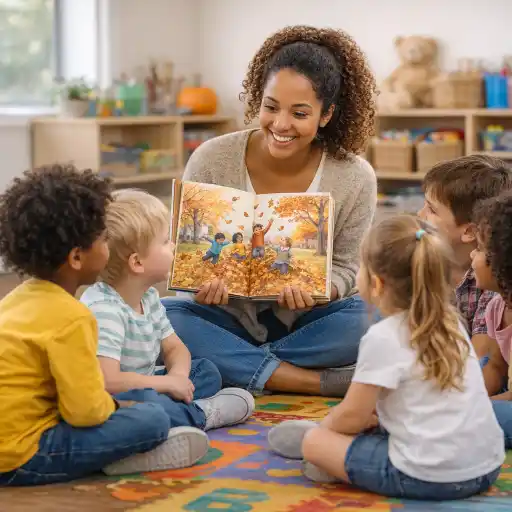
How can you make the read-aloud accessible and engaging?
Plan for the children who will be in the room, including their ages, communication preferences, sensory needs, and interests. A strong read-aloud does not depend on elaborate materials. A book, a few open-ended props, and time for children to respond can support attentive listening, language, and imaginative retelling.
- Offer different ways to join in: speaking, signing, pointing, moving a prop, drawing, or observing.
- Use picture choices, gestures, repeated phrases, or simple visual supports when they help children follow the story.
- Allow wait time; children may need a pause to process a prompt or find a way to respond.
- Choose a small set of props that extend the story without treating cultural objects as decoration or shorthand.
- 🍂 Invite children to retell the story, invent a new ending, or create a different seasonal setting together.
Safety belongs in the plan as well. For young children, choose age-appropriate, washable materials; avoid small objects that could pose a choking hazard; and inspect natural items before use. Follow program procedures for cleaning materials and checking for allergens. State requirements vary - check your state licensing agency.
After the reading, extend the story through dramatic play, drawing, sequencing, or dictation. Observe whether children return to the book, which questions invite conversation, and whether any child needs a different way to participate. These small adjustments strengthen #literacy, #belonging, and #curiosity while keeping the experience grounded in children’s real interests.
How can programs avoid common pitfalls and improve over time?
Good intentions are a useful beginning, but they do not replace careful selection and reflection. A common pitfall is treating a single book as enough representation or reserving diverse stories for one holiday or month. Another is choosing books for attractive fall illustrations without checking whether the story relies on stereotypes, presents one tradition as universal, or gives characters little agency.
- Avoid tokenism: Build representation across many books, topics, and times of year.
- Avoid assumptions: Do not presume a child celebrates a holiday or has access to a particular fall activity.
- Avoid forced sharing: Never ask a child to explain or represent a family, language, or community.
- Avoid props without context: Choose materials that support the story and make participation possible, rather than turning identity into decoration.
After a read-aloud, note which parts engaged children, what questions arose, and whether family input suggested a useful change. At staff meetings, review a small group of frequently read books together and discuss whose experiences appear, who takes action, and what children might infer from the text and pictures. Directors can support this work by setting aside planning time and inviting families to offer feedback in ways that are comfortable and optional.
A simple planning tool can keep the process manageable: record the title and purpose, the perspectives represented, questions to ask, possible adaptations, and any family suggestions. Revisit the plan as children’s interests and classroom membership change. For focused professional development, the Strength in Differences: Cultural Diversity course Buy Now $24.00 offers additional learning related to cultural responsiveness and inclusive practice.
Conclusion: How can you make fall read-alouds reflect children’s lives?
When fall books do not match children’s lives, providers can respond by choosing stories with care, recognizing that seasonal experiences vary, and creating discussion that welcomes children’s observations without requiring personal disclosure. The aim is not to find a single book that represents everyone. It is to build a collection and a read-aloud practice in which many children can recognize parts of their lives and encounter others’ experiences with respect.
Begin with a small, practical step: review a book you plan to read, prepare two open-ended questions, and offer children more than one way to participate. Invite family input when appropriate, keep contributions voluntary, and observe how children respond. Over time, these thoughtful choices can make seasonal storytime a place where every child’s ideas have room to grow.
State requirements vary - check your state licensing agency.
- 45 Hour Child Growth and Development
- What Makes Me Special: An Overview of Autism and ADHD
- Children at the Wheel: Emergent Curriculum
- CDA Bridge Bundle: Preschool
- 45 Hour School Age Methods and Materials
- CDA Bridge Bundle: Family Child Care
- CDA Bridge Bundle: Infant/Toddler
- CDA Family Child Care Credential with Portfolio Review
- Creating Environments that Nurture Growth and Community
- Phonological Awareness
- CDA Certification en Español: Recursos y Consejos para Educadores Bilingües
- ¿Cómo solicito la licencia para una guardería en California?
- Regulaciones de Licenciamiento de Cuidado Infantil en California para Centros y Hogares de Cuidado Infantil Familiar
- Proporciones de Cuidado Infantil y Tamaños de Grupo por Edad en Nueva Jersey (Guía Rápida para Centros y Hogares)
- Proporciones de Cuidado Infantil y Tamaños de Grupo por Edad en Virginia (Guía Rápida para Centros y Hogares)
- Cómo Celebrar el Día Nacional del Kindergarten
- Lista para Guardería en Casa en Illinois: Cómo Iniciar una Guardería en el Hogar
- Lista para Guardería en Casa en California: Cómo Iniciar una Guardería en el Hogar
- Retraso del Habla en la Guardería: Cómo Pueden Ayudar los Proveedores
- Cómo Trabajar en el Cuidado Infantil en California: Requisitos y Pasos
- Cómo Ser Maestra de Preescolar en Illinois
- Capacitación Previa al Servicio para Proveedores de Cuidado Infantil en Maryland
- Canciones, juegos y preguntas de círculo para niños
- Fall Detectives: 10 Questions Pre-K Kids Can Investigate This Season
- How Can Preschool Teachers Use Fall Activities to Strengthen Family Engagement?
- How Can Child Care Providers Celebrate Fall Without Assuming Every Family Shares the Same Traditions?
- How Can You Plan a Fall Celebration That Welcomes Families with Different Holiday Beliefs?
- How Can Fall Read-Alouds Reflect the Lives of All Children?
- Who Lives Under That Log? How Can Preschoolers Observe Fall Insects Without Disturbing Them?
