Children can delight in the sounds, stories, and words of many languages without being asked to interpret for adults or perform for classmates. The Building Bridges for Dual Language Learners  Buy Now $16.00 course offers child care providers practical ways to support language development, honor home languages, and partner with families; it can help you turn this welcoming approach into consistent classroom practice. Read on for simple ways to invite curiosity while protecting each child’s choice and comfort.
Why should language exploration be separated from translation?
Language exploration invites children to notice how words sound, how stories travel, and how people communicate. Translation is a specific task: conveying meaning from one language to another. Preschoolers may enjoy sharing a word or singing a familiar song, but they should not be expected to translate instructions, explain a culture, or speak on demand. That responsibility belongs to adults and qualified interpreters when accurate interpretation is needed.
Making this distinction protects children’s agency and relationships. A child can be proud of a home language and still prefer not to use it publicly. A child may also be learning a new language, processing what they hear, or choosing gestures and observation as participation. The California preschool guiding principles emphasize allowing voluntary participation and avoiding pressure to respond in English; NAEYC likewise recommends affirming children’s use of home languages.
There is a deeper developmental reason to welcome more than one language: Head Start’s home-language guidance notes that continued first-language development supports children’s learning and school readiness. The goal is not to turn children into classroom resources, but to build a community where #languages are ordinary, valued ways of communicating.
How can educators invite curiosity without putting children on the spot?
Make participation genuinely optional. Invite the whole group to listen, notice, move, draw, or try a word, while making clear that no one has to speak. Instead of asking, “Who can translate this?” try, “Would anyone like to share a word they know, or should we listen to the recording?” When a child contributes, respond to the meaning warmly, then continue the activity rather than turning the moment into a public lesson about that child.
- Offer choices: children may speak, point, gesture, sing, draw, listen, or pass.
- Use language-neutral prompts: “What do you notice about the sounds?” or “Which part would you like to try?”
- Share responsibility: invite family-approved recordings, books, and community resources rather than relying on one child.
- Normalize variation: explain that people may use different words or pronunciations for the same idea.
- 😊 Celebrate participation in any form, including attentive listening and playful movement.
Children who use more than one language may mix languages or pause before speaking. These patterns should not automatically be treated as confusion or disengagement. The Desired Results guidance for dual language learners advises educators to give children time and allow voluntary participation. A calm invitation followed by a real pause communicates that the child controls whether and how to join.
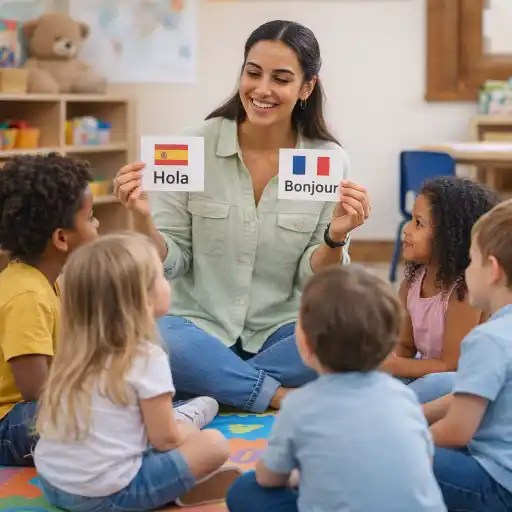
What everyday activities make language exploration meaningful?
Language becomes memorable when it is connected to play, relationships, and concrete experiences—not isolated drills. A greeting song, a familiar picture book in different languages, or a pretend market with family-informed labels can help children notice how words differ while keeping the shared idea accessible. NAEYC’s guidance on honoring home languages highlights family engagement, multilingual greetings, songs, books, and affirmation during play as practical approaches.
- Listen and move: Play a family-approved song and invite children to clap, sway, or choose a movement, without asking anyone to explain every lyric.
- Read together: Share a story in English and, when available, a home-language version or recording. Let children respond through images, acting, or words they choose.
- Explore dramatic play: Add menus, signs, pretend packages, and labels verified with families. Children can play without reading or translating them aloud.
- Notice sounds: Compare a few words for a concept—such as greetings or animal names—using a picture or object as a shared anchor.
- Follow children’s interests: If a child uses a word during play, acknowledge it and keep the play moving rather than requesting a translation.
These experiences teach the whole group that language diversity is part of ordinary classroom life. They also let children engage through their strengths: rhythm, memory, dramatic expression, observation, or conversation. For practical professional learning in language development and culturally responsive activities, explore Building Bridges for Dual Language Learners Buy Now $16.00.
How can teachers support home languages and family partnership?
Families know which words, stories, and language practices are meaningful to their children. Ask open questions such as, “What songs does your child enjoy?” or “Are there words we can use to make arrival feel familiar?” Make contribution optional and specific: a caregiver might recommend a book, share a pronunciation, send a short recording, or simply describe the child’s interests. Avoid treating families as unpaid translators or assuming one family speaks for an entire language community.
When a word or translation will appear in classroom materials, verify spelling, pronunciation, and context with a family member or trusted language resource. Regional vocabulary and family preferences vary. Represent languages in ordinary routines—not only during a cultural celebration—and pair written words with objects, pictures, or gestures so all children can understand the activity.
For important health, safety, developmental, or enrollment conversations, use program procedures and qualified interpreters as appropriate; do not ask a child to interpret sensitive information. Family collaboration should broaden the child’s learning opportunities, not transfer adult communication duties to them. NAEYC’s strategies for honoring home languages provide additional examples of family-informed classroom practice.
How can educators assess participation without counting translations?
Look beyond spoken English or the number of words a child repeats. Observe whether the child attends to a song, follows a story through pictures, joins a game with movement, initiates pretend play, shares an idea in any language, or responds to a peer. These behaviors show engagement and meaning-making even when a child does not speak for the group.
Document what happened, the context, and what support helped: Was the group small? Were visuals available? Did the child choose to participate after hearing a recording? Include family perspectives about the child’s communication at home. Head Start’s intentional language-support guide encourages programs to examine environments and adult practice, rather than placing the burden for access on children.
Common pitfalls include repeatedly calling on a child to translate, praising only public speech, correcting mixed-language responses, and using a child as a representative of a whole culture. Instead, affirm the message, allow wait time, and offer alternatives. If a developmental concern persists across settings and languages, work with the family and appropriate specialists; do not assume multilingualism itself is the cause. State requirements vary - check your state licensing agency.
Conclusion: What is the educator’s role in language exploration?
Preschoolers can explore languages through stories, music, play, sound, and everyday relationships without being assigned the job of translating. Educators create the conditions: welcoming materials, voluntary invitations, accurate family-informed resources, and multiple ways to participate. Children remain learners and community members—not interpreters on demand.
Keep the central goal in view: nurture curiosity while honoring each child’s choice and home-language identity. Invite, model, listen, and pause. When children see that their words are valued but never demanded, the classroom becomes a place where linguistic diversity supports connection and belonging. For further learning, explore Language Development in Early Childhood Buy Now $16.00, Reading Aloud and Storytelling Buy Now $16.00, and Supporting Families and Caregivers in Language and Literacy Buy Now $16.00.
- Building Bridges for Dual Language Learners
- Recognize, Respond, Respect: Supporting Diverse Learners
- Building Bridges for Dual Language Learners: For Workforce Solutions
- Birth to Five CDA Credential with Portfolio Review
- Pediatric RSV First Aid & CPR/AED
- CDA Bridge Bundle: Preschool without Portfolio Review
- Emergent Learning & Development
- Creating Environments that Nurture Growth and Community
- Building Bridges for Dual Language Learners
- Supporting Families and Caregivers in Language and Literacy
- 💛🧩 ¿Cómo puedo hacer que mi enseñanza sea inclusiva para los niños con autismo?
- 😅❌ ¿Cómo Puedo Manejar a un Niño que Dice “¡NO!” a Todo en el Aula?
- Apoyo en Español para Capacitaciones Grupales Presenciales y por Zoom en Cursos Selectos
- 10 Ejemplos de Cómo la Cultura Influye en el Desarrollo Infantil
- Proporciones de Cuidado Infantil y Tamaños de Grupo por Edad en Maryland (Guía Rápida para Centros y Hogares)
- Proporciones de Cuidado Infantil y Tamaños de Grupo por Edad en Virginia (Guía Rápida para Centros y Hogares)
- ¿Cuál es la Diferencia Entre la Crianza Respetuosa y la Crianza Permisiva?
- Actividades de Otoño Fáciles para Preescolares esta Temporada
- Apoyo en Preescolar para Retrasos del Habla: Estrategias Simples que Ayudan
- Retraso del Habla en la Guardería: Cómo Pueden Ayudar los Proveedores
- Cómo Trabajar en el Cuidado Infantil en Carolina del Norte: Requisitos y Pasos
- Celebrando la amistad en el cuidado infantil durante el Día de los Mejores Amigos
- Canciones, juegos y preguntas de círculo para niños
- Cómo simplificar la capacitación para sus empleados de daycare
- Are You Ready to Be a Lead Teacher? 7 Signs You’re Prepared to Step Up
- How Can Child Care Providers Communicate Effectively with Families Who Speak Different Languages?
- How Can We Celebrate Every Family and Create a Classroom Where Everyone Is Represented?
- How Can Child Care Providers Support Healthy Child Growth and Development?
- How Can You Plan Developmentally Appropriate Activities for Preschoolers?
- How Can Preschoolers Explore Different Languages Without Being Expected to Translate?
