A child who says “No, I don’t like that” is offering more than a food opinion—they are practicing language, choice, and self-advocacy. With a few thoughtful prompts, snack can become a welcoming moment for conversation and early literacy without pressuring children to eat. Explore On My Plate: Children’s Nutrition  Buy Now $24.00 to deepen your understanding of preschool nutrition, balanced meals, and portion sizes, then use the practical ideas below to make everyday snack chats feel more natural.
Why are food-preference conversations valuable at preschool snack time?
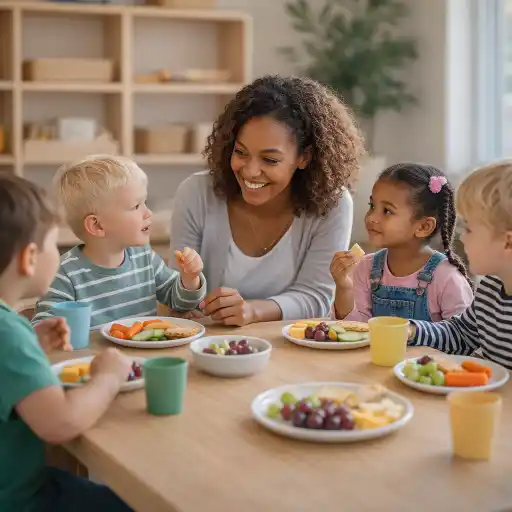
Snack is a familiar, social routine with real objects children can see, smell, and describe. That concrete context gives preschoolers meaningful opportunities to express preferences, listen to peers, take conversational turns, and encounter new vocabulary. Research and practice guidance describe mealtimes as useful settings for building language and social skills when adults make space for genuine back-and-forth talk.
Food conversations can also support autonomy and belonging. Children may have different tastes, family traditions, sensory experiences, dietary needs, or levels of familiarity with a food. Respectful discussion communicates that these differences are ordinary—not something a child has to defend. A preference is information, not misbehavior.
For providers, the goal is not to persuade every child to like every snack. Instead, create a safe, low-pressure environment where children can share an idea, hear another perspective, or simply observe. A child who listens quietly is still part of the group. This approach makes snack an opportunity for #language, connection, and curiosity while keeping nourishment and children’s dignity at the center.
How can educators invite children to share preferences without pressure?
Ask open, optional questions that make room for different answers. Avoid turning the conversation into a quiz or asking children to justify a refusal. Pause after asking; a little wait time gives children space to think, respond with words or gestures, or choose not to speak.
- “What do you notice about this pear?”
- “Would you like to tell us what you think about its color or smell?”
- “Which fruit do you enjoy at snack? You can also pass on answering.”
- “Does this remind you of a food you eat with your family?”
Use neutral descriptions rather than labels such as “good,” “bad,” “yucky,” or “the best.” If a child says, “I don’t like banana,” respond calmly: “You don’t want banana right now. I hear you.” You can add, “Some people like it and some people don’t.” Avoid suggesting that a child must take a bite before expressing a preference.
Children communicate in many ways. Accept pointing, facial expressions, home-language words, signs, and silence as valid participation. If a child says “crunchy,” extend the thought without correcting: “Yes, the apple feels crisp and crunchy when you bite it.” Small, responsive exchanges encourage #choice and confidence without making food preferences a public performance.
How can snack conversations support vocabulary and emergent literacy?
Food offers a lively starting point for describing words, comparisons, storytelling, and print awareness. Introduce sensory vocabulary in context—juicy, smooth, tart, soft, round, ripe—and let children use words that feel comfortable to them. When a child offers a short phrase, model a slightly longer sentence that builds on the idea rather than correcting the child directly.
A simple fruit reader can connect snack talk to books. The ChildCareEd printable Emergent Readers – Fruits Buy Now $1.75 introduces banana, pear, lemon, peach, and cherry with short, repetitive sentences and illustrations children can color. Read a page before or after snack, point to a fruit name, and invite children to find or describe a matching fruit if it is being served. The book is a literacy invitation—not a reason to expect a child to taste a food.
Try brief activities that keep children’s ideas at the center:
- Notice-and-name: “I see a yellow banana. What do you see?”
- Sound play: say “pear” and think of playful rhymes or words that begin with the same sound.
- Shared storytelling: “If this orange could talk, what might it say?”
- Picture-to-object matching: connect an illustration or word to the fruit bowl, when available and safe.
Use a warm, conversational tone and avoid demanding a response from each child. These small moments support #literacy, listening, and expressive language while keeping snack relaxed.
How can teachers respond when children like different foods?
Normalize variety instead of comparing children. One child may enjoy berries while another prefers crackers; a third may be content to look. Preferences can reflect experience, culture, sensory comfort, appetite, or individual needs. Adults may not know the reason, and children should not be asked to explain family choices at the table.
Model respectful language: “We all have foods we enjoy, and our favorites can be different.” When appropriate, describe what is present without ranking anyone’s snack: “I see strawberries and toast on the table.” Do not call a child “picky,” praise one child as a “good eater,” or compare lunchboxes. These comments can turn a social routine into a judgment about the child or family.
Responsive feeding guidance emphasizes that adults provide food and a supportive setting while children communicate whether and how much they eat. Do not force bites, require children to finish a portion, or use food as a reward or punishment. If a child declines a food, acknowledge the message and continue the routine calmly. Repeated, low-pressure exposure can allow familiarity to grow over time, but tasting is not the measure of participation.
Partner with families privately about cultural practices, dietary needs, and preferences that may help the classroom feel more familiar. Follow individual care plans and program procedures for allergies and other health concerns. A respectful table protects #belonging and helps children learn that different preferences are welcome.
How can directors make food conversations safe, inclusive, and consistent?
Consistent adult language helps children know what to expect. Directors can discuss a shared approach during staff meetings: invite rather than demand, describe rather than judge, and accept children’s verbal and nonverbal communication. Include substitutes and support staff so the approach continues across classrooms and busy days.
Safety remains part of every snack routine. Before serving food, staff should review allergies and written care plans, check labels as required, reduce cross-contact risks, supervise children closely, and prepare foods in developmentally appropriate ways. Keep conversation activities secondary to safe seating and active supervision. Follow program procedures and applicable meal-pattern guidance when planning snacks.
Useful team practices include:
- Agree on neutral phrases staff can use when a child declines food.
- Make participation optional; children can talk, point, listen, or pass.
- Choose books and pictures that reflect varied foods and family traditions.
- Share concerns about nutrition, allergies, or eating patterns privately and collaboratively with families.
- Review snack routines for choking risks, food allergies, and individual plans.
State requirements vary - check your state licensing agency. For additional professional learning, the relevant ChildCareEd course On My Plate: Children’s Nutrition Buy Now $24.00 covers preschool nutritional needs, MyPlate, meal planning, portions, and practical preparation. Directors can use it to strengthen shared staff knowledge while continuing to follow their program’s policies and local guidance.
What should providers remember about talking food preferences?
Food-preference conversations work best when they are curious, optional, and respectful. Snack time can strengthen vocabulary, early literacy, peer connection, and children’s ability to communicate what they like or do not want. Use open prompts, sensory words, stories, and simple fruit books to spark conversation, while remembering that listening quietly or declining to answer is also acceptable.
Most importantly, separate learning from pressure to eat. Do not shame, compare, bribe, or require tasting. Honor family and cultural differences, follow each child’s safety and dietary plan, and keep supervision at the forefront. A practical next step is to choose one neutral prompt for tomorrow’s snack—perhaps, “What do you notice?”—then give children time to respond in their own way. The goal is not to produce matching preferences; it is to build a welcoming table where every child’s voice and choices matter.
Additional courses and learning resources
- On My Plate: Children’s Nutrition Buy Now $24.00 — preschool nutrition, MyPlate, meal planning, and portions.
- Healthy Habits from the Start Buy Now $24.00 — nutrition and healthy development, with classroom and family connections.
- Nutrition Essentials for Child Care Providers Buy Now $16.00 — nutrition, food labels, storage, allergies, and feeding challenges.
- Food Preparation and Nutrition Buy Now $32.00 — planning, preparing, and storing food safely.
- Wellness in Action: Teaching Healthy Habits to Children Buy Now $55.00 — practical, inclusive approaches to healthy habits and food-related learning.
For further reading, see Better Kid Care’s ideas for talking about food, NAEYC’s mealtimes-as-learning-times guidance, and Head Start’s child feeding practices.
- 45 Hour Child Growth and Development
- 45 Hour Preschool Methods and Materials
- Birth to Five CDA Credential with Portfolio Review
- 45 Hour Infant and Toddler Methods and Materials
- CDA Bridge Bundle: Family Child Care without Portfolio Review
- CDA Bridge Bundle: Infant/Toddler without Portfolio Review
- CDA Bridge Bundle: Preschool without Portfolio Review
- Texas Director Credential
- Supporting Families and Caregivers in Language and Literacy
- Eid al-Fitr Classroom Activities: Easy Ideas for Child Care and Preschool
- Recursos en Español sobre el Sueño Seguro del Bebé
- ¿Cómo afecta la dopamina a los niños: señales, efectos e influencias diarias?
- Fiesta Activity Ideas for Preschool and Elementary Kids
- Proporciones de Cuidado Infantil y Tamaños de Grupo por Edad en Virginia (Guía Rápida para Centros y Hogares)
- Lista para Guardería en Casa en Texas: Cómo Iniciar una Guardería en el Hogar
- Canciones, juegos y preguntas de círculo para niños
- How can Minnesota child care programs welcome Somali, Hmong, and Spanish-speaking families?
- How Can Farm-to-Table Experiences Teach Toddlers Where Food Comes From?
- How do we build trust with families from day one?
- Veggie Faces, Rainbows, and Snack Boards: Creative Ways to Present Vegetables to Kids
- How Can Child Care Providers Support Families from Diverse Cultural Backgrounds?
- How Do Fruits vs. Vegetables Sorting Mats Build Healthy Eating Habits?
- What Are Simple Ways to Partner With Families All Year?
- How Can Child Care Providers Build Healthy Habits for Young Children?
- How Can You Make a Classroom Cooking Activity Accessible to Children with Different Abilities?
- When Is Translation Not Enough in Parent Communication?
- How Can Child Care Providers Ask Families About Support Needs Respectfully?
- How Can You Share Field Trip Learning with Families Who Could Not Attend?
- How Can Preschool Snack-Time Conversations Honor Food Preferences and Build Learning?
