Could a cucumber smile, a rainbow of peppers, or a child-designed snack board make vegetables feel less intimidating? Creative presentation gives children a playful, low-pressure way to explore color, texture, choice, and taste while supporting nutritious routines. For a deeper foundation in balanced menus, food safety, allergies, and feeding challenges, explore Nutrition Essentials for Child Care Providers  Buy Now $16.00 to strengthen professional knowledge and apply safer classroom practices.
Why does creative vegetable presentation matter in early care?
Vegetables contribute important vitamins, minerals, fiber, and variety to children’s diets. The CDC recommends offering a range of nutrient-dense foods, including vegetables and fruits, as part of meals and snacks. Early care settings are especially influential because repeated experiences with food can shape familiarity, preferences, and children’s confidence around new tastes.
Presentation does not “trick” children into eating. Instead, it changes the invitation. A plain pepper strip may seem unfamiliar; the same strip arranged as a sun ray becomes an opportunity to notice, describe, touch, and perhaps taste. This distinction protects children’s autonomy while making the experience more engaging.
Creative food activities also support learning. Children can classify colors, count pieces, compare textures, use positional language, practice fine-motor coordination, and collaborate with peers. The farm-to-early-care model similarly connects food, gardening, taste tests, cooking, and educational experiences.
- Offer vegetables alongside familiar foods rather than presenting them as a test.
- Use descriptive language such as “crisp,” “smooth,” “juicy,” or “cool.”
- Respect children’s hunger and fullness cues; tasting should not be required.
- Keep portions small and provide more when appropriate.
For providers, the goal is not a perfect plate. It is a welcoming #environment where children can build #curiosity and positive associations with food.
How can providers create simple veggie faces?
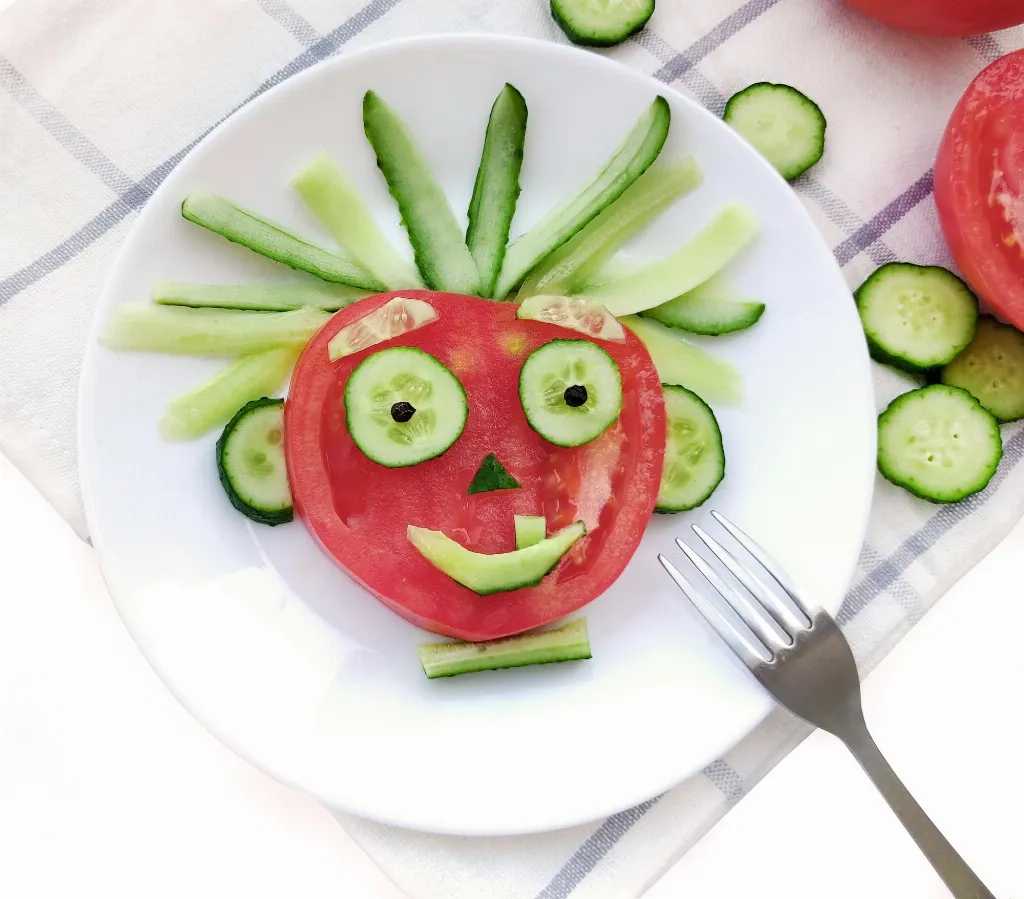
Veggie faces are flexible, inexpensive, and easy to adapt for different ages. Begin with a stable base, such as hummus on a plate, whole-grain toast, a tortilla, or a cucumber round. Then invite children to arrange familiar vegetables into facial features.
- Cucumber rounds or bell-pepper rings can become eyes.
- Cherry tomato halves or shredded carrot can become cheeks.
- Thin pepper strips, green beans, or snap peas can form smiles.
- Olive pieces, peas, or corn can add pupils or freckles when permitted.
- Spinach, herbs, broccoli, or shredded cabbage can become hair.
Offer a few choices rather than an overwhelming assortment. For example, provide two eye options, two mouth options, and one or two colorful toppings. Children may create happy faces, animals, monsters, or imaginary characters. Storytelling can extend the activity: “What is your character’s name?” “Where does your veggie friend live?” Providers can build on this imaginative approach with a child-friendly story about gut health and nourishing foods.
Cookie cutters can shape soft vegetables, cheese, bread, or tortillas. However, tools and ingredients must match developmental abilities. Adults should handle sharp knives, appliances, hot foods, and wooden skewers. Use child-safe utensils and close supervision.
Avoid framing vegetables as hidden ingredients or using food as a reward. Visible, respectful exploration helps children understand what they are eating and supports trust. As recommended by KidsHealth, involving children in preparation may increase willingness to try unfamiliar foods, but participation should remain voluntary.
 How can a vegetable rainbow become a learning-rich snack?
A rainbow snack board makes color and variety visible. Arrange vegetables in an arc or in separate color groups: red peppers or tomatoes, orange carrots, yellow corn, green cucumbers or broccoli, and purple cabbage. Add a dip “cloud” at each end using hummus, yogurt dip, or another program-approved option.
Children can help wash produce, sort foods by color, count pieces, and decide the order of the rainbow. Providers can introduce vocabulary such as “beside,” “above,” “under,” “bright,” and “dark.” A short conversation about gardens, sunlight, rain, or where food grows can connect snack to science and community learning.
- 🌈 Ask children which color they want to investigate first.
- Compare crunchy raw vegetables with softer cooked vegetables.
- Invite children to predict which foods will be sweet, mild, or tangy.
- Record observations through drawings, photos, or a simple class graph.
Rainbow presentation should not imply that every child must eat every color. A child may participate by sorting, naming, smelling, or touching. Repeated, low-pressure exposure is more supportive than insisting on immediate acceptance; some children need many opportunities before a food becomes familiar.
For younger children, adapt the design carefully. Hard raw vegetables may need to be cooked until soft, thinly sliced, or cut into developmentally appropriate pieces. Always follow current choking-prevention guidance and your program’s policies.
How can providers design balanced snack boards?
A snack board can combine nutrition, independence, and social learning without becoming complicated. Start with two or more food groups and include familiar as well as less familiar choices. A practical board might contain cucumber rounds, soft pepper strips, whole-grain crackers, cheese, fruit, and a small container of hummus.
Use compartments, muffin tins, or individual plates to separate ingredients. This can help children who are sensitive to foods touching. Arrange foods by color, shape, or texture, but keep the design simple enough for staff to reproduce consistently.
- Vegetables: cucumber, steamed broccoli, carrots prepared safely, peas, or peppers.
- Protein: hummus, beans, yogurt, cheese, egg, or another approved food.
- Whole grains: whole-grain crackers, pita, toast, or rice cakes.
- Fruit: berries, bananas, pears, or soft canned fruit as appropriate.
- Dips: hummus, guacamole, plain yogurt dip, or an allergy-safe alternative.
Invite children to build a “garden,” “underwater scene,” or “construction site.” Build-your-own formats give children meaningful choices while adults maintain responsibility for what is offered and how it is prepared. Family-style serving may also support autonomy when children are developmentally ready and supervision is adequate.
Plan boards around the program’s menu cycle, budget, allergies, and food-storage capacity. If participating in CACFP, consult current meal-pattern guidance and your sponsoring organization. State requirements vary - check your state licensing agency.
How can programs keep creative vegetable snacks safe and inclusive?
Creativity never replaces safety. Before serving, review each child’s developmental feeding skills, allergy information, cultural preferences, and health needs. Keep children seated upright and actively supervised throughout snack.
- Read ingredient labels every time, including donated or packaged foods.
- Prevent cross-contact with clean hands, sanitized surfaces, and separate utensils when necessary.
- Cut grapes and cherry tomatoes appropriately; soften hard vegetables and remove pits, stems, and tough skins.
- Avoid whole nuts, large chunks, sticky globs of seed butter, popcorn, and other high-risk foods when policies or developmental guidance require avoidance.
- Keep emergency action plans accessible to authorized staff and ensure staff know the program’s response procedures.
Allergy inclusion requires more than removing peanuts. Milk, egg, wheat, soy, sesame, and other allergens may also need accommodation. Ask families about successful foods and sensory preferences, and provide equivalent alternatives rather than isolating a child from the activity.
Common mistakes include making every snack elaborate, pressuring children to taste, and allowing food sharing. Use a rotation: one simple face, one rainbow, and one build-your-own board each month. Offer neutral encouragement such as, “You noticed the pepper is crunchy,” rather than praise tied to eating. For more comprehensive preparation, storage, and allergy guidance, providers may also consider Food Preparation and Nutrition Buy Now $32.00.
How can directors turn these ideas into consistent practice?
Directors can make creative presentation sustainable by building it into planning rather than treating it as an occasional special event. Create a shared ingredient list, photo examples, substitution chart, and safety checklist. Staff can then offer engaging snacks without spending excessive time on preparation.
A monthly “presentation menu” might include:
- Week one: veggie faces on toast or hummus.
- Week two: a rainbow cup or color-sorted tray.
- Week three: an animal or garden snack board.
- Week four: child-designed plates using familiar ingredients.
Use observation to guide future planning. Which textures do children explore? Which arrangements invite conversation? Which children prefer separated foods, dips, or cooked vegetables? Share these observations with families without labeling children as “picky.” Collaboration can reveal culturally meaningful foods and strategies that work at home.
These activities also support curriculum goals. Children practice #fine-motor skills while arranging pieces, language while describing foods, mathematics while counting and sorting, and social-emotional skills while negotiating shared materials. Documentation may include children’s comments, photographs of the process, or a short reflection on participation.
For providers seeking a broader wellness framework, Healthy Starts: Safety, Nutrition, and Wellness in Child Care Buy Now $55.00 connects nutrition with supervision, allergies, illness prevention, and children’s overall well-being. A playful snack is most effective when it fits within a consistent, responsive program culture.
Conclusion
Veggie faces, rainbows, and snack boards answer the central question by making vegetables inviting without making eating compulsory. They transform snack into an opportunity for exploration, choice, conversation, and developmentally appropriate learning.
The strongest approach is simple: offer colorful vegetables with familiar foods, involve children in safe preparation, use playful designs as invitations, respect hunger and sensory differences, and maintain rigorous allergy and choking-safety routines. When providers plan these experiences intentionally, children can build confidence and #healthy relationships with food one small, joyful discovery at a time.
Frequently asked questions
Should children be required to taste a vegetable?
No. Encourage exploration without pressure. Looking, touching, smelling, or arranging food can be meaningful steps.
What are good vegetables for creative presentation?
Cucumbers, bell peppers, tomatoes, peas, broccoli, carrots, and cabbage offer varied colors and shapes. Prepare them according to age and safety guidance.
Can snack boards be used with toddlers?
Yes, when foods are developmentally appropriate, portions are safe, and children remain seated and supervised. State and program requirements should guide implementation.
How often should a new vegetable be offered?
Offer repeated, low-pressure opportunities alongside familiar foods. Acceptance often develops gradually.
How can families be included?
Share menus, invite culturally relevant suggestions, and send home simple ideas such as color sorting, vegetable faces, or child-designed snack plates.
Do creative snacks replace balanced meals?
No. They are a presentation strategy within a balanced menu that also includes appropriate protein, whole grains, fruit, dairy or fortified alternatives, and water.
Additional courses for professional growth
- CDA Home Visitor Subject Area 3 Part 3 Birth to 5
- CDA Home Visitor Subject Area 2 Part 3 Birth to 5
- Bienvenido! Welcoming All Families
- Birth to Five CDA Credential with Portfolio Review
- Presentation Strategies & Training Techniques
- Pediatric RSV First Aid & CPR/AED
- Art from the Heart for Preschoolers: Open Ended Art Projects that Build Self-Esteem
- Creating Environments that Nurture Growth and Community
- Texas Director Credential
- Healthy Lunchbox Ideas for the New School Year: Keep Kids Energized & Excited about Their Meals
- Gut Gnomes and Fairy Food: How to Feed the Magical Creatures Living in Your Kid’s Tummy
- CDA Certification en Español: Recursos y Consejos para Educadores Bilingües
- 🔍 ¿Qué ves cuando observas a un niño aprender?
- 🥦✨ ¿Cómo apoyar a los niños selectivos a probar nuevos alimentos sin presión?
- 👶😴¿Es Normal que los Niños Griten o Lloren al Despertarse?
- ❄️ ¿Qué actividades al aire libre funcionan bien para los niños de Illinois en cada estación? 🌷🍂
- Pascua En El Aula: Actividades Sencillas Para Aprender y Celebrar Con Seguridad
- Menos Estrés a la Hora de Comer: Rutinas Simples Que Sí Funcionan
- ¿Cómo puedo usar escenarios de juego de roles de primeros auxilios en mi aula?
- ¿Cómo puedo enseñar habilidades de primeros auxilios con escenarios de juego de roles?
- ¿Cómo afecta la dopamina a los niños: señales, efectos e influencias diarias?
- Proporciones de Cuidado Infantil y Tamaños de Grupo por Edad en Nueva Jersey (Guía Rápida para Centros y Hogares)
- Proporciones de Cuidado Infantil y Tamaños de Grupo por Edad en Virginia (Guía Rápida para Centros y Hogares)
- Lista para Abrir una Guardería en Casa en Dakota del Norte: Cómo Empezar
- Temas y Actividades para el Día Nacional del Kindergarten para Proveedores
- Consejos de Supervisión Activa para Salones de Preescolar y el Juego al Aire Libre
- Retraso del Habla en la Guardería: Cómo Pueden Ayudar los Proveedores
- Veggie Faces, Rainbows, and Snack Boards: Creative Ways to Present Vegetables to Kids
- ¿Qué habilidades preceden al recorte y cuándo deben aprender los niños a usar tijeras?
