Children’s most inventive play often begins when adults resist the urge to explain what to do next. If you want to strengthen children’s creativity while still supporting learning and safety, The Best Promotion is Play  Buy Now $24.00 offers a focused next step, with practical ways to understand play and support it in the classroom. Read on for simple strategies that help you guide thoughtfully, then step back and let children’s ideas lead.
Why does creative play need room to unfold?
Creative play is more than a pleasant break in the day. As children invent stories, transform materials, and negotiate shared ideas, they practice flexible thinking, language, problem-solving, collaboration, and self-regulation. When adults prescribe every step or define a single correct result, children have fewer chances to make decisions and test their own theories.
That does not mean educators should withdraw completely. A supportive environment offers meaningful materials, adequate time, and attentive supervision while leaving the direction of play largely with children.
For providers and directors, this balance matters in everyday practice. A block-building episode may involve early math, spatial reasoning, storytelling, and peer cooperation without needing a scripted lesson. The educator’s work is to recognize what is happening, protect the conditions that allow it to deepen, and intervene when support is genuinely useful.
How can you prepare an environment that invites children to lead?
Begin with the room rather than a long explanation. Children are more likely to initiate and sustain play when materials are accessible, familiar enough to use independently, and open to multiple purposes. A scarf can become a river, a cape, or a roof; a box may become a bus, a shop, or a hiding place. Simple, versatile materials make children the designers of the play. Junk art offers one practical way to use clean recycled materials for open-ended art that supports creativity and fine-motor development.
- Offer a small selection of open-ended materials: blocks, fabric, cardboard, play dough, art tools, and safe natural objects.
- Place materials where children can reach, combine, and return them with growing independence.
- Rotate a few items when interest changes rather than adding everything at once.
- Provide a generous, uninterrupted period so ideas have time to develop.
- Adapt materials and access so children with different abilities, languages, and sensory preferences can participate.
What should you do before joining children’s play?
Pause and observe before stepping in. Notice what children are trying to do, which materials they choose, how they communicate, and what they try when something does not work. An observation-based approach helps distinguish between a child who is absorbed and a child who is signaling that they need help or a new entry point.
Close observation can also reveal the thinking behind an action. Instead of showing a child the “right” way to build a ramp, you might describe what you noticed: “You moved the board higher, and now the car is rolling farther.”
Try this brief sequence:
- Watch and listen long enough to understand the child’s current idea.
- Describe what you see without evaluating it: “You’re lining up the stones beside the path.”
- Wait for a response, gesture, or invitation before adding a prompt.
- Record a short note or child quote if it will help you plan a useful follow-up.
Observation is an active teaching practice, not a passive one. It lets you respond to children’s interests with greater precision and protects their ownership of the play.
How can you guide play without taking it over?
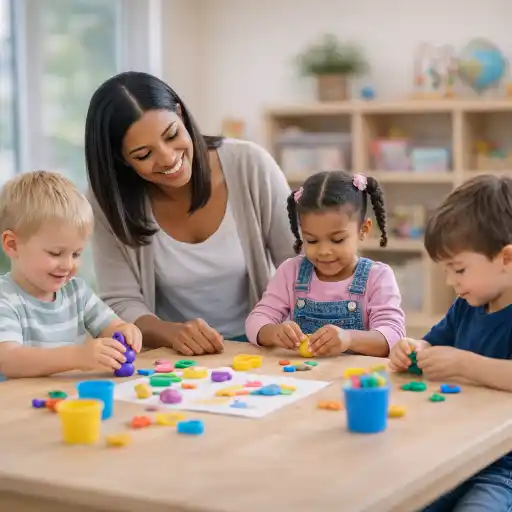
When an entry is helpful, keep it brief, responsive, and easy for children to accept or ignore. You might join at the edge of a pretend restaurant, offer a missing prop, or model a phrase for negotiating roles. Then give the children space to decide what happens next. The teacher’s role can shift between observer, participant, language partner, and mediator, depending on what the moment calls for.
Use comments and questions that invite thinking rather than prescribe a product:
- “I wonder what your plan is for the bridge.”
- “What else could this fabric become?”
- “You tried two ways to make it stand. What are you thinking of trying now?”
- “How could everyone have a part in this game?”
Avoid rapid-fire questioning, corrections, or turning the play into an adult-led quiz. If children are deeply engaged, a quiet presence may be the most useful support. If frustration, exclusion, or a safety concern arises, offer just enough help to restore participation and wellbeing, then return control where possible.
Guidance should be responsive to age, temperament, communication, and individual needs. Some children welcome an adult’s playful contribution; others prefer observation from nearby.
Which common habits can unintentionally limit creativity?
Well-intended teaching moves can sometimes narrow play. A sample to copy, a fixed sequence of steps, or repeated questions about what a child is making can communicate that there is an expected answer. Product-focused crafts may be appropriate occasionally, but they should not replace opportunities to explore materials and make independent choices.
- Over-explaining: Give a short invitation, then allow time for children to respond in their own way.
- Fixing every problem: Stay close for safety, but allow manageable challenges and attempts to solve them.
- Asking questions without listening: Ask one open prompt, then pause and attend to the child’s response.
- Overloading the play area: Present a few purposeful materials and rotate them as interests shift.
- Requiring the same outcome: Value children’s varied interpretations and processes, not just a finished object.
For example, when a child turns a toy kitchen into a drum set, there is no need to redirect them to pretend cooking simply because that is the toy’s intended use. A curious response—“You found a new sound”—validates the idea while leaving room for further experimentation.
Creative play also takes different forms across children and cultures. Avoid assuming that quiet play is disengaged or that every child will join a group narrative in the same way. Offer multiple ways to participate, and respect children’s choices to watch, build alone, or enter a shared game gradually.
How can you reflect on and extend creative play over time?
After play, reflect on what children showed you rather than judging whether the activity matched your original plan. What captured their attention? What problems did they work through? Which materials or social arrangements helped them participate? These observations can inform tomorrow’s environment: add a few props, make a material easier to access, or protect more uninterrupted time.
Documentation can be simple and useful. A photograph, a brief anecdotal note, or a child’s own words can help staff see growth in storytelling, persistence, negotiation, or flexible problem-solving. Share the learning behind play with families in concrete terms: “Maya changed the block design twice after testing its balance,” rather than relying on a broad claim that children were creative.
Use team reflection to maintain a consistent approach. Directors can invite staff to discuss when they stepped in, what cues children offered, and whether an adult prompt expanded or redirected the play. Consider these five ChildCareEd courses for further learning; all links are to English-language offerings:
- The Best Promotion is Play Buy Now $24.00 — strategies for understanding and supporting play in the classroom.
- Role of Play in Learning Buy Now $16.00 — a closer look at play’s place in child development and learning.
- Play, Learn, Grow Online Version Buy Now $16.00 — developmentally appropriate practice and support for different learning styles.
- Art from the Heart for Preschoolers Buy Now $35.00 — open-ended art experiences that foster choice and self-esteem.
- Beautiful Junk: Using Recycled Materials in the Classroom Buy Now $16.00 — ideas for turning everyday materials into invitations to imagine.
Use documentation to guide planning, not to turn every play episode into a formal assessment. A responsive cycle—observe, reflect, adjust, and observe again—keeps the curriculum connected to children’s actual interests.
Conclusion: How can you encourage creativity while giving fewer instructions?
Encouraging creative play means preparing a safe, accessible environment, protecting time for exploration, observing before intervening, and using brief, open-ended support when it can help. Children need adults who are present and attentive, but they also need room to make decisions, revisit ideas, and invent their own purposes for materials.
Start with one manageable change: remove a step-by-step sample, put a few versatile materials within reach, or wait several seconds longer before offering help. Notice what children do with that freedom. When educators guide with intention and then step back, they make space for the resourcefulness and imagination children already bring to play.
Five key takeaways: protect child choice, offer open-ended materials, observe first, prompt sparingly, and reflect on what children’s play reveals.
- The Best Promotion is Play
- Bienvenido! Welcoming All Families
- CDA Bridge Bundle: Preschool
- Pediatric RSV First Aid & CPR/AED
- CDA Bridge Bundle: Family Child Care
- The Best Promotion is Play
- CDA Bridge Bundle: Infant/Toddler
- Creating Environments that Nurture Growth and Community
- Texas Director Credential Renewal
- Texas Director Credential
- Tiny Tinkerers: How Messy Play Today Could Lead to Tomorrow’s Top Inventors
- Tiny Hands, Big Dreams: Fostering Creativity in Preschoolers
- How Earning a CDA Might Just Make You a Child Whisperer (Or At Least a Crayon Removal Expert)
- Gift of Gratitude: Fostering Emotional Intelligence in Children through Acts of Kindness
- DIY Snow Globes: The Fine Motor Craft That’ll Keep Kids (and Adults) Busy for Hours
- CDA Certification en Español: Recursos y Consejos para Educadores Bilingües
- 10 Ejemplos de Cómo la Cultura Influye en el Desarrollo Infantil
- Regulaciones de Licenciamiento de Cuidado Infantil en California para Centros y Hogares de Cuidado Infantil Familiar
- Proporciones de Cuidado Infantil y Tamaños de Grupo por Edad en Maryland (Guía Rápida para Centros y Hogares)
- Proporciones de Cuidado Infantil y Tamaños de Grupo por Edad en Virginia (Guía Rápida para Centros y Hogares)
- How can indoor creative play encourage teamwork for preschoolers in California?
- Canciones, juegos y preguntas de círculo para niños
- How can we encourage curiosity instead of simply giving answers?
- Animal Relay Race for Kids: 10 Wild Ways to Race Without Running
- How Can Child Care Providers Use Art and Creative Expression to Support Young Children?
- How Can “Almost Finished” Activities Encourage Young Children to Problem-Solve?
- How Can Open-Ended Summer Art Encourage Planning and Creativity?
- What Skills Come Before Cutting, and When Should Children Learn to Use Scissors?
- How Can Child Care Providers Encourage Creative Play Without Giving Too Many Instructions?
- How Can Early Childhood Teachers Encourage Problem-Solving Without Giving the Answer?
