Summer can be a happy time for kids — no school, more play, and outdoor fun. It can also be a time when some children miss the regular meals they get during the school year. As a child care provider or director in #Michigan, you can help by using the Child and Adult Care Food Program (#CACFP) and summer meal programs to make sure every child gets healthy #meals when school is out. This article explains what these programs are, how they work in Michigan, why they matter, common mistakes to avoid, and answers to questions families and staff often ask. Pairing meals with simple, developmentally appropriate enrichment can increase participation and learning; see our Get Ready for Summer activity ideas for art projects, nature walks, and easy center-based activities you can use alongside meal services.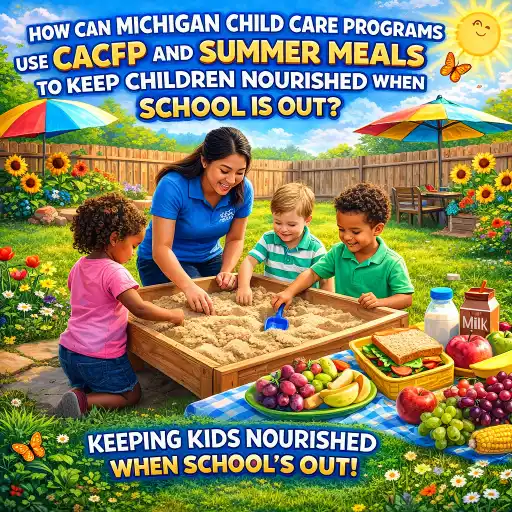
What are CACFP and summer meal programs, and how do they run in Michigan?
🍎 The Child and Adult Care Food Program (CACFP) gives money to child care programs to serve nutritious meals and snacks to children. CACFP supports centers, family child care homes, Head Start, and some afterschool programs.
🥪 CACFP pays back programs for meals that meet the nutrition rules (fruits, vegetables, grains, protein, dairy,y or alternatives). See helpful tips on planning and menus at ChildCareEd’s nutrition guide.
Summer meal options in Michigan:
- 🌞 The Michigan Department of Education runs the Summer Food Service Program (SFSP) for community sites and sponsors. Learn more at the MDE Summer Food Service Program page.
- 📍 Michigan also promotes Meet Up & Eat Up — open summer meal sites where kids can get free meals with no paperwork. Find sites at 211 NE Michigan or through the MDE site.
How the pieces fit together:
- Many programs use CACFP for year-round care and may switch to SFSP or the Seamless Summer Option during the summer.
- Some sponsors (schools, nonprofits, parks) can run open meal sites to reach more children where they already play.
How can my program run CACFP or summer meals this year?
- 📋Check eligibility and choose a sponsor or apply:
- • Contact MDE’s nutrition office or a CACFP sponsor to learn how to apply. See Michigan’s CACFP resources at ChildCareEd and MDE’s SFSP page at michigan.gov.
- 🥗 2) Plan simple, reimbursable menus:
- • Use CACFP meal patterns and SFSP meal patterns when serving summer meals. ChildCareEd offers easy menu tips at How can child care programs promote nutrition. June is National Fresh Fruit and Vegetables Month — see simple, child-friendly ways to feature fresh fruits and vegetables and promote healthy eating in your program at June is National Fresh Fruit and Vegetables Month.
- 🧾Keep good records and train staff:
- Track daily meal counts, attendance, receipts, and menus. Proper recordkeeping helps you get reimbursements.
- Provide short training sessions on portion sizes, allergies, and food safety. ChildCareEd has courses on food storage and preparation at food storage & prep.
- 🍽️ Food preparation and nutrition: To help staff plan CACFP and SFSP-compliant menus and build strong, safe mealtime practices, ChildCareEd's Food Preparation and Nutrition
 Buy Now $32.00 is a 4-hour online course covering child nutrition basics, meal pattern requirements, safe food handling, and how to create positive eating environments — a direct match for the menu planning, portion sizing, and recordkeeping steps outlined in this guide.
- 🍽️Engage families and the community:
- • Share your weekly menu, meal times, and site locations. Use Meet Up & Eat Up listings to promote open sites (211 NE Michigan). You can also learn from examples in other states of how summer programs build inclusion and support development, for example how summer camp programs foster community and support child development.
Why does providing meals in summer matter for children and communities?
- 🔎 Nutrition and learning: Children need steady,y healthy food to focus, learn, and play. Missing school meals can mean less energy and more worry at home. The research summarized in child nutrition reports shows that summer meals help reduce hunger and support learning readiness (see national program primers like School Meals Programs: A Primer).
- 🤝 Community safety and access: Open summer sites meet children where they are — parks, libraries, and community centers. Michigan’s Meet Up & Eat Up served millions of meals in recent summers and makes meals easy to access: no sign-up, just show up and eat (211 NE Michigan).
- 🏫 Smooth school transitions: Programs like Head Start already serve family-style meals and follow CACFP rules to help children build healthy habits. Local programs such as NEMCSA highlight family-style meals in early education to support growth and learning (NEMCSA Nutrition).
Why this matters for your program:
- • Keeping kids fed helps attendance, behavior, and the chance to learn during summer camps and programming.
- • CACFP and SFSP reimbursements help your budget so you can serve better food without extra cost to families.
What are common mistakes, and what do families usually ask? (How to avoid pitfalls and answer FAQs)
Common mistakes to avoid:
- ❌ 1) Not checking meal patterns or paperwork — Fix: Use simple menu templates and checklists, and train staff. ChildCareEd menu tools and courses can help (ChildCareEd nutrition).
- ❌ 2) Weak recordkeeping — Fix: Keep daily meal counts, receipts, and attendance in one place. Numbered logs save time during audits.
- ❌ 3) Not planning for allergies or choking safety — Fix: Maintain up-to-date allergy plans, read labels, and follow safe-food prep practices (Nut-free snack ideas).
- Allergy and food safety: For staff who need to feel confident maintaining allergy plans and preventing choking hazards at mealtimes, ChildCareEd's Illness, Medication, and Allergies in Child Care Buy Now $32.00 is a 4-hour online course covering allergy recognition, medical statement procedures, and safe food preparation — directly supporting the allergy plan maintenance and choking safety steps described throughout this article.
Top FAQs (quick answers you can share with families):
- Q: Are summer meals free? A: Yes — many Meet Up & Eat Up, and SFSP sites serve free meals to kids under 18. Check local site info at MDE SFSP or 211 NE Michigan.
- Q: Do families need to sign up? A: Most open sites do not require sign-up. Some camps or enrolled programs may ask for registration.
- Q: Can infants and toddlers be served? A: Yes, but follow infant feeding rules and CACFP infant meal patterns. See ChildCareEd’s infant feeding guidance (Starting solids safely).
- Q: How do I find a sponsor if I’m a family home provider? A: Contact local CACFP sponsors listed on your state CACFP page or MDE. ChildCareEd also lists sponsor help for Michigan providers (Michigan CACFP).
Conclusion: Quick checklist to keep children fed and safe this summer
- ✅ Contact MDE or a CACFP sponsor to confirm eligibility and deadlines. (MDE SFSP, ChildCareEd Michigan CACFP).
- ✅ Plan simple menus that meet CACFP/SFSP meal patterns. Use ChildCareEd menu tips for quick ideas (nutrition guide).
- ✅ Train staff on food safety, allergy plans, and recordkeeping. ChildCareEd courses and resources can help with staff readiness.
- ✅ Share site times and menus with families and promote open sites like Meet Up & Eat Up (211 NE Michigan).
- ✅ Remember: state requirements vary - check your state licensing agency and the Michigan Department of Education for rules and dates.
Thank you for the food to feed children in your care. Using #CACFP and summer meal programs keeps kids healthy, improves their ability to learn, and supports families in your #community. Keep serving good food, keep records simple, and reach out for help when you need it — your effort makes a big difference for #children in #summer.
- Get Ready for Summer!
- CDA Certification en Español: Recursos y Consejos para Educadores Bilingües
- Cómo Abrir Una Quardería En Casa Sin Dinero?
- Requisitos Para Ser Maestra Principal En Un Daycare: Lo Que Necesitas Para Empezar
- Recursos en Español sobre el Sueño Seguro del Bebé
- Regulaciones de Licenciamiento de Cuidado Infantil en California para Centros y Hogares de Cuidado Infantil Familiar
- Proporciones de Cuidado Infantil y Tamaños de Grupo por Edad en Maryland (Guía Rápida para Centros y Hogares)
- Proporciones de Cuidado Infantil y Tamaños de Grupo por Edad en Nueva Jersey (Guía Rápida para Centros y Hogares)
- Proporciones de Cuidado Infantil y Tamaños de Grupo por Edad en Virginia (Guía Rápida para Centros y Hogares)
- Lista para Guardería en Casa en Illinois: Cómo Iniciar una Guardería en el Hogar
- Lista para Guardería en Casa en Texas: Cómo Iniciar una Guardería en el Hogar
- Retraso del Habla en la Guardería: Cómo Pueden Ayudar los Proveedores
- How can Michigan daycares teach healthy eating habits to toddlers?
- How can grants and vouchers in Michigan help child care providers?
- Canciones, juegos y preguntas de círculo para niños
- How can Michigan child care programs use CACFP and Summer Meals to keep children nourished when school is out?
- Cómo simplificar la capacitación para sus empleados de daycare
- How can SUN Meals and CACFP keep North Dakota children fed all summer?
- Should I Add an Afterschool Component to My Michigan Child Care Program?
- What Do Michigan's Cash-to-Families Programs Mean for the Children in Your Care?
