Hey Georgia childcare teachers, summer camp and extended-day programs are powerful contexts for fostering belonging and mutual responsibility in young children. Did you know well-designed summer offerings can intentionally cultivate a shared group identity and sustained prosocial action? For applied techniques, see our Community and Family Engagement in Childcare  Buy Now $24.00 and Classroom Management is Collaboration! Buy Now $16.00 courses, both designed to help practitioners translate theory into routines and interactions that promote socioemotional competence. Having a “sense of community” means both identifying with a group and participating in its practices — giving help, accepting responsibility, and practicing the norms that sustain relationships.
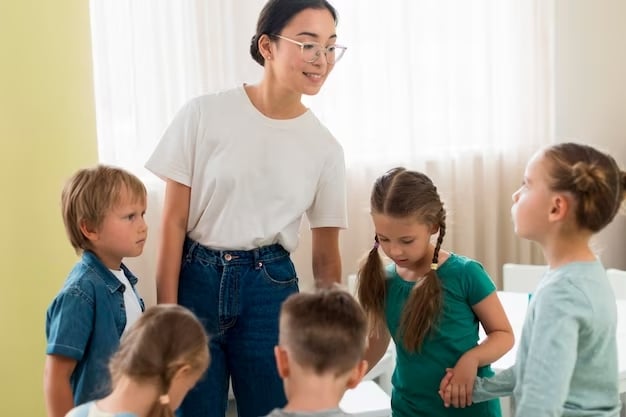
With April being Preventing Child Abuse & Neglect Awareness Month, what better time to get children in your program to develop a sense of community and a feeling of security than now? Because young children are essentially social beings, communities are meaningful and appealing to them. The early childhood classroom is usually a child’s first community beyond those provided by their caregivers. How children interact with one another helps them internalize new information and shapes the way children think. Collaborative activities allow children to learn from and teach one another.
How can teachers help children develop a sense of community in the classroom?
Here are some ways teachers in your program can help children to develop a sense of community within their own classrooms:
- Create an environment where children are expected to be kind and supportive of one another.
- Arrange the classroom so different size groups can gather.
- Establish a consistent daily routine.
- Call attention to activities the whole class can participate in.
- Organize activities that promote participation with others.
- Involve children in the community beyond the classroom.
Explain and scaffold expectations. Define kindness with concrete behaviors (helping, turn-taking, using words instead of hands) and scaffold those behaviors with role-play and teacher narration. Use sustained shared thinking and scaffolding to help children generalize prosocial strategies across contexts.
Design flexible learning spaces. Arrange centers and furniture so dyads, small groups, and larger circle times are all accommodated; this spatial flexibility supports different modes of peer interaction and collaborative problem solving. See our article Creating Community for specific classroom layouts and activity sequences.
Use predictable routines to build safety and agency. Consistent morning rituals, snack procedures, and transition songs reduce cognitive load so children can invest energy in peer relationships and collaborative tasks.
Plan classwide participation. Use shared projects (class mural, community garden) and rotating roles so children see themselves as contributors. Small, achievable responsibilities increase competence and belonging.
Structure cooperative learning. Design tasks that require interdependence (paired storytelling, shared block-builds). Explicitly teach strategies for negotiation and conflict resolution and model reflective talk.
Extend learning beyond the classroom. Invite families, local elders, or community helpers to co-create activities; such engagement strengthens the ecological supports around a child and signals to families that the program values partnership. For more on building classroom-community connections in Georgia contexts, see Connections That Last: Helping Georgia Early Educators Build Stronger Classrooms Through Community and Collaboration.
 How can teachers involve families and the broader community?
By creating a sense of community within our early care programs, children can take these skills they have learned and become lifelong members of a collaborative community.
At H&H Child Care Training we support practitioners in developing these competencies through targeted professional learning that links practice, reflection, and program quality. Strengthening classroom community can also support programs working toward higher levels in Quality Rated by demonstrating family engagement, social-emotional support, and developmentally appropriate classroom organization.
What courses and trainings help teachers build classroom community?
Some courses to help are:
- Community and Family Engagement in Childcare Buy Now $24.00 — strategies for authentic family partnership and community linkage.
- Classroom Management is Collaboration! Buy Now $16.00 — practical co-regulation and classroom systems that sustain inclusion.
- Bridging Intent and Response: Communication Buy Now $32.00 — supports for responsive language and adult-child interaction strategies.
Each course includes applied examples, video modeling, and reflection prompts so teachers can adapt approaches to their program context; practitioners working in Georgia can document Bright from the Start clock hours for many of these courses.
For complementary perspectives on supporting resilience and trauma-informed practice that underpin secure communities, see Ringing in Resilience.
What Georgia regulations and resources should summer program providers follow?
All our online courses provide text, voice, and videos to make the content engaging as well as informative and are Bright from the Start approved for clock hours! Search the GaPDS website under our Approved Sponsor Organization code (TR-ASO-76) for a full list of all our courses.
Providers operating in Georgia should consult GaPDS and Bright from the Start guidance for training approval, staff-child ratios, and licensing requirements; maintaining documentation of training and family-engagement practices supports compliance and continuous quality improvement. For ideas about Georgia-specific summer program activities and field trips, see Summer Field Trips for Daycares in Georgia.
How can educators assess and sustain community outcomes?
Assessing community outcomes means measuring both social processes (turn-taking, helping, conflict resolution) and program practices (consistent routines, family engagement). Use simple observational tools, checklists, and brief child interviews to document change over time. Share findings with families and use them to plan next steps: adapt group routines, set new class roles, or target small-group interventions. Consider periodic reflective team meetings to align adult practice with children's emerging social competencies.
Technology can support documentation when used responsibly — capture short video clips of collaborative work and annotated observations (see Can Early Childhood Programs Use Technology Responsibly to Enhance Learning?).
For program-level planning and to connect community practices to enrollment and family satisfaction, consider curriculum maps that embed collaborative learning goals across weeks and seasons. For ideas on Georgia program supports and broader policy context, see Could Georgia Pre-K Expand to 3-Year-Olds?.
Visit our website to see a full list of classes on how to support the children in your classroom today!
Summary: Building classroom community requires intentional routines, designed interactions, family partnership, and continuous assessment. Strong communities advance children’s socioemotional development and program quality. #community #collaboration #Georgia #earlyeducation #play
- Bienvenido! Welcoming All Families
- CDA Bridge Bundle: Family Child Care without Portfolio Review
- Art from the Heart for Preschoolers: Open Ended Art Projects that Build Self-Esteem
- CDA Bridge Bundle: Infant/Toddler without Portfolio Review
- CDA Bridge Bundle: Preschool without Portfolio Review
- Positive Attention: Interactions & Supervision for Infants & Toddlers
- Texas Director Credential
- 10 Hour Health and Safety Orientation Training
- How Can Childcare Educators Thrive in the Big Apple?
- Slaying Metaphorical Dragons of Fear and Self-Doubt in Childcare Educators
- Gift of Gratitude: Fostering Emotional Intelligence in Children through Acts of Kindness
- CDA Certification en Español: Recursos y Consejos para Educadores Bilingües
- 🚌 ¿Qué Significan las Regulaciones de Transporte de Illinois para las Excursiones Infantiles? 🚦
- Curso de Comunicación de 9 Horas de Maryland
- Requisitos para Guarderías en Casa en Georgia
- Child Care Resource Center in Georgia: What Is It and How Can It Help?
- How can Georgia early childhood educators build mutual respect with parents through daily communication?
- What Leadership Skills Does Every Childcare Director Need?
- CAPS Daycare Assistance: Help Paying for Child Care
- Connections That Last: Helping Georgia Early Educators Build Stronger Classrooms Through Community and Collaboration
- How Can Child Care Providers Help Families Access Child Care Assistance?
- What Happens After You Apply for CAPS in Georgia?
- What Can You Do If You Don’t Qualify for Georgia CAPS Child Care Assistance?
- Social Studies Activities for Toddlers: Start With Home, Helpers, and Their Little World
- How Can Child Care Providers Respond When a Child Publicly Names a Favorite Teacher?
- How Can You Help a Preschool Group Include the Child Who Is Often Left Out?
