Learning is happening during handwashing, meals, arrivals, dressing, and cleanup—even when no formal lesson is planned. With a simple observation system and purposeful notes, providers can make that learning visible while strengthening planning and family communication; the Observing & Assessing in Child Care  Buy Now $16.00 course offers focused training on documenting development and using assessment information to individualize experiences. For a ready-to-use starting point, explore the Learning Is Everywhere Documentation Forms resource and consider how it can reduce paperwork while improving the quality of your evidence.
Why does documenting routine learning matter?
Ordinary routines are repeated, authentic contexts in which children communicate, solve problems, practice self-help skills, regulate emotions, and participate in a community. Because these moments occur every day, they provide multiple opportunities to notice emerging abilities rather than relying on a single planned activity or isolated assessment.
Documentation matters when it helps educators understand children and make better decisions. A short note about a child negotiating a turn at snack, remembering the handwashing sequence, or sorting utensils can inform curriculum, individualized support, and family conversations. NAEYC describes observation, documentation, and assessment as ongoing, purposeful, and developmentally, culturally, and linguistically responsive processes. Similarly, Head Start emphasizes selecting documentation methods according to what educators want to learn and the context in which learning occurs.
Effective documentation should make learning visible without turning teachers into clerks. The goal is not to record everything. The goal is to collect enough accurate evidence to answer a meaningful question about a child’s strengths, interests, participation, or next step.
- Arrival may reveal belonging, communication, separation, and independence.
- Meals may reveal vocabulary, fine-motor coordination, mathematics, and social participation.
- Cleanup may reveal classification, memory, cooperation, and executive function.
- Transitions may reveal sequencing, self-regulation, listening, and flexible thinking.
State requirements vary - check your state licensing agency when establishing documentation, privacy, and record-retention procedures.
How can providers notice learning without interrupting routines?
Begin with a focused question. Instead of trying to assess every domain at once, decide what you want to learn: How does the child communicate a need? What strategies does the child use to persist? Can the child follow a familiar sequence with less support? A clear focus helps the provider remain present and prevents documentation from becoming intrusive.
A practical routine is notice, name, support, and record. First, observe what the child is attending to or attempting. Next, describe the action or language without judgment. Then offer only the amount of support needed to extend participation. Finally, capture a brief note as soon as practical.
- 🔎 Notice: A child struggles to open a lunch container.
- Name: “The lid feels tight.”
- Support: “What could we try? I can hold the container while you turn the lid.”
- Record: “During lunch, Sam rotated the lid twice, asked for help, and reopened the container after the teacher stabilized it.”
Short interactions are sufficient. A 20- to 60-second exchange can provide meaningful evidence when it occurs naturally and is repeated across contexts. Follow children’s lead, add language, allow wait time, and avoid replacing their effort with adult efficiency.
Use the everyday routines as learning opportunities approach to connect observation with responsive interaction. The central question is not “Did the child complete the routine perfectly?” but “What did the child understand, attempt, communicate, or need in this context?”
What should a high-quality routine observation include?
A useful note is factual, contextualized, and connected to a possible next step. Include the child, date, time or routine, setting, materials, people involved, observable actions, exact words when possible, and adult support. Avoid conclusions that cannot be verified, such as “was lazy,” “did not care,” or “is advanced.”
Compare the difference between “Ava did well at snack” and “During snack, Ava used tongs to transfer four apple pieces to her plate, counted each piece, and said, ‘I need one more.’” The second note provides evidence of fine-motor coordination, one-to-one counting, language, and quantity awareness.
A flexible form can use five prompts:
- Context: What routine or activity was occurring?
- Observation: What did the child say or do?
- Adult response: What prompts, materials, or adaptations were provided?
- Interpretation: What learning or strength may this evidence suggest?
- Next step: What will you offer, change, or observe next?
The Learning Is Everywhere Documentation Forms resource can help staff use these prompts consistently. Directors can introduce one form, model two or three examples, and review completed notes during brief team meetings. Consistency matters more than complexity.
Documentation should describe strengths as intentionally as concerns. A balanced record helps prevent deficit-based interpretations and gives families a fuller picture of their child’s competence.
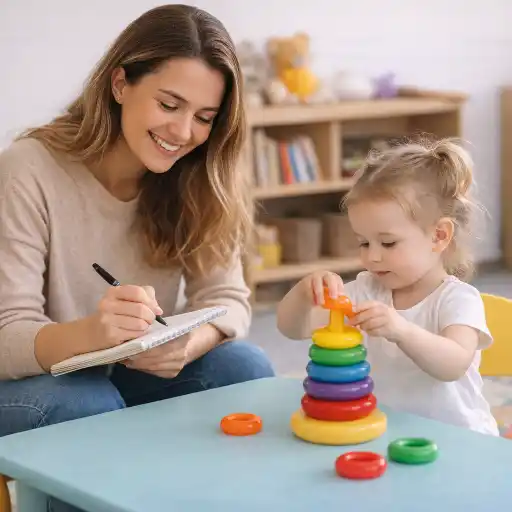
How can routine documentation capture multiple domains of development?
Children rarely learn in isolated domains. One ordinary event may reveal language, cognition, physical coordination, social-emotional development, and approaches to learning simultaneously. Providers should therefore look for connections rather than forcing each observation into only one category.
During handwashing, for example, a toddler may remember a sequence, respond to positional language, imitate an adult, coordinate movements, and communicate a preference. During cleanup, a preschooler may classify objects, count materials, negotiate roles, follow a multi-step direction, and persist when the room becomes busy.
- Language: Record words, gestures, questions, explanations, and conversational turns.
- Cognition and mathematics: Note counting, comparing, sorting, sequencing, predicting, and problem-solving.
- Physical development: Observe balance, grasp, coordination, tool use, and stamina.
- Social-emotional development: Capture cooperation, emotional expression, self-regulation, and help-seeking.
- Approaches to learning: Document curiosity, persistence, flexibility, initiative, and attention.
For infants and toddlers, small changes are significant: reaching toward a spoon, anticipating a familiar song, turning toward a caregiver’s voice, or using a gesture to request more. For children learning multiple languages, documentation should include home-language communication and family interpretation whenever possible. NAEYC recommends assessment methods that respect children’s languages, experiences, and varied ways of demonstrating competence.
Do not assume that a skill absent in one routine is absent generally. Repeat observations across meals, play, outdoor time, transitions, and caregiving moments before drawing conclusions.
How can directors create a manageable documentation system?
A sustainable system protects teacher-child interaction time. Directors can establish a shared cycle: focus, observe, capture, reflect, plan, and revisit. Teachers might focus on two or three children each day, rotate routines across the week, and complete longer reflections during scheduled planning time.
Use a small set of complementary methods:
- Anecdotal notes for brief, significant moments.
- Checklists for tracking recurring skills or routines.
- Work samples and photographs, with documented permission, to show process and growth.
- Learning stories for richer narratives that connect observation, reflection, and family voice.
- Team reviews to identify patterns and calibrate interpretation.
Digital systems can help, but technology is not automatically better. Protect records with passwords, limit access, follow program policy, and obtain consent for photographs, video, or public displays. Never allow documentation requirements to reduce supervision or responsiveness.
Directors should also clarify where records are stored, who may contribute, how corrections are made, and how long records are retained. Staff need examples of objective language and protected time to practice. A short weekly review can ask: What did we learn? What will we change? Which children or routines need more observation?
Professional learning can deepen this process. The Tracking Progress, Shaping Futures: Observation & Assessment Skills Buy Now $55.00 course explores objective observation, multiple measures, bias reduction, and goal setting. For privacy and ethical recordkeeping, consider Privacy Matters: Documentation and Observation in Early Learning Buy Now $55.00. These courses complement—not replace—the daily forms and reflective conversations that make documentation useful.
How should routine evidence guide planning and family partnerships?
Documentation becomes assessment when educators interpret evidence and act on it. Use a simple cycle: observe, document, interpret, plan, and reobserve. Ask what the child is learning, which conditions supported participation, what barrier may have affected performance, and what small adjustment could extend learning.
Suppose a teacher observes that Mateo independently gathers cups during snack, counts them inaccurately, and asks peers to help distribute them. The next plan might include numeral cards, a smaller group, and language such as “How many cups do we need?” The teacher can then reobserve whether Mateo coordinates counting and distribution with less support.
Share evidence with families as an invitation, not a verdict. Begin with a strength, provide a concrete example, and ask what the family notices at home. For example: “During cleanup, Laila sorted animals by size and explained, ‘The babies go here.’ Have you noticed her comparing objects at home?” Family perspectives may reveal skills in another language, cultural routine, or familiar setting that are not yet visible in the classroom.
When concerns persist, use multiple observations and sources before making significant decisions. Screening identifies possible concerns; it does not diagnose or label children. Follow referral procedures and involve families respectfully.
Common mistakes include:
- Writing impressions instead of observable facts.
- Collecting isolated notes without a purpose.
- Observing only children who attract attention or present challenges.
- Confusing a missed performance with a missing skill.
- Sharing images or records without verifying consent.
The remedy is a focused question, varied contexts, strengths-based language, and a clear next step. Documentation should serve children—not merely satisfy a binder.
Conclusion: How can ordinary routines become meaningful documentation?
Providers can document learning during ordinary routines by observing with a focused question, recording concrete actions and words, noting adult support, connecting evidence to developmental domains, and planning a small next step. Meals, handwashing, arrival, dressing, cleanup, and transitions are not interruptions to learning; they are rich contexts in which children demonstrate competence, relationships, language, independence, and problem-solving.
Start small: choose one routine, use one form, document a few children, and review the notes with colleagues. The Learning Is Everywhere Documentation Forms resource can make this process practical and consistent, while targeted professional learning can strengthen observation, assessment, privacy, and planning skills. State requirements vary - check your state licensing agency, and keep the central purpose in view: accurate documentation helps adults notice children more deeply and respond more intentionally.
Frequently asked questions
How often should routine observations be written?
Brief notes may be captured daily, while more detailed observations can be scheduled weekly or monthly. Follow program policy and ensure all children are observed across varied contexts.
How long should a note be?
Usually one to several factual sentences are enough. Add interpretation and next steps during planning time when possible.
Can one observation address several domains?
Yes. Children’s learning is integrated. A single event may provide evidence of language, mathematics, physical coordination, social development, and persistence.
Should photographs be part of documentation?
They can be useful when they show process and are paired with context and objective notes. Obtain appropriate permission and protect confidentiality.
What if a family disagrees with an observation?
Listen respectfully, share the specific context and words or actions recorded, invite the family’s perspective, and collaborate on additional observation rather than treating one note as definitive.
- Stay Alert! Steps for Emergency Prep
- Lesson Planning for Preschoolers
- CDA Preschool Credential with Portfolio Review
- CDA Family Child Care Credential with Portfolio Review
- Pediatric RSV First Aid & CPR/AED
- CDA Infant/Toddler Credential with Portfolio Review
- CDA Bridge Bundle: Family Child Care
- CDA Home Visitor Credential Birth to 5
- Texas Director Credential
- Proporciones de Cuidado Infantil y Tamaños de Grupo por Edad en Maryland (Guía Rápida para Centros y Hogares)
- Proporciones de Cuidado Infantil y Tamaños de Grupo por Edad en Virginia (Guía Rápida para Centros y Hogares)
- Capacitación Previa al Servicio para Proveedores de Cuidado Infantil en Georgia
- Capacitación CDA gratuita en Illinois
- How Can Child Care Providers Recognize "Learning in Disguise" During Everyday Activities?
- What Makes a Great Home Daycare? 10 Things Parents Notice First
- What Does Compassion Look Like in Child Care? 10 Everyday Moments That Matter
- How Can Child Care Providers Support Healthy Brain Development in Young Children?
- How Can Child Care Programs Build Meaningful School Readiness?
- How Can Child Care Providers Understand and Support Infant Milestones?
- How Can Child Care Providers Support Infant Development?
- How Can Child Care Providers Turn Everyday Routines into Learning Opportunities?
- Why Do Home-Language Resources Matter for Preschool Families?
- What Is Co-Regulation and How Can Child Care Teachers Use It?
- How Can Child Care Providers Document Learning During Ordinary Routines?
- What Speech and Language Milestones Should Child Care Providers Know?
- When Should a Child Care Provider Be Concerned About Development?
- How Can Child Care Providers Support Kindergarten Emotions on the First Day of School?
- How Can Child Care Providers Respond When a Child Publicly Names a Favorite Teacher?
- How Can Infant Care Staff Prepare to Support a Baby with an Ongoing Health Condition?
