When children hear their home languages welcomed in care, they gain a stronger sense of belonging while building foundations for communication, literacy, and identity. Explore practical ways to make language visible in daily practice, and consider Building Bridges for Dual Language Learners  Buy Now $16.00 to deepen staff knowledge and gain immediately usable strategies for classroom practice and family partnership.
Why Does Respecting Home Language Matter?
A child’s home language is more than a communication system; it is connected to family relationships, cultural identity, memory, and knowledge. Infants and young children use familiar language and culturally shaped communication patterns to establish meaningful relationships and understand their world. When programs treat that language as an asset, children receive a clear message: “You and your family belong here.”
Research summarized by Head Start home-language guidance indicates that children are more successful when they continue developing strong language and literacy skills in their home language while acquiring English. Concepts, vocabulary, narrative abilities, and print knowledge can transfer across languages. Supporting the first language therefore complements—not competes with—English development.
This commitment also advances #equity and inclusion. A program that expects every child to communicate only through English may unintentionally silence family expertise or misinterpret normal bilingual development. State requirements vary - check your state licensing agency, but high-quality practice begins with respect, curiosity, and collaboration.
How Can Programs Learn About Each Child’s Language Experience?
Effective support starts with accurate, family-centered information. Avoid assuming that a child’s language experience can be inferred from nationality, name, or appearance. Families are the experts on which languages children hear, understand, and use, as well as when children prefer each language.
During enrollment and ongoing conversations, ask open-ended questions such as:
- Which languages does your child hear and use at home?
- What words does your child use for comfort, food, toileting, and family members?
- Which stories, songs, gestures, or routines are familiar?
- How would you like us to communicate with your family?
- What helps your child feel secure in a new setting?
Document the answers respectfully and revisit them as children grow. Language is not static: families may use multiple languages, dialects, sign languages, or different communication styles. Ask families how names are pronounced and practice until you can say them correctly.
Directors can strengthen consistency by creating a brief language profile for each child, including preferred family communication methods and key phrases. Protect this information as confidential and share it only with staff who need it to support the child.
What Classroom Practices Make Home Languages Visible?
Providers do not need to be fluent in every language to create a linguistically responsive environment. Small, consistent choices can make language functional rather than decorative.
- Post picture labels with English and home-language words when families provide accurate translations.
- Use multilingual books, recorded stories, music, and rhymes during everyday routines.
- Learn greetings, comfort phrases, and words connected to basic needs.
- Invite families to contribute photographs, songs, recipes, or pretend-play materials.
- Pair children with supportive peers who share a language when appropriate and comfortable.
- Use visual schedules, gestures, objects, and demonstrations so children can participate before they speak English.
Responsive interaction is especially powerful. Observe what interests the child, pause, follow the child’s lead, and expand communication through words, gestures, or actions. The Hanen Centre’s guidance emphasizes simplifying language, stressing important words, slowing the pace naturally, and showing meaning with objects or gestures. These practices support all children, not only DLLs.
😊 A greeting song in several languages can become a joyful daily ritual while teaching the whole group that different languages are a normal and valued part of community life.
How Can Teachers Support Language and Literacy Without Replacing the Home Language?
Language-rich learning should occur in both the home language and English whenever possible. Read-alouds, storytelling, dramatic play, songs, conversation, and print exploration offer meaningful contexts for vocabulary and comprehension. Head Start language and literacy guidance notes that these skills can develop in any language and that home-language development prepares children for English learning. For another example of language-affirming practice, explore how Montessori nurtures young bilingual learners.
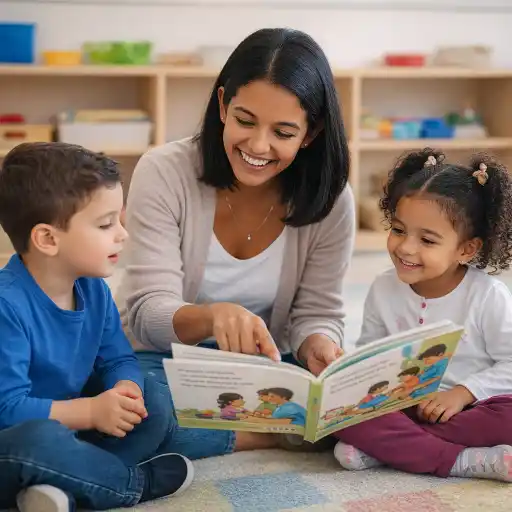
During shared reading, invite children to predict, point, retell, act, or connect the story to their experiences. Families can read or tell the same story in the home language, while teachers use pictures and gestures to build English vocabulary. Dialogic reading—asking questions, listening carefully, and expanding children’s responses—can strengthen oral language in either language.
Do not require children to translate or perform their home language for peers. Instead, offer authentic choices: a child may teach a word, listen to a family recording, use a bilingual book, or communicate through drawing and movement. Code-switching, mixing languages, and periods of limited speech can be normal features of bilingual development. A quiet child may be processing language, observing social expectations, or communicating nonverbally.
Plan activities around concepts rather than isolated English words. For example, a cooking experience can involve counting, describing textures, sequencing steps, and discussing family traditions. The concept of “more,” “hot,” or “first” can be developed through any language and then connected to English naturally.
How Should Programs Partner With Families and Assess Development Fairly?
Respectful family partnership means treating caregivers as collaborators, not simply recipients of translated information. Communicate strengths frequently, offer multiple contact methods, and use qualified interpreters for complex conversations when needed. Never rely on children to interpret sensitive information.
Invite families to participate in curriculum planning, share words and songs, recommend books, and describe how communication appears at home. A short message such as “Maya persisted with the puzzle today” followed by “What puzzles does she enjoy at home?” creates a two-way exchange.
Assessment must account for the child’s complete language repertoire. Combine observations, work samples, family reports, language samples, and information from qualified specialists. Whenever possible, gather evidence in both languages or with trained bilingual support. The Illinois Early Intervention Clearinghouse highlights the importance of evaluating young DLLs through multiple sources and familiar contexts.
Common mistakes include:
- Assuming limited English means limited understanding.
- Advising families to stop speaking their strongest language.
- Using a single English-only measure to make placement or referral decisions.
- Reducing culture to occasional celebrations or stereotypes.
- Translating words literally without checking cultural meaning and family preference.
Document what children can do, the language used, the context, and the supports provided. If concerns persist across languages and settings, collaborate with families and appropriate specialists rather than attributing every difficulty to bilingualism.
What Can Directors Do to Build Language-Respectful Program Systems?
Individual teachers can make meaningful changes, but directors create the conditions that make those changes sustainable. Begin with a program self-assessment: Which languages are represented? Do enrollment materials and emergency information meet families’ communication needs? Are books and dramatic-play materials inclusive? Do staff receive time and support to learn responsive strategies?
Develop a simple language-access plan that includes:
- Family language preferences and interpretation procedures.
- A process for collecting accurate translations and pronunciations.
- Expectations for bilingual books, visuals, and family contributions.
- Assessment procedures that avoid English-only conclusions.
- Staff reflection on bias, assumptions, and communication practices.
Professional learning can help teams move from good intentions to consistent practice. Bridging Cultures: Family Communication & Collaboration Buy Now $55.00 focuses on culturally and linguistically responsive communication, listening, second-language development, and meaningful family representation. Additional options include Culture, Communication, and Collaboration in Assessment Buy Now $55.00, Planning for Every Child Buy Now $55.00, and Strength in Differences: Cultural Diversity Buy Now $24.00.
Use staff meetings to review one classroom example, identify a barrier, and choose one manageable action. Progress might look like more accurate name pronunciation, stronger family response rates, increased use of multilingual books, or improved documentation across languages.
Conclusion: How Can Early Childhood Programs Respect Home Languages Every Day?
Respecting home languages means preserving children’s connections to family while expanding their opportunities to communicate and learn. The most effective approach is neither English-only nor symbolic multiculturalism; it is intentional, relationship-based practice that values every language as a resource.
- Ask families about language, routines, strengths, and preferences.
- Make home languages visible through books, labels, music, gestures, and play.
- Use responsive interactions and predictable routines to reduce communication barriers.
- Assess development across languages and contexts rather than relying on English-only evidence.
- Build staff systems that support interpretation, professional learning, and family voice.
When providers honor the languages children bring, they strengthen belonging, family trust, early literacy, and equitable participation. Each greeting, story, label, and listening moment becomes a practical affirmation that children do not have to leave part of themselves at the classroom door.
Additional Courses for Child Care Providers
- Building Bridges for Dual Language Learners Buy Now $16.00
- Bridging Cultures: Family Communication & Collaboration Buy Now $55.00
- Culture, Communication, and Collaboration in Assessment Buy Now $55.00
- Planning for Every Child: Responsive Strategies in Action Buy Now $55.00
- Strength in Differences: Cultural Diversity Buy Now $24.00
- CDA Home Visitor Subject Area 3 Part 3 Birth to 5
- Language and Literacy Foundations in Pre-K
- Recognize, Respond, Respect: Supporting Diverse Learners
- Creating Environments that Nurture Growth and Community
- Language Development in Early Childhood
- CDA Home Visitor Credential Birth to 5
- Montessori Cultural Activities: Exploring the World Through Play and Learning
- Building Bridges for Dual Language Learners
- Supporting Families and Caregivers in Language and Literacy
- Language Development in School Age
- CDA Certification en Español: Recursos y Consejos para Educadores Bilingües
- 10 Ejemplos de Cómo la Cultura Influye en el Desarrollo Infantil
- Retraso del Habla en la Guardería: Cómo Pueden Ayudar los Proveedores
- Cómo Trabajar en el Cuidado Infantil en Carolina del Norte: Requisitos y Pasos
- How can child care programs best support Dual Language Learners?
- How can we celebrate diversity and inclusion in California early childhood classrooms?
- How can child care programs support diversity and inclusion?
- How can Minnesota child care programs welcome Somali, Hmong, and Spanish-speaking families?
- How can child care programs support immigrant and multilingual families?
- How can child care programs best support Dual Language Learners?
- More Than ABCs and 123s: The Real Importance of Early Childhood Education
- Why Do Bilingual Classroom Activities Matter for Dual Language Learners?
- From Mealtime to Manners: How Cultural Influences Show Up in Everyday Child Care
- How Can Child Care Programs Build Meaningful School Readiness?
- How Can Child Care Providers Create Effective Family Education Workshops?
- How Can We Celebrate Every Family and Create a Classroom Where Everyone Is Represented?
- What Are the Best Ways to Support a Child’s Speech Development?
- How Can Early Childhood Programs Respect and Strengthen Children’s Home Languages?
- How Can Child Care Providers Navigate Developmental Delay Conversations with Caregivers?
- How Can Providers Support Families Who Rely on Head Start?
