Every child deserves more than a place in the room—they deserve meaningful participation, relationships, and a genuine sense of belonging. Build practical skills with Access for All: Inclusion and the ADA Buy Now $25.00 and Special Needs: From Referral to Inclusion  Buy Now $24.00, two focused trainings that can strengthen your understanding of accommodations, referral, and inclusive classroom practice. Read on for concrete steps your team can begin using in daily routines.
What does meaningful inclusion look like in early childhood?
Inclusion is not simply enrolling a child with a disability or placing them beside peers. It means arranging the program so each child can access activities, participate with others, learn, and experience belonging. The joint federal policy statement on inclusion describes inclusive early childhood programs as high-quality settings where children receive individualized supports and participate alongside peers.
This distinction matters in ordinary moments: choosing a book, joining a song, exploring the playground, asking for help, or deciding what to play. A child may participate by speaking, signing, pointing, using a communication device, moving independently, or receiving assistance. The goal is not to make every child do an activity in exactly the same way; it is to make the activity meaningfully accessible.
Inclusion is also a shared responsibility. Educators, directors, families, specialists, and public systems each contribute knowledge and support. An inclusive program holds high expectations while recognizing that children may need different pathways, tools, or amounts of time to participate. When #belonging is treated as a daily practice—not a special event—children and families receive the message that their presence is valued.
Why should programs prioritize inclusion?
Early learning settings are often a child’s first experience of community beyond home. The relationships and routines children encounter can shape their sense of identity, connection, and understanding of difference. The OECD’s review of inclusion in early childhood education and care emphasizes that organizational and teaching practices influence children’s day-to-day experiences and can help reduce inequities.
For children with disabilities, participation alongside peers can create authentic opportunities to communicate, explore interests, practice emerging skills, and build relationships. For peers, inclusive experiences can nurture cooperation, curiosity, and respect for individual differences. Families benefit when they are treated as partners and can see their child’s strengths recognized in the program.
Inclusion also helps teams examine whether classroom barriers—not a child’s abilities—are limiting participation. A crowded pathway, unclear transition, inaccessible toy, or one-size-fits-all group activity may be changeable. This strengths-based perspective encourages educators to ask, “What can we adjust?” rather than “Why can’t this child do it?” Small, consistent adaptations can improve the experience for the entire group and help staff make more responsive decisions.
How can educators make spaces, materials, and activities accessible?
Begin by observing the child’s participation across the whole day. Notice where the child engages easily, where support is needed, and what environmental features may help or hinder. The ECTA Center’s indicators for high-quality inclusion highlight accessible environments, child-centered approaches, family partnerships, peer interaction, and responsive instruction.
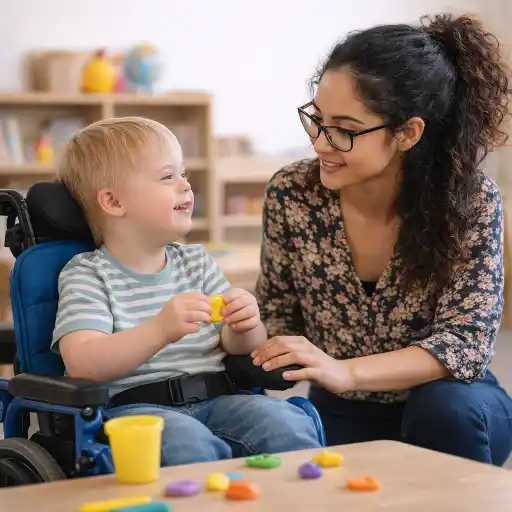
- Keep pathways clear and arrange furniture so children using mobility devices can move safely among activity areas.
- Place frequently used materials within reach and adapt tools when needed—for example, with larger grips, stable trays, or easy-to-manipulate pieces.
- Use visual schedules, photos, gestures, objects, and clear verbal cues to make routines and directions easier to understand.
- Offer multiple ways to join an activity: listening, touching, moving, watching, speaking, signing, or using augmentative and alternative communication.
- Provide choices for seating, sensory breaks, or participation when these support the child’s access and well-being.
- 🌟 Try one manageable change at a time, then observe whether it increases engagement, independence, or peer interaction.
Universal Design for Learning offers a useful planning lens: provide multiple ways for children to engage, access information, and show what they know. Adaptations should preserve the purpose of the activity while reducing barriers. For example, a child can take part in a sorting game by pointing to a choice, placing an object, or directing a peer. A well-planned #classroom makes these options ordinary rather than singling out one child.
How can programs collaborate with families and specialists?
Families know a child’s communication, interests, routines, strengths, and successful supports across settings. Start with open-ended questions such as, “What helps your child feel comfortable during transitions?” or “How does your child let you know what they want?” Listen without judgment, share observations in plain language, and agree on practical strategies together. Head Start’s guidance on engaging families of children with disabilities underscores the value of culturally and linguistically responsive communication and family partnership throughout screening, evaluation, planning, and transitions.
With family permission and appropriate privacy safeguards, coordinate with early interventionists, special educators, therapists, and other professionals involved in the child’s support. Ask specialists to demonstrate how a strategy can fit into real routines such as meals, play, arrival, and cleanup. A written one-page guide can help staff across shifts understand the child’s preferred communication, helpful materials, important routines, and agreed-upon supports.
Providers are not responsible for diagnosing children. They can, however, observe development, document specific examples, discuss concerns respectfully with families, and help families connect with evaluation or early intervention resources. The CDC explains that families or care providers can contact their state or territory’s early intervention program for children under age three, or the local public school system for preschool special education evaluation when a child is age three or older. These conversations should be supportive, confidential, and centered on the family’s choices.
How should providers address rights, accommodations, and common pitfalls?
Programs should understand their obligations under applicable disability laws and seek reliable guidance when questions arise. The U.S. Department of Justice’s ADA guidance for child care centers explains that covered providers must make individualized assessments, consider reasonable modifications, support effective communication, and address accessibility. Decisions should not be based on stereotypes or assumptions about a diagnosis. When safety concerns arise, assess the specific facts and consider whether appropriate modifications or supports can address them. This overview is not a substitute for legal advice.
Common pitfalls are often unintentional, but they can limit access:
- Using a blanket rule: Avoid automatic exclusions based on diagnosis or anticipated support needs. Consider the child’s individual circumstances.
- Waiting for a formal diagnosis: Use responsive classroom strategies while a family considers evaluation or services; do not diagnose.
- Focusing only on deficits: Identify strengths, interests, and successful conditions as the foundation for planning.
- Making supports inconsistent: Decide who will provide a strategy and when, and make sure relevant staff know the plan.
- Leaving families out: Invite family expertise and use their preferred language and communication methods whenever possible.
Keep objective notes about context, support provided, and the child’s response rather than using labels. Review what is working with families and colleagues, and adjust thoughtfully. State requirements vary - check your state licensing agency. Ongoing professional learning can also help teams translate inclusive principles into reliable everyday practice; consider Including All Children and the Americans with Disabilities Act Buy Now $35.00, Effective Approaches for Autism and Inclusion Buy Now $55.00, and Exceptional Children and Early Intervention Buy Now $25.00.
Conclusion: What are the most important first steps?
How can early childhood programs better include children with disabilities? By designing for access, adapting everyday routines, building on each child’s strengths, and treating families as essential partners. Inclusion is a continuing process of noticing barriers, trying thoughtful supports, and learning from children and families—not a single checklist or placement decision.
Start with one routine this week. Observe who can participate and who encounters a barrier; choose one practical adjustment; explain the plan to the team; and check in with the family about what they notice. Keep communication respectful, document observations objectively, and seek support from specialists when appropriate. These steady actions help create environments where children can learn, play, communicate, and grow together. Above all, hold firmly to the belief that every child has a place in the community and deserves the support to participate.
- A Better Space For All
- From Play to Planning: Building Culturally Competent, Child-Centered Curriculum
- Beyond the Classroom: Connecting Families to Essential Services
- What Makes Me Special: An Overview of Autism and ADHD
- Pediatric RSV First Aid & CPR/AED
- CDA Bridge Bundle: Family Child Care without Portfolio Review
- CDA Bridge Bundle: Infant/Toddler without Portfolio Review
- CDA Bridge Bundle: Preschool without Portfolio Review
- Access for All: Inclusion and the ADA
- CDA Certification en Español: Recursos y Consejos para Educadores Bilingües
- Can Continuing Education in North Dakota Directly Impact Child Outcomes?
- ADA Training for Child Care Providers in Maryland
- The Top Rewards of Working in Early Childhood Education
- How can music and movement strengthen early childhood programs in North Dakota?
- ADA Training Online in Illinois: Requirements, Access, and Inclusion
- What Should a School-Age Curriculum Include? A Guide for After-School Programs
- How Do You Choose 10 Books for Your CDA Bibliography? Examples by Topic
- When Should Maryland Child Care Staff Take the Including All Children and the ADA Course?
- Including Every Child: What Child Care Providers Should Know About the ADA
- ADA Training Maryland: Does Your Certificate Expire or Do You Need to Take the Course Again?
- I Already Took the ADA Course—Do I Need It Again? Maryland Child Care Training Questions Answered
- Special Needs Training for Early Childhood Educators: Which Course Should You Take?
- Can You Open a Daycare Just for Children With Special Needs? Licensing, Training, and Staffing Explained
- How Can Child Care Programs Build Meaningful School Readiness?
- How Can We Celebrate Every Family and Create a Classroom Where Everyone Is Represented?
- How Can Child Care Programs Build Effective Emergency Preparedness?
- How Can Early Childhood Programs Better Include Children With Disabilities?
