When an emergency interrupts the ordinary rhythm of your program, a clear plan can help adults respond with confidence and keep children connected to familiar routines. Begin strengthening your program with Emergency and Disaster Preparedness  Buy Now
 $55.00$45.00, a self-paced course that helps child care professionals understand emergency protocols, evacuation procedures, and calm crisis response while supporting ongoing professional learning.
Preparedness is not about predicting every event or eliminating uncertainty. It is about creating practical systems that staff can remember, children can experience without unnecessary fear, and families can trust. Federal guidance from the Emergency Preparedness Manual for Early Childhood Programs emphasizes planning before, during, and after emergencies, including mental health and recovery.
Why does emergency preparedness matter in early childhood settings?
Young children depend on adults for protection, communication, transportation, medication, emotional regulation, and reunification. Unlike many adults, infants and toddlers may have limited mobility and communication skills. Children with disabilities, chronic medical conditions, or specialized equipment may face additional barriers during evacuation, shelter-in-place, or power outages.
Preparedness also protects the adults who provide care. When roles, supplies, communication methods, and decision-making processes are established in advance, staff do not have to invent procedures during a stressful event. The CDC identifies early care and education providers as important community infrastructure because they help protect children during emergencies and support recovery afterward.
A strong plan is therefore both a safety document and a relationship document. It communicates to families that the program has considered their children’s individual needs and has a process for maintaining care, information, and connection when normal operations are disrupted.
How should a program identify and prioritize its emergency risks?
Begin with a location-specific risk assessment rather than copying a generic plan. Consider environmental, facility-based, health-related, and human-caused hazards that are plausible in your community. Review local alerts, historical events, building characteristics, transportation routes, and guidance from emergency management officials.
- Natural hazards: hurricanes, floods, tornadoes, wildfire, extreme heat, earthquakes, or severe winter weather.
- Facility hazards: fire, gas leak, hazardous materials, structural damage, utility loss, or water interruption.
- Health emergencies: infectious disease outbreaks, allergic reactions, serious injuries, or medication-related events.
- Security emergencies: unauthorized entry, violence, or a need to shelter in place.
Next, rank each risk by likelihood and potential impact. Ask: Which children or adults may need additional support? What equipment, transportation, medication, or communication would be required? Which community partners should be contacted before an incident occurs?
Use an all-hazards framework, but add scenario-specific actions. Evacuation is appropriate when remaining inside is more dangerous; shelter-in-place may be safer during severe weather or an external environmental threat. State requirements vary - check your state licensing agency before finalizing risk categories, drill schedules, or required plan components.
What should a written emergency plan include?
A useful plan is detailed enough to guide action but organized enough to use under pressure. Child Care Aware® of America identifies written plans as a central tool for anticipating procedures before an emergency occurs. Plans commonly include evacuation, relocation, shelter-in-place, lockdown, communication, reunification, continuity of operations, and collaboration with public officials.
Include the following information in a paper binder and a secure digital backup:
- Emergency contacts for families, staff, responders, licensing officials, health consultants, and community partners.
- Primary and alternate evacuation routes, assembly areas, relocation sites, and reunification locations.
- Staff roles, alternates, attendance procedures, room-check responsibilities, and medication assignments.
- Procedures for infants, toddlers, children with disabilities, chronic medical needs, allergies, or specialized equipment.
- Communication templates, approved spokespersons, language-access strategies, and backup communication methods.
- Continuity procedures for records, payroll, staffing, enrollment, essential services, and temporary relocation.
Write steps in plain language and use consistent terms. A short action sheet posted in each classroom can supplement the full plan. Review the plan at least annually and after drills, staff changes, facility changes, or an actual incident.
How can programs prepare supplies and individual supports?
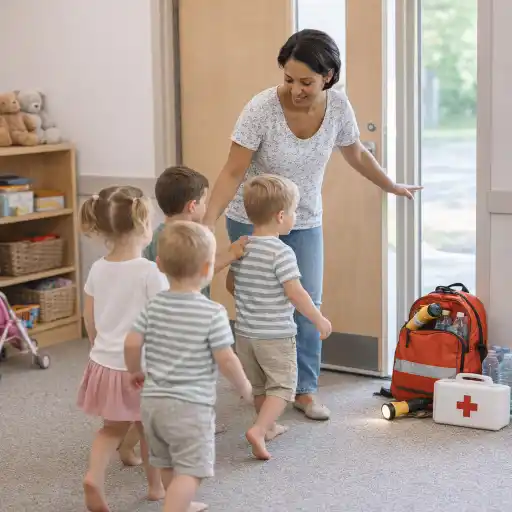
Emergency supplies should be accessible, labeled, inventoried, and matched to the children in care. A classroom go-bag can travel with the group, while a larger center kit supports prolonged sheltering or relocation. Keep essential records protected from water and unauthorized access, and maintain paper copies in case technology fails.
- Information: current attendance, emergency contacts, authorized pickup information, allergies, medications, medical action plans, and copies of the emergency plan.
- Basic needs: water, nonperishable food, diapers, wipes, formula or breastfeeding supports, blankets, clothing, and sanitation materials.
- Safety tools: first aid supplies, gloves, flashlights, batteries, whistles, a battery or hand-crank radio, chargers, maps, and pens.
- Comfort materials: books, crayons, familiar objects, and quiet activities that support emotional regulation.
- Accessibility supports: mobility aids, communication tools, sensory supports, spare batteries, and child-specific equipment as appropriate.
Infants and toddlers require particular planning because of feeding, diapering, limited mobility, identification, and routine needs. Children with special health care needs may require medication, electricity-dependent equipment, accessible transportation, or a specialized shelter. Coordinate with families and, when appropriate, health care providers and emergency services. Inspect kits on a regular schedule and replace expired or damaged items.
🧸 Comfort items are not extras; they can help children reconnect with familiar routines when the environment feels unfamiliar.
How should staff practice drills while protecting children’s emotional well-being?
Practice transforms a written plan into shared muscle memory, but drills should be developmentally appropriate and trauma-informed. Child Care Aware® recommends regular evacuation and shelter-in-place practice, involving children who are present and documenting each drill. Follow the frequency and type required by your state and licensing authority.
Before practicing, explain the purpose in simple language: “We are practicing how to stay safe.” Avoid dramatic simulations, frightening props, surprise scenarios, or language that suggests danger is occurring. Infants and toddlers may need brief, quiet practice with close adult support. Preschoolers can follow songs, visual cues, or simple routines. Older children may help review routes, count attendance, or discuss how adults keep the group safe.
Assign and rehearse specific staff responsibilities:
- Who carries the roster and emergency binder?
- Who checks bathrooms, sleeping areas, and less visible spaces?
- Who gathers medications and specialized equipment?
- Who leads communication with responders and families?
- Who supervises children at the assembly or reunification site?
After each drill, conduct a short debrief. Record the date, scenario, participants, time, successes, barriers, and corrective actions. A calm debrief with children can reinforce safety without revisiting frightening details.
How can programs communicate and reunify families effectively?
Communication should be clear, redundant, accessible, and coordinated. Families need to know what happened, whether children are safe, where the program is located, and what action is expected of them. Designate one communication lead so staff can focus on supervision and care.
Use multiple channels, such as text alerts, phone calls, email, an emergency webpage, or a phone tree. Maintain printed contacts because cell service, internet access, or electricity may be unavailable. Messages should be brief and factual: state the program’s status, location, next update time, and any identification requirements.
Reunification procedures should include:
- A primary and alternate reunification site.
- Identity verification using approved identification and authorization records.
- A sign-out process documenting the adult, child, time, and staff member.
- Separate roles for greeting, verification, child escort, traffic flow, records, and family communication.
- Procedures for custody restrictions, missing authorized adults, and children who remain uncollected.
Practice the process without creating anxiety. The American Academy of Pediatrics emphasizes the importance of family separation and reunification planning during disasters. Share general procedures with families during enrollment and update contact information regularly. State requirements vary - check your state licensing agency for specific reunification and documentation expectations.
What common mistakes weaken emergency preparedness?
Even well-intentioned programs can overlook practical details. Identifying common weaknesses helps directors improve systems without blaming staff.
- Outdated contact information: Ask families to confirm information routinely and whenever circumstances change.
- Plans that are too long or inaccessible: Keep a complete plan, but post concise action sheets where staff can see them.
- Unclear backup assignments: Every essential role needs an alternate for absences, breaks, and staffing changes.
- Technology dependence: Store paper rosters, maps, contacts, and procedures in go-bags and emergency binders.
- Ignoring recovery: Include emotional support, temporary operations, records, finances, staffing, and communication after the immediate danger ends.
- Scary drills: Use calm, predictable, age-appropriate practice rather than realistic simulations that may cause distress.
Directors can build an improvement cycle: plan, practice, document, revise, and communicate. Invite local fire, emergency management, public health, and child care resource organizations to review appropriate portions of the plan. Training such as Stay Alert! Steps for Emergency Prep Buy Now $25.00 can further support staff understanding of evacuation, shelter-in-place, lockdown, supplies, communication, documentation, and children with special needs.
Conclusion: What is the practical path to stronger preparedness?
Effective emergency preparedness answers the central question—how can child care programs protect children and sustain care during disruption?—with a coordinated cycle of assessment, planning, preparation, practice, communication, and recovery.
- Assess local hazards and the needs of every child and adult.
- Write a clear plan with roles, routes, supplies, communication, reunification, and continuity procedures.
- Prepare classroom go-bags, center kits, protected records, medications, and comfort materials.
- Practice regularly using calm, developmentally appropriate, trauma-informed methods.
- Document lessons learned, update the plan, and verify state and local requirements.
Preparedness is a continuing professional responsibility, not a one-time binder project. When directors make readiness visible and manageable, staff gain confidence and children experience safety through consistent relationships and routines.
- Adult/Child/Infant CPR AED and Adult First Aid Blended
- Basic Health & Safety and Breastfeeding Awareness
- Adult Only CPR AED and Adult First Aid Blended
- Bienvenido! Welcoming All Families
- Pediatric RSV First Aid & CPR/AED
- Adult First Aid Only - Blended
- 45 Hour School Age Methods and Materials
- Texas Director Credential
- D.C. Emergency Preparedness Training
- Learn CPR and Be the Hero in a Crisis!!
- First Aid & CPR ~ Empowerment Through Lifesaving Skills
- CDA Certification en Español: Recursos y Consejos para Educadores Bilingües
- 🌪️Fire Drills, Flashlights & Fast Thinking: Why Emergency Preparedness Is a Must
- Capacitación en Salud y Seguridad Preventiva en Línea para Proveedores de Cuidado Infantil
- Normas de Licenciamiento de Cuidado Infantil en Virginia para Centros Diurnos Infantiles y Hogares Diurnos Familiares
- How do ChildCareEd's urban childcare courses help Michigan providers in high-density communities?
- How do we handle a child care emergency in New York: policies, drills, and preparedness?
- How do I write an emergency preparedness plan that meets Michigan licensing rules?
- How do I build an effective emergency preparedness plan for my Kansas child care program?
- What Emergency Preparedness Does Every Child Care Program Need?
- How Do You Create an Effective Emergency Staffing Plan for Your Child Care Program?
- How can I develop effective emergency leadership procedures for my childcare program?
- Emergency and Disaster Preparedness Training Online: What Will You Learn?
- Emergency Form for Child Care: Could a Substitute Find What They Need in 30 Seconds?
- Evacuate, Shelter, or Lock Down? How to Respond to Different Child Care Emergencies
- How Can Child Care Programs Build Effective Emergency Preparedness?
- Field Trip Emergencies: What Changes When You Are Away from the Center?
