Every day you care for little children. Being ready to use #CPR and an #AED can save a life. This short 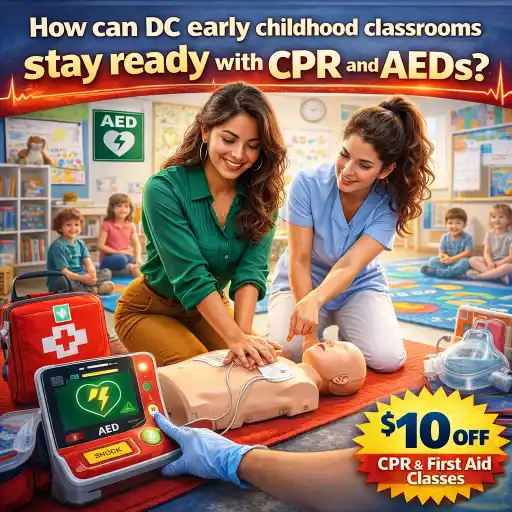 guide helps directors and providers in Washington, DC, understand what training, tools, and paperwork you need to keep your classroom safe. State requirements vary - check your state licensing agency.
Why it matters:
1. Quick help saves lives. If a child or adult has a sudden cardiac emergency, immediate CPR and an AED raise the chance of survival.
2. Families trust programs that plan and practice. A clear plan and trained #staff calm children and families. ChildCareEd offers DC-approved training and classes you can use; see the DC training overview at ChildCareEd DC trainings.
Read on for four practical questions and easy steps you can use this week.
What CPR and AED training should DC early childhood staff have?
Short answer: Every caregiver who may care for children should have pediatric CPR and first aid training, plus AED training or access to a trained person. In DC, many programs use ChildCareEd courses that meet local preservice and annual needs. See DC training options at ChildCareEd DC trainings and specific course options like Pediatric In-Person First Aid & CPR at ChildCareEd First Aid & CPR Buy Now $95.00.
- 🔹 Enroll staff in a recognized course (AHA, Red Cross, or ChildCareEd). The Red Cross and MedlinePlus explain what these courses teach: Red Cross CPR/AED, MedlinePlus CPR.
- 🩺 Complete pediatric content for infants and young children. Courses from ChildCareEd cover infants, children, and adults and usually give a 2-year certificate — example: blended and in-person classes: ChildCareEd blended class and upcoming blended class.
- ✅ Keep certificates in staff files and on a training tracker. Update before expiration (often every 2 years).
- 🔎 Plan for at least one person on every shift to be current in CPR/AED and first aid.
Why this helps: trained staff act fast and feel confident. If you need a short place to start, ChildCareEd lists DC-approved preservice bundles and CPR courses at DC preservice guide.
Where should we place AEDs and how do we keep them ready?
Short answer: Put AEDs where adults can get them quickly, keep them tested, and register them with emergency services if your state asks. The CDC explains best practices for public access defibrillation programs: CDC PAD State Law Fact Sheet.
- 🚨 Pick locations: 1) main entrance, 2) gym or play area, 3) office or kitchen. Choose spots that responders or staff can reach in seconds.
- 🔹 Follow placement guidance in law and best practices. Many states ask that AEDs be in easy-to-find places and sometimes that locations be registered with EMS or 911 centers — see examples in the CDC PAD fact sheet and state law summaries like AED State Laws.
- 🛠️ Maintenance: test monthly, replace batteries/pads per manufacturer, and keep a log. The CDC lists routine testing and maintenance as a key PAD program component.
- 📣 Signage and access: post a sign and make sure staff know the code or door to reach it quickly. Include AED location on your classroom emergency map and in each Go-Bag.
- 📞 Register or notify local dispatch if required. Some laws ask you to tell the local emergency dispatcher where AEDs are located.
Why this matters: an AED in the right place cuts time to shock and raises survival chances. Pair placement with training so staff know how and when to use it. For more on school and childcare emergency planning, see ChildCareEd's emergency resources and sample plans at Sample Emergency Action Plan Buy Now $0.00.
How do we practice CPR/AED in drills and add it into our emergency plan?
Short answer: Add CPR/AED steps to your written emergency plan, train with calm drills, and practice tabletop exercises with staff. ChildCareEd offers sample plans and emergency preparedness guidance you can adapt: ChildCareEd emergency readiness.
- 📝 Write short steps: include who will call 911, who will start #CPR, who will get the #AED, and who will watch the other children. Keep this 1–2 page plan in each room and a copy in Go-Bags.
- 🔹 Use tabletop practice: talk through a scenario with staff before doing live drills. This helps staff know roles without frightening children. See ChildCareEd tips on calm drills at How can early childhood programs be ready for emergencies?.
- 🙂 Practice age-appropriate drills: for toddlers, keep drills short and reassuring; for preschoolers, use songs or short cues. Avoid scary role-play. Invite local EMS or trainers to observe and advise. You can also coordinate outreach and recognition with local services—consider acknowledging them on National Responders Day (October 28) to thank responders and strengthen your partnership.
- 🩹 Run skills checks after training: verify chest compression technique and AED pad placement during skills sessions. ChildCareEd offers blended courses with hands-on verification: blended class example.
- 📄 Debrief and update plan: after drills, note what worked, what confused staff, and update your plan. Document drills for licensing records.
Common mistakes and how to avoid them:
- 🔸 Not assigning a clear person to start CPR — fix: name roles on the plan.
- 🔸 Letting AED batteries go out — fix: monthly checks and a maintenance log.
- 🔸 Scaring children with loud, realistic simulations — fix: use calm language and brief practices.
What about documentation, legal items, and communicating with families?
Short answer: Keep training records, AED logs, incident reports, and a clear reunification plan. Know legal protections for lay rescuers and check DC rules and your insurer. The CDC PAD fact sheet explains legal and program elements like immunity and EMS coordination: CDC PAD State Law Fact Sheet.
- 📁 Training records: keep certificates for each staff member and a shift roster that shows who is current in #CPR and first aid.
- 🧾 AED logs: record monthly checks, battery and pad replacements, and any AED use. Keep the manufacturer’s instructions and warranty info with the log.
- 📞 Incident reports: document facts after an emergency — time, actions taken, who called 911, and parent notification. ChildCareEd offers forms and templates like their emergency form resources: ChildCareEd health & safety resources.
- 🔎 Know legal protections: many states provide limited liability for good-faith AED use and program maintenance — see PAD law summaries at CDC PAD and state law guides like AED State Laws.
- 📣 Family communication: tell families about your AED, training, and what you practiced. Share a short, calm note after drills or real events with next steps and resources.
State requirements vary - check your state licensing agency and your local OSSE contacts in DC for exact rules. ChildCareEd lists DC licensing contacts and approved trainings on the ChildCareEd DC page.
Conclusion
Quick checklist you can follow this week:
- ✅ Make sure at least one staff member per shift is current in #CPR and pediatric first aid. Use ChildCareEd or Red Cross classes: ChildCareEd CPR & First Aid Buy Now $95.00, Red Cross CPR/AED.
- ✅ Place an AED where staff can reach it fast, log maintenance, and register it with EMS if required. See CDC PAD guidance: CDC PAD.
- ✅ Add CPR/AED steps to your 1–2 page emergency plan and practice with calm drills. Use ChildCareEd sample plans: Sample Emergency Action Plan Buy Now $0.00.
- ✅ Keep records, document drills and incidents, and tell families what you did. State requirements vary - check your state licensing agency.
If you want a ready-made class or blended option for your team, ChildCareEd lists DC-friendly sessions and blended skills verifications here: blended class example and upcoming DC session. You protect your #children by planning, training, and practicing with kindness and calm.
FAQ (short):
- Q: Who must be trained? A: All staff who care for children and any substitute staff on site.
- Q: How often to renew? A: Usually every 2 years for CPR; check course rules and state licensing.
- Q: Can an untrained person use an AED? A: Many laws protect good-faith rescuers, but training and practice are best. See CDC PAD law summary.
- Q: Where to find DC-approved courses? A: Start with ChildCareEd's DC training pages: ChildCareEd DC trainings.
- CDA Certification en Español: Recursos y Consejos para Educadores Bilingües
- 👶 ¿Cuáles son las proporciones y grupos requeridos en Dakota del Norte? 🏫
- Curso Para Trabajar En Daycare:Qué Necesitas Para Empezar
- Cómo Abrir Una Quardería En Casa Sin Dinero?
- Recursos en Español sobre el Sueño Seguro del Bebé
- ¿Cómo pueden los equipos de cuidado infantil practicar habilidades rápidas de primeros auxilios en situaciones reales?
- 10 Ejemplos de Cómo la Cultura Influye en el Desarrollo Infantil
- Proporciones de Cuidado Infantil y Tamaños de Grupo por Edad en Maryland (Guía Rápida para Centros y Hogares)
- Proporciones de Cuidado Infantil y Tamaños de Grupo por Edad en Nueva Jersey (Guía Rápida para Centros y Hogares)
- Proporciones de Cuidado Infantil y Tamaños de Grupo por Edad en Virginia (Guía Rápida para Centros y Hogares)
- Consejos de Supervisión Activa para Salones de Preescolar y el Juego al Aire Libre
- Retraso del Habla en la Guardería: Cómo Pueden Ayudar los Proveedores
- Cómo Trabajar en el Cuidado Infantil en Carolina del Norte: Requisitos y Pasos
- Cómo Ser Maestra de Preescolar en Maryland
- How can Washington early childhood programs stay safe with CPR and AEDs?
- How can Oklahoma child care providers stay ready with CPR and AED skills?
- Are We Ready? CPR and AED Preparedness for Florida Early Childhood Educators
- How can DC early childhood classrooms stay ready with CPR and AEDs?
- Canciones, juegos y preguntas de círculo para niños
- Cómo simplificar la capacitación para sus empleados de daycare
