Every day you care for little people who move fast, explore, and sometimes take risks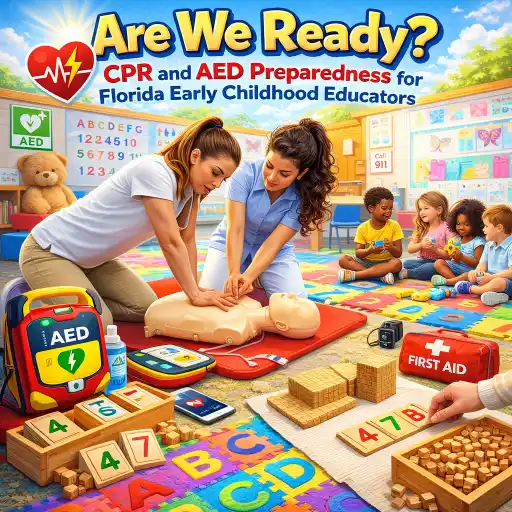 . This guide helps Florida early childhood leaders and staff get practical about being ready to use #CPR and an #AED so children stay safe. You will find clear steps, simple checklists, and links to trusted training and planning resources from ChildCareEd and public health organizations. Keep in mind: state requirements vary - check your state licensing agency. For a big-picture Florida training overview, see What Is the Florida DCF 45-Hour Child Care Training?. Stay calm — you can build readiness with small, steady steps. #Florida #safety #training
What does Florida expect from child care programs for CPR and AED readiness?
Florida licensing and best practices expect programs to have staff with current pediatric First Aid and CPR, clear emergency plans, and documented training. 1) At least one adult on site (and during transport) should hold approved First Aid/CPR certification. See the Florida 45-hour guidance at ChildCareEd. 2) Keep certification records in staff files and on your roster. 3) Include AEDs in your emergency plan when possible and follow local law for placement and reporting. For practical course and certification info, ChildCareEd explains program-ready CPR/AED courses at CPR and First Aid Training for Child Care Providers.
- Document who is certified and when they renew.
- Make sure at least one certified person is on every shift and on buses or vehicles.
- Link your plan to local EMS and include AED locations in your site map.
Tip: Post a simple emergency card by each phone and in each classroom listing certified staff and AED location. #AED
How do we train staff and keep everyone confident to use CPR and an AED?
Training options: 1) In-person hands-on (AHA/Red Cross/HSI). 2) Blended (online + skills check). 3) Remote Skills Verification (RSV) — helpful for small programs. ChildCareEd describes blended and RSV options and why they work for busy providers at renewal and RSV info.
- 📅 Schedule regular training and re-certification every 2 years (or as your chosen provider requires).
- 🧰 Practice hands-on skills on manikins so chest compressions and AED pad placement feel familiar.
- 📋 Keep a training log with course name, provider, and certificate copies (ChildCareEd has resources on tracking staff training at Health and Safety Training Resources Buy Now $0.00).
- 🔁 Run short skills refreshers during staff meetings (10–15 minutes).
Why this matters: confident staff act faster. When people practice, they make fewer mistakes and help children sooner. #training
How should we store, maintain, and include an AED in our emergency plan?
AEDs save lives when placed, maintained, and used quickly. The CDC outlines state PAD recommendations, including placement, training, EMS coordination, and maintenance — see the PAD state law fact sheet at CDC PAD State Law Fact Sheet. Many states also have AED laws and immunity rules.
- 📍 Placement: put AEDs where adults can access them quickly (gym, main hallway, kitchen area).
- 🧾 Registry: tell local EMS where your AED is located if your state requests it.
- 🔌 Maintenance: follow manufacturer guidance — check battery and pads monthly and document checks.
- 📝 Plan: add AED steps to your Emergency Action Plan and practice them in drills. ChildCareEd offers a sample plan you can adapt at Sample Child Care Emergency Action Plan Buy Now $0.00. For broader disaster and emergency preparedness training tailored to Florida early childhood programs, see When the Unthinkable Happens.
Quick checklist: clear signage, staff training on AED use, logged maintenance, EMS notification, and inclusion in drills. #safety
What common mistakes do programs make, and how can we run drills and document well?
Common mistakes:
- ❌ Letting certification expire. Fix: set calendar reminders for renewals and trainings.
- ❌ Not checking AED batteries or pads. Fix: assign monthly checks and log them.
- ❌ Assuming everyone knows where the AED is. Fix: post AED maps and practice retrieval during drills.
- ❌ Skipping hands-on practice. Fix: do short quarterly skill refreshers with manikins.
Running drills (best practices):
- 🕒 Schedule drills quarterly (fire/evac + medical scenario practice).
- 👥 Involve all staff and rotate roles so everyone practices being the responder and the supervisor.
- 📝 After each drill, document: time, who participated, what worked, what needs change. Update the plan and training log.
FAQ (short):
- Q: Who pays for AEDs and training? A: Many programs budget for safety; grants and local health partners sometimes help. See training pricing and course options at ChildCareEd Florida courses.
- Q: Can online-only CPR meet licensing? A: Often blended or hands-on verification is required—check your licensing rules and the course details.
- Q: Are staff protected legally if they use an AED? A: Many states offer Good Samaritan or limited liability protections — check local law and the CDC PAD fact sheet.
Why it matters: being ready protects children and builds parent trust. Start small: 1) verify one staff certification today, 2) plan a short AED map for your walls, and 3) schedule a 15-minute skills refresher this month. You’ve got this — support is available at ChildCareEd. #CPR #AED
Conclusion
Action steps for this week:
- Check that at least one person per shift is First Aid/CPR certified and file their certificate.
- Identify where an AED would be placed and who will check it monthly.
- Plan a 15-minute hands-on refresh session for staff and list it on your calendar.
For training, sample plans, and courses tailored to Florida providers, visit ChildCareEd resources such as Stay Ready: First Aid and Emergency Procedures and the Florida course listings at ChildCareEd Florida Courses. Remember: small steps and regular practice build confident responders. #training #Florida
- Keeping Our Youngest Students Safe: The Vital Importance of Pediatric First Aid and CPR Training for Teachers
- Life in the Fast Lane: Why First Aid Training & CPR is Critical for Those Working With Children
- Getting Ready for the New School Year: Prioritizing Safety with First Aid and CPR Training
- First Aid & CPR ~ Empowerment Through Lifesaving Skills
- Pediatric First Aid and CPR Training with ChildCareEd - Empower Yourself!!
- Save Lives With Skill: CPR Training
- CDA Certification en Español: Recursos y Consejos para Educadores Bilingües
- Why Every Parent and Educator Should Learn Adult, Child, and Infant CPR
- What Parents and Educators Need to Know About Child Safety
- ¿Cómo pueden los equipos de cuidado infantil practicar habilidades rápidas de primeros auxilios en situaciones reales?
- How can Washington early childhood programs stay safe with CPR and AEDs?
- How can Georgia early childhood educators build confidence with CPR and AED training?
- Are We Ready? CPR and AED Preparedness for Florida Early Childhood Educators
- How can DC early childhood classrooms stay ready with CPR and AEDs?
- How do we handle a child care emergency in New York: policies, drills, and preparedness?
- Pediatric First Aid for Teachers: Are Your Skills Still Fresh When an Emergency Happens?
