Outdoor play supports movement, exploration, social learning, and healthy risk-taking—but only when staff complete a purposeful safety check first. Use the Playground Safety Made Simple: Daily Outdoor Play Checklist Buy Now $1.49 as a practical routine to identify potential hazards, review outdoor areas before children begin playing, and strengthen consistent #supervision practices. For focused professional learning, consider Family Child Care: Building, Premises, and Outdoor Safety, which covers outdoor hazards, boundaries, surfacing, weather, water, and sight-and-sound supervision. For a broader team experience, Active Supervision: A Strategy That Works Buy Now $35.00 can help staff build consistent habits that support safer play and ongoing professional development.
Why does a pre-play check matter?
A playground may appear safe from a distance while conditions have changed overnight. Rain can displace protective surfacing, wind can bring down branches, and maintenance work can leave tools or materials behind. Equipment that was safe yesterday may now have a loose fastener, sharp edge, hot surface, or damaged barrier.
A pre-play inspection is not about eliminating every challenge. Children benefit from developmentally appropriate opportunities to climb, balance, run, and test their abilities. The goal is to distinguish healthy challenge from preventable danger. The CDC identifies outdoor play as valuable for physical activity, motor development, attention, social learning, and healthy development, while also emphasizing protection from injury, heat, insects, and water-related risks (CDC outdoor play and safety guidance).
State requirements vary - check your state licensing agency. Your program should also follow manufacturer instructions, applicable CPSC and ASTM guidance, and written policies.
- Assign one trained adult to complete the inspection.
- Check before every outdoor session, not only at the beginning of the day.
- Repeat the check after storms, repairs, deliveries, or unusual events.
- Document findings and corrective action rather than relying on memory.
What should staff inspect on equipment and surfacing?
Begin with equipment at children’s eye level. Look closely at swings, slides, climbers, platforms, ladders, guardrails, connectors, chains, ropes, fasteners, caps, and anchors. Staff should look for cracks, rust, splinters, sharp edges, missing components, protruding bolts, unstable structures, and damaged plastic or wood.
Pay special attention to entrapment and entanglement risks. Openings, gaps, or damaged barriers can trap a child’s head, neck, fingers, hands, feet, or limbs. Clothing hazards may include drawstrings, necklaces, scarves, loose straps, or bicycle-helmet straps. Teach children to use equipment as intended—such as sliding feet-first and waiting until the landing area is clear—but do not rely on verbal reminders to control a structural hazard.
Then inspect the full fall zone. Protective surfacing can migrate, compact, erode, become contaminated, or collect hard objects. Check beneath swings, at slide exits, and around climbing equipment.
- Remove glass, litter, animal waste, rocks, branches, and broken toys.
- Look for exposed soil, roots, concrete footings, holes, and standing water.
- Confirm that loose-fill material is distributed evenly and maintained according to applicable guidance.
- Inspect unitary surfaces for cracks, buckling, separation, or deterioration.
- Tag and block any equipment that cannot be used safely.
How should staff check boundaries, visibility, and supervision readiness?
Physical safety and supervision are inseparable. A well-maintained structure still creates risk if adults cannot see or reach children quickly. Before children enter, staff should examine the yard from several positions, including a child’s eye level. Identify blind spots behind slides, tunnels, storage sheds, landscaping, fencing, or crowded equipment.
Divide the outdoor area into clearly defined zones and assign responsibility before play begins. Each adult should know which children and spaces they are covering, who carries the first-aid kit, and who leads the response if a child is missing or injured. Head counts should occur when children leave the classroom, enter the yard, change areas, and return indoors.
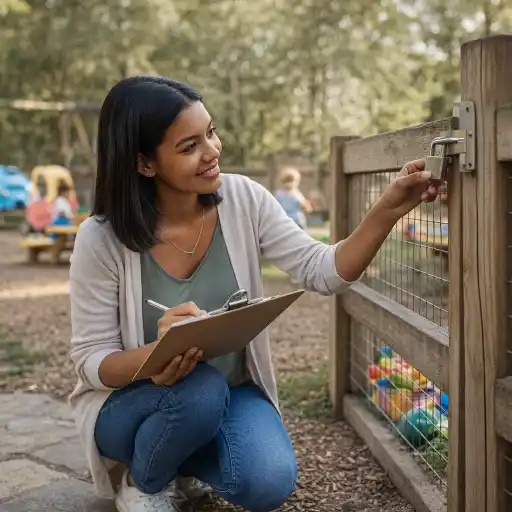
Inspect the perimeter as carefully as the play structures. Gates should close and latch reliably. Fences should be secure, free of dangerous gaps, and separated from climbing aids such as trees, benches, or equipment. Check access points near roads, parking areas, bodies of water, maintenance spaces, and delivery routes.
- 📍 Post a zone map near the exit and review it during a brief staff huddle.
- Keep phones, paperwork, and nonessential conversations away during active supervision.
- Recheck gates and boundaries after visitors, deliveries, landscaping, or repairs.
- Move, scan, listen, count, anticipate, and engage throughout outdoor play.
What environmental conditions should staff evaluate?
Outdoor risks change with temperature, weather, air quality, and seasonal conditions. Staff should check the local forecast and air-quality information according to program policy. Lightning, severe wind, smoke, poor air quality, ice, flooding, and extreme heat may require delaying or moving play indoors.
Touch high-contact surfaces such as metal slides, rails, seats, and dark plastic before children use them. If a surface is too hot to touch comfortably, keep children away until it cools or provide another activity. Inspect for wet or slippery equipment, mud, fallen branches, damaged shade structures, insect nests, animal waste, unknown plants, and standing water.
Sun protection should be planned rather than improvised. The CFOC guidance recommends shade, limiting intense sun exposure, written permission for sunscreen, labeled individual sunscreen, and handwashing before and after application (CFOC sun safety guidance). Provide water and scheduled breaks, and communicate clothing, hats, sunscreen, and weather expectations with families.
- Check for ticks, mosquitoes, stinging insects, nests, and standing water.
- Use repellents only with appropriate permission and according to label directions.
- Keep children away from snakes, rodents, and other animal hazards.
- For water play, maintain constant close supervision, secure chemicals, and follow sanitation requirements.
- Remember that small pools and water containers can create serious drowning risks.
What should staff do when they find a hazard?
The value of a checklist depends on what happens after an unsafe condition is identified. First, move children away from the area. Then stop access by using a barrier, closing a gate, or placing a visible “Do Not Use” tag on the equipment. Notify the director or designated maintenance lead immediately.
Record the date, time, location, specific condition, person notified, and action taken. “Playground unsafe” is less useful than “left swing chain has corrosion near the upper connector.” Specific notes help maintenance staff respond and allow directors to identify recurring problems.
Assign an owner and completion date for each repair. Do not return equipment to service simply because someone says it was fixed. A responsible person should verify the repair, inspect the surrounding area, and document the return-to-service date. For structural failures, damaged anchors, uncertain repairs, or surfacing concerns, consult the manufacturer or a qualified professional.
Near-misses also deserve documentation. A child who nearly exits through an unlatched gate or slips on a wet surface provides important information about system weaknesses, even when no injury occurs.
- Protect children immediately.
- Communicate the closure to every staff member.
- Document injuries, hazards, and near-misses.
- Review patterns during staff meetings without blame.
- Update the checklist, supervision plan, environment, or training when needed.
How can directors make outdoor checks consistent?
Consistency improves when the process is short, visible, assigned, and reviewed. Keep the form near the outdoor exit, use the same categories each day, and train new staff with a completed example. Require initials, time, findings, and corrective action—not merely a signature.
Directors can create a simple schedule that distinguishes daily checks from deeper reviews. Daily inspections address immediate hazards. Weekly or monthly reviews can examine surfacing condition, equipment maintenance, fencing, accessibility, repair trends, and documentation. Comprehensive inspections should follow applicable standards, manufacturer requirements, and local licensing expectations.
Common mistakes are usually process problems, not evidence that staff do not care:
- ❌ Signing without inspecting: Require specific observations and action notes.
- ❌ Checking only in the morning: Inspect before each outdoor session and after severe weather.
- ❌ Leaving unsafe equipment available: Tag, block, and communicate the closure.
- ❌ Ignoring near-misses: Track them to reveal recurring environmental or supervision concerns.
- ❌ Using one adult for too much space: Adjust zones, staffing, or group arrangements.
For additional staff learning, 1,2,3, Eyes on Me: Classroom Safety  Buy Now
 $32.00$24.00 addresses safe indoor and outdoor environments and continuous supervision. Building and Physical Premises Safety Buy Now $10.00 provides broader training on identifying hazards, bodies of water, traffic, and prevention strategies. A fifth useful option is Creating the Natural Outdoor Classroom Buy Now $16.00, which supports intentional outdoor environments while keeping safety and development in view.
Conclusion: What should staff check before outdoor play?
Before outdoor play, staff should inspect equipment, fall-zone surfacing, clothing and entrapment hazards, gates and fencing, visibility, age appropriateness, weather, air quality, temperature, pests, water, and emergency supplies. They should also establish supervision zones, complete head counts, document findings, and remove hazards from use immediately.
The strongest routine is brief enough to happen every time and detailed enough to support action: inspect, assess, assign, supervise, document, and review. These habits protect children while preserving the joy, challenge, and developmental value of outdoor play. State requirements vary - check your state licensing agency.
Frequently asked questions
How often should staff inspect the outdoor area?
Complete a pre-use check before each outdoor session and repeat it after severe weather, repairs, deliveries, or other events that could change conditions.
What should happen when equipment is damaged?
Move children away, block access, attach a “Do Not Use” notice, notify the director, document the issue, and verify the repair before returning the equipment to service.
Who should complete the checklist?
The program should designate a trained staff member, often the lead teacher or person responsible for outdoor play. The inspector should initial and record the time.
What if weather changes during play?
Follow the program’s weather and air-quality policy, monitor conditions continuously, and move children indoors promptly for lightning, unsafe air, extreme temperatures, severe wind, or other dangerous conditions.
Why document near-misses?
Near-misses reveal weaknesses before a serious injury occurs. Reviewing them can lead to changes in equipment placement, supervision zones, maintenance, or staff training.
- 45 Hour Child Growth and Development
- 45 Hour Preschool Methods and Materials
- Basic Life Support (BLS) Blended Healthcare Providers
- 45 Hour Infant and Toddler Methods and Materials
- 45 Hour School Age Methods and Materials
- 45-Hour Infant and Toddler Curriculum
- Texas Director Credential
- 10 Hour Health and Safety Orientation Training
- Family Child Care: Building, Premises, and Outdoor Safety
- ¿Cómo pueden los equipos de cuidado infantil practicar habilidades rápidas de primeros auxilios en situaciones reales?
- Proporciones de Cuidado Infantil y Tamaños de Grupo por Edad en Maryland (Guía Rápida para Centros y Hogares)
- Consejos de Supervisión Activa para Salones de Preescolar y el Juego al Aire Libre
- What Kind of Property Works for a Child Care Center?
- How can Nevada early childhood educators keep classrooms safe in hot weather?
- How can child care programs keep playgrounds safe every day?
- Daycare Temperature Regulations in Alaska: How Cold Is Too Cold?
- How can child care programs prevent heat-related illness during outdoor play?
- How Can Child Care Programs Keep Outdoor Play Safe?
- Daycare Outdoor Weather Safety: Temperature, Heat Index, and Playtime
- Childcare Weather and Air Quality Chart: Keeping Outdoor Play Safe
- Active Supervision in Early Childhood: Simple Strategies That Work
- Which Active Supervision Strategy Should You Use During Transitions, Meals, Naps, and Outdoor Play?
- Playground Safety Checklist for Daycares: 10 Hidden Hazards Staff Often Miss
- Active Supervision Examples: 10 Real Classroom Scenarios—Safe or Unsafe?
- How Can Child Care Providers Use Active Supervision Techniques in Indoor and Outdoor Play Areas?
- How Can Child Care Programs Build Effective Sun Safety Practices for Children?
- How Can Child Care Programs Prevent Common Playground Injuries?
- What Should Child Care Staff Check Before Outdoor Play?
- What Water Safety Rules Should Every Early Childhood Program Teach?
