Heavy rain and strong wind can change a familiar yard in ways that are easy to miss—from washed-out surfacing to unstable branches and hidden debris. Use the Playground Safety Made Simple: Daily Outdoor Play Checklist Buy Now $1.49 as a starting point for reviewing outdoor conditions, alongside additional checks for storm damage specific to your yard. A consistent review helps you identify what needs attention before children return to play. For practical training tailored to home-based programs, explore Family Child Care: Building, Premises, and Outdoor Safety  Buy Now $16.00, which covers outdoor hazards, weather, boundaries, surfacing, and active supervision. Read on for ways to make post-weather checks a dependable part of your outdoor routine.
Why does a post-weather yard check matter?
Rain and wind can leave hazards that are not obvious from the doorway. A branch may be caught in a tree canopy, mulch may have shifted away from a fall area, or runoff may have exposed a footing. Wet surfaces can also remain slippery after the rain stops. A quick, systematic inspection helps identify these changes before children enter the yard.
Outdoor play supports movement, exploration, social learning, and developmentally appropriate risk-taking. The goal is not to make the yard risk-free; it is to distinguish worthwhile challenges from preventable hazards. National early childhood guidance recommends daily checks of play areas and prompt attention to broken parts, protrusions, unstable equipment, debris, and wet or icy conditions. See the CFOC daily play-area inspection guidance and the CDC’s outdoor play and safety recommendations.
Make a post-rain or post-wind walk-through part of your routine, even when the weather event seemed modest. State requirements vary - check your state licensing agency, and follow your program’s policies, equipment instructions, and applicable local guidance.
What should you inspect first after rain or wind?
Before children go outdoors, walk the entire yard—not just the play equipment. Start at the entry and perimeter, then check the play area, paths, structures, and drainage. Look from adult and child-height perspectives, since small hazards can be difficult to see in grass or loose-fill material.
- Scan for fallen or hanging branches, leaves, litter, glass, sharp objects, animal waste, and damaged toys.
- Check pathways and play zones for mud, slippery patches, holes, roots newly exposed by erosion, and standing water.
- Look at fences and gates: confirm the fence is secure and the gate closes and latches reliably.
- Inspect sheds, shade structures, benches, planters, and other items that wind or water could shift.
- Check nearby trees for cracked limbs, leaning trunks, or signs of instability; keep children away and seek qualified help if a tree may be unsafe.
Do not ask children to help clear storm debris. If you cannot safely remove an item, or if it may be contaminated by floodwater, isolate the area and consult the appropriate maintenance or public-health professional. Floodwater can carry contaminants, so avoid letting children play in water that may have entered from outside the yard.
How can you assess surfacing, drainage, and equipment?
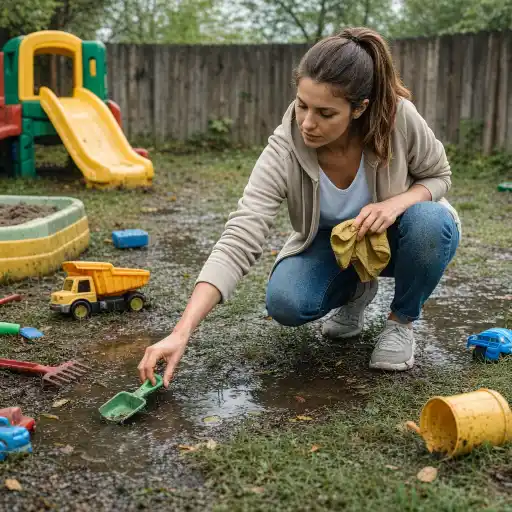
Heavy rain can wash loose-fill materials out of high-use areas, compact them, or leave them uneven. Check beneath swings, around climbers, and at slide exits for thin or displaced surfacing, exposed soil, roots, footings, or hard surfaces. Look for erosion channels and soft spots that may indicate water has moved beneath the surface. On unitary surfaces, such as rubber tiles or poured-in-place material, inspect for lifted edges, cracks, separation, or damage.
Follow manufacturer instructions and applicable surfacing guidance when determining whether material is adequate. Do not guess at technical requirements or attempt structural repairs beyond your expertise. Persistent puddles, recurring erosion, or areas that remain saturated may signal a drainage problem that needs professional assessment. The post-storm playground inspection guide outlines common concerns such as displaced surfacing, exposed foundations, and drainage changes.
Inspect equipment for cracks, bent parts, missing or loose hardware, movement at the base, and damaged rails, platforms, or moving components. Do not test equipment in a way that could expose a child or staff member to danger. If its stability is uncertain, close it off until it can be assessed.
- 🛑 Block off equipment or surfacing that may be unsafe; a verbal reminder alone is not enough.
- Check that runoff is not flowing toward the home, walkways, or play equipment.
- Clear drain openings only when safe and within staff responsibilities.
When should children stay out of part or all of the yard?
Choose a cautious approach whenever a hazard is uncertain. Keep children away from areas with structural damage, unstable trees or large branches, significant erosion, standing or potentially contaminated floodwater, exposed footings, or damaged impact-absorbing surfacing. Close an individual piece of equipment when the problem is limited to that item and the rest of the yard can be safely separated. Close the entire yard when hazards affect access, supervision, boundaries, or multiple play zones.
While an area is closed, use a physical barrier, secure gate, or clear “Do Not Use” marker that children cannot easily bypass. Tell every staff member what is closed and why, and provide an appealing indoor or alternative activity. This is not an overreaction: a short delay is preferable to asking children to play in a space whose safety is unclear.
After the hazard is corrected, a responsible adult should verify the repair or cleanup, recheck the surrounding area, and record when the space returned to use. For significant storm damage, flooding, or uncertain repairs, consult a qualified professional, the equipment manufacturer, or local authorities as appropriate. Emergency plans should also address how the program responds to severe weather and recovers afterward; see the Head Start emergency preparedness manual.
How should providers document findings and follow up?
Clear records turn a one-time inspection into a useful safety process. Write down the date and time, weather conditions, areas inspected, specific hazards, immediate steps taken, and the person notified. Photographs can help show the condition before repairs, but take them only when doing so does not distract from supervising children or create additional risk.
Be precise. Instead of writing “yard unsafe,” note “mulch displaced beneath east swing; soil and footing visible; swing area blocked at 8:10 a.m.” Assign a person to follow up and include a target date. Record who completed the repair and who verified the area before reopening. Near-misses—such as a child slipping on a wet path—are also worth documenting because they can reveal drainage or supervision issues before an injury occurs.
- Inspection date, time, and staff member completing the check.
- Weather event and observed conditions, including water pooling or wind debris.
- Exact location and description of each concern; add a photo when useful.
- Immediate protective action, notification, repair owner, and follow-up date.
- Verification and date the area or equipment returned to use.
Review recurring problems at staff meetings and update the yard checklist, maintenance plan, or supervision zones as needed. Documentation is not about assigning blame; it supports consistent decisions and helps your team learn from changing conditions.
How can you make post-storm inspections practical and consistent?
Keep the process short enough to use every time and detailed enough to guide action. Post a checklist near the outdoor exit, assign a staff member to inspect after significant weather, and make sure everyone knows how to close an unsafe area. A simple sequence—perimeter, trees and debris, pathways, surfacing, equipment, drainage, then documentation—reduces the chance of skipping an important area.
Common pitfalls are usually routine gaps rather than a lack of care. Avoid assuming the yard is safe because damage is not immediately visible; skipping the drainage and surfacing check; allowing children to enter while staff are still inspecting; or reopening equipment based only on a verbal report that it was fixed. Recheck after additional rain, maintenance work, landscaping, or a new report from staff or families.
Before outdoor time resumes, connect the inspection to active supervision and pre-play checks. Staff should know which areas are open, where children may play, and how to keep sight and sound supervision effective. Familiar outdoor routines can reassure children after a storm, while a clear plan helps adults remain attentive and responsive.
Conclusion: What is the safest way to check the yard after bad weather?
After heavy rain or wind, inspect the entire yard before children enter: look for debris and tree damage, check boundaries and paths, assess drainage and surfacing, and examine equipment for visible damage or instability. Close off any uncertain area, document the hazard and corrective action, and reopen only after a responsible adult verifies it is safe to use.
These practical steps help family child care providers protect children while preserving the learning and joy of outdoor play. A consistent routine, clear communication, and thoughtful follow-up make weather-related decisions more manageable—and help your team respond with confidence when the yard changes overnight.
- 👧 ¿Cómo iniciar y abrir una guardería en Texas? Lo que necesitas saber
- 🚨 Reporte Obligatorio en Nevada
- ¿Qué Se Necesita para Comenzar una Guardería en Casa en Texas?
- ¿Cómo pueden los equipos de cuidado infantil practicar habilidades rápidas de primeros auxilios en situaciones reales?
- Regulaciones de Cuidado Infantil en Maryland para Centros y Hogares de Cuidado Infantil Familiar
- Regulaciones de Licenciamiento de Cuidado Infantil en California para Centros y Hogares de Cuidado Infantil Familiar
- Lista para Abrir una Guardería en Casa en Dakota del Norte: Cómo Empezar
- Lista para Guardería en Casa en California: Cómo Iniciar una Guardería en el Hogar
- Lista para Guardería en Casa en Texas: Cómo Iniciar una Guardería en el Hogar
- ¿Qué Temperatura Es Demasiado Fría para Jugar al Aire Libre en el Cuidado Infantil?
- Retraso del Habla en la Guardería: Cómo Pueden Ayudar los Proveedores
- Cómo Trabajar en el Cuidado Infantil en California: Requisitos y Pasos
- Cómo Ser Maestra de Preescolar en Illinois
- Capacitación Previa al Servicio para Proveedores de Cuidado Infantil en Dakota del Norte
- Child Care Weather Guidelines: Using the 2026 Weather Watch Chart
- Celebrando la amistad en el cuidado infantil durante el Día de los Mejores Amigos
- Daycare Outdoor Weather Safety: Temperature, Heat Index, and Playtime
- How Can Child Care Programs Maintain Playground Safety Inspections and Standards?
- What Should Child Care Staff Check Before Outdoor Play?
- How Should You Check a Family Child Care Yard After Heavy Rain or Wind?
