Children are more likely to remember a dance they help invent than one they are simply asked to copy. With a few autumn-inspired movement ideas and a visual sequence board, you can turn children’s suggestions into a shared routine that supports creativity, listening, and coordination. Explore Mind’s Medicine: Music in Early Childhood  Buy Now $16.00 for practical guidance on planning developmentally appropriate musical experiences, and consider Inclusive Lessons for Preschoolers Buy Now $16.00 to strengthen your approach to adapting activities so more children can participate meaningfully.
Why does making a dance together matter?
A group dance can be much more than a festive seasonal activity. When children choose movements, decide what comes next, and practice the sequence together, they engage in active learning that connects sound, body, language, memory, and relationships. Movement experiences can help children explore how music feels in their bodies and express ideas through movement, rather than relying only on verbal explanations. Research on preschool music learning highlights the role of bodily engagement in connecting sound, movement, and intention (Movement Experiences in Preschool Music Classes).
Co-creating also gives children agency. A child who suggests “swirl like a leaf” contributes to the group’s plan; peers can build on that idea, practice taking turns, and discover that one movement can be interpreted in several ways. A predictable visual sequence offers support without requiring every child to move identically. It can also help educators revisit the dance on another day, giving children a familiar framework to extend.
Consider the learning opportunities woven into a short dance:
- Gross-motor practice through bending, reaching, turning, stepping, and balancing.
- Sequencing and recall as children anticipate which movement comes next.
- Language development through action words such as “sway,” “drift,” “stomp,” and “freeze.”
- Cooperation as children contribute ideas and participate in a shared experience.
These overlapping goals make the dance a meaningful part of the curriculum—not merely a performance to prepare.
How can you plan a child-led fall dance?
Start with observation and conversation rather than a finished choreography. Invite children to notice the season: What moves in the wind? How does a leaf fall? What might a squirrel do? Their answers offer movement possibilities and useful vocabulary. Seasonal music activities can pair children’s ideas about autumn with actions, rhythm, and sound (Fall Music and Movement Activities).
Keep the first session short and flexible. Select a small set of movements—three or four is often enough to begin—and let children test each one to music or a steady beat. Model a movement when children need a starting point, but avoid turning the activity into a demand to copy an adult. Invite children to suggest alternatives, demonstrate from a seated position, or watch before joining.
A simple planning sequence might look like this:
- Notice: Share a fall picture, a safe natural object, or a short conversation about autumn.
- Imagine: Ask children how leaves, wind, animals, or rain might move.
- Explore: Try several actions freely, with and without music.
- Choose: Let the group select a few movements to connect into a sequence.
- Repeat: Practice the short dance, adjusting its pace or order as children offer ideas.
Repetition helps children become familiar with the sequence, while occasional choices keep the activity open-ended. The goal is shared invention, not a polished stage performance.
How do you use a visual sequence board?
A visual sequence board makes the dance visible and easier to revisit. Use pictures, simple drawings, photographs of children demonstrating actions (with appropriate program permissions), or clear movement symbols. Arrange the cards from left to right or top to bottom so children can see the order. Pair each picture with a short label—such as “float,” “turn,” or “freeze”—and say the word as you point to it.
For a classroom-ready option, the Create-a-Fall-Dance Visual Sequence Board Buy Now $1.49 can help make a group’s ideas concrete. Use the board as a prompt, not a script: children may switch cards, add a movement, or choose a different way to show the same idea. The board can support recall and give children a clear preview of what is coming, particularly when the dance is repeated across several days.
Try a simple four-part sequence:
- 🍂 Float like a leaf: sway gently with arms moving down.
- Turn like the wind: make a slow turn or move hands in a circle.
- Stomp through leaves: take a few grounded steps or tap feet while seated.
- Freeze like a tree: pause in a comfortable shape until the music begins again.
Keep images uncluttered and place the board where children can see it without crowding. Picture prompts can also be adapted as gestures, objects, or tactile symbols to make the sequence more accessible.
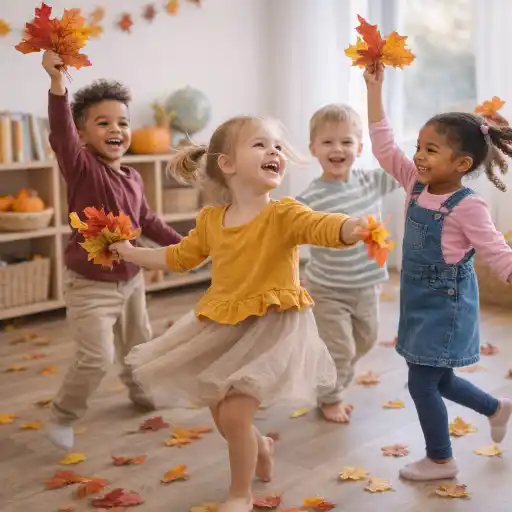
How can you support movement, music, and memory?
Use music as a cue that helps children notice changes in tempo, energy, and pauses. A gentle section might invite swaying or floating; a stronger beat can suggest stomping or marching. You can also use a drum, clapping, or a spoken rhythm if recorded music is not practical. Seasonal music-and-movement ideas often use musical starts and stops to cue actions such as drifting, gathering, and jumping (Fall Music Activity with Leaves).
Teach the dance in manageable chunks. Point to one or two pictures, model the movement, and repeat before adding another part. Then practice the whole sequence with the visual board available. Over time, pause before a card and invite children to recall what comes next. Keep the tone playful: remembering two actions is a success, and children can look back at the board whenever they need support.
For practical facilitation:
- Use a consistent start-and-stop signal and practice it before the dance begins.
- Repeat the same short sequence on different days before adding complexity.
- Use action words and invite children to describe how a movement feels or sounds.
- Offer a slow version, a seated version, or a smaller movement for children who prefer less intensity.
- Let children take turns choosing a card or leading one movement.
Active musical participation can create opportunities to connect rhythmic patterns with movement and language. A study of a preschool musical-activity program reported gains in receptive vocabulary for its participating group, while also noting that more research is needed to explain exactly how the activities contributed (Implementing a Musical Program to Promote Preschool Children’s Vocabulary Development). Keep expectations grounded: the dance is a rich learning experience, not a promise of a specific outcome.
How can every child participate safely and comfortably?
Inclusive planning begins by recognizing that meaningful participation can look different from child to child. One child may leap, another may sway from a chair, and another may point to the next picture or keep the beat with a soft instrument. These are all valid ways to contribute. Offer more than one response option and allow children to observe before joining, pause, or re-enter without pressure.
Prepare the space before the music starts. Move furniture or other obstacles, mark a comfortable movement area, check that the floor is not slippery, and ensure children have enough room to move without bumping into one another. Keep volume moderate and consider sensory preferences, mobility needs, and individual care plans. State requirements vary - check your state licensing agency.
Helpful adaptations include:
- Show the visual card while also saying and demonstrating the movement.
- Offer seated, standing, small-range, and no-touch alternatives.
- Use scarves or soft props only when they are safe and appropriate for the group.
- Give children choices about sound level, proximity to speakers, and whether to participate.
- Invite family input about familiar autumn words, music, and movement traditions.
Avoid treating stillness or watching as misbehavior. A child may be learning by observing, regulating, or deciding when to join. A supportive educator can describe what is happening, acknowledge children’s ideas, and adapt the experience while keeping supervision active.
How can educators avoid common pitfalls and extend the dance?
Common pitfalls include teaching too many steps at once, prioritizing a performance over children’s process, and using a single movement style as the only measure of participation. A long sequence can overwhelm young children’s working memory; a teacher-led routine can leave little space for their ideas. Keep the dance short, return to the board for reminders, and make room for children to alter the sequence. Preschool dance resources also recommend giving children cues and keeping memory challenges playful rather than demanding perfect recall (Preschool Dance Movement Cards).
After the dance, invite children to reflect in ways that suit them. Ask which movement they enjoyed, what they would change, or which card should begin the next version. Children might draw a movement, retell the sequence with picture cards, or demonstrate a favorite action. These brief reflections help educators notice interests, emerging skills, and useful adaptations for future sessions.
Directors can support staff by making a simple planning template available: learning intention, sequence images, safety check, participation options, music cue, and one observation question. Staff can note whether children anticipate a cue, contribute an idea, or use new action words. Those observations can guide the next iteration without turning a joyful activity into a formal test.
For deeper professional learning, CDA Subject Area 2 Buy Now $80.00 explores physical and intellectual development, including the arts and music, while Balancing Active Play in Child Care Buy Now $16.00 addresses planning active, creative, and quieter experiences. These courses offer additional context for educators and directors refining classroom practice.
Conclusion: What helps a fall dance stay memorable?
A memorable fall dance grows from children’s ideas, a clear sequence, repeated practice, and flexible ways to participate. Begin with autumn observations, invite children to invent movements, and use a visual board to make the order visible. Pair the actions with musical cues, keep the routine brief, and make safety and inclusion part of the plan from the start.
The central question—how can children create a fall dance they’ll remember?—is answered through participation: children remember what they help shape. Value the process as much as the finished sequence. When children see their ideas reflected in the dance, they can move, recall, communicate, and create together in ways that feel joyful and genuinely their own.
- A Better Space for All
- Beyond the Classroom: Connecting Families to Essential Services
- What Makes Me Special: An Overview of Autism and ADHD
- Teacher Mentoring in ECE
- CDA Bridge Bundle: Family Child Care without Portfolio Review
- CDA Bridge Bundle: Infant/Toddler without Portfolio Review
- CDA Bridge Bundle: Preschool without Portfolio Review
- Wellness in Action: Teaching Healthy Habits to Children
- Professional Integrity in Child Care
- Pumpkins, Pinecones, and Leaves: Autumn-themed STEM Projects
- Proporciones de Cuidado Infantil y Tamaños de Grupo por Edad en Virginia (Guía Rápida para Centros y Hogares)
- Consejos de Supervisión Activa para Salones de Preescolar y el Juego al Aire Libre
- Las Mejores Ideas de Excursiones para Guarderías en Texas
- Can simple indoor movement games teach listening and cooperation to preschoolers in Oklahoma?
- How can child care programs boost physical activity for young children?
- How can music and movement strengthen early childhood programs in North Dakota?
- Canciones, juegos y preguntas de círculo para niños
- How can I build gross motor skills indoors and outdoors for the children in my program?
- How can I host a safe, engaging freeze-dance party in my daycare?
- Too Wiggly to Sit? Fall Movement Activities Toddlers Will Love
- Rainy Fall Day? 12 Indoor Activities Preschoolers Won’t Want to Stop
- How Can You Adapt Fall Learning Activities for Children of Different Ages?
- How Can Child Care Programs Plan a Halloween Celebration Where Food Is Optional?
- How Can Preschoolers Revisit Fall Through Photos, Predictions, and Discoveries?
- 10 Fun Indoor Activities for District of Columbia Child Care Programs During Fall and Winter
- How Can Children Create a Fall Dance They’ll Remember?
- How Can You Help Children Return to a Fall Project Across Several Days?
