Child care leaders and teachers in Minnesota face hard moments with children every day. This article explains how ChildCareEd's behavior management courses give staff practical skills so they can handle most challenges at the program level without calling outside consultants. You will find clear steps, course links, examples, and short lists you can use with your team this week. We use simple ideas so your staff can practice right away. These ideas also tie into research-backed tools like the Pyramid Model and CSEFEL.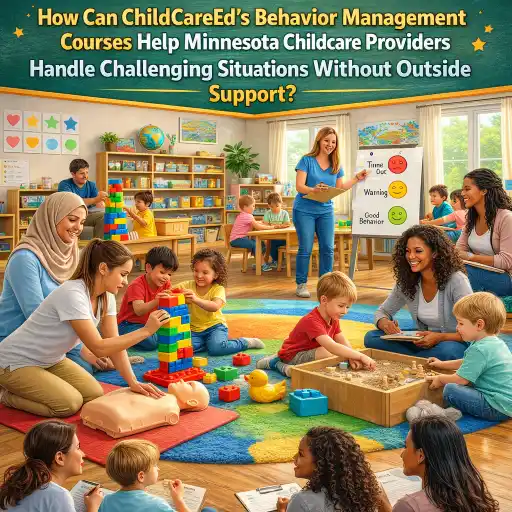
What do ChildCareEd behavior courses teach that helps staff manage on their own?
- 😊 Clear routines and signals: Courses like Classroom Management is Collaboration!
 Buy Now $16.00 teach attention signals and predictable schedules that make transitions smoother. These quick tools cut down on many problems before they start.
 - 📋 Step-by-step responses: Trainings such as Turning Behavior Around for Toddlers and Preschoolers Buy Now $25.00 show staff a simple, calm script to use in the moment so safety and teaching come first.
- ✅ Prevention and classroom design: The Proactive Behavior Guidance article shows how room layout, visual schedules, and small-group plans remove triggers.
- 🧰 Practical tools and visuals: ChildCareEd's resource pages and articles (see Resources for Managing Behaviors) include printable First/Then cards, break cards, and cue cards staff can make and use tomorrow.
- 🤝 Respectful language and repair: Courses and posts like Managing Behaviors Without Shame teach staff how to protect children’s dignity and rebuild trust after a hard moment.
These lessons are short and job-focused, so your team can practice during staff meetings or take the online course individually. The courses emphasize everyday moves, not long theory, which helps #providers feel ready and supported in their own #classroom work. State requirements vary - check your state licensing agency.
How can Minnesota programs use course skills day-to-day to prevent and respond to challenges?
ChildCareEd focuses on hands-on steps you can try right away. Here are easy, numbered actions to bring training into daily routines.
- 🎯 Pick one routine and practice it:
1) Choose a transition (drop-off, clean-up, line-up). 2) Teach a short attention signal from Positive Classroom Management. 3) Practice 2–3 times a day until most children respond.
- 🧭 Use visuals and simple rules:
Post 3 easy rules and a picture schedule. ChildCareEd resources include printable visuals so staff can set these up quickly (Free Resources).
- 🔁 Short scripts for moments:
Train staff to use a calm 3-step script: name the feeling, set the limit, teach one replacement skill. The course Classroom Management is Collaboration!
Buy Now $16.00 models these short scripts so teachers are ready when stress hits. - 📊 Track patterns with ABC notes:
Have staff jot Antecedent-Behavior-Consequence notes for a week. Patterns help you fix triggers. ChildCareEd articles on decoding behavior give simple forms and examples (How can I manage challenging behaviors).
- 🤝 Practice family messages:
Train staff to share a quick strength + fact + plan note with families. Using consistent words helps children get the same message at home and at the program, and it builds trust.
These daily changes come from courses and posts like Supporting Teachers Through Sustainable Behavior Management Practices. Simple, repeated practice builds staff skill. For Minnesota providers, these steps reduce the need for outside consultants because staff learn to solve many patterns themselves. State requirements vary - check your state licensing agency.
How do courses help build sustainable practices and strong family partnerships without outside consultants?
ChildCareEd courses teach systems, not just single fixes. Here is how they support long-term, in-house change.
- 📚 Shared language for your team:
When everyone completes the same course (for example, Turning Behavior Around Buy Now $25.00 or Classroom Management is Collaboration!
Buy Now $16.00), staff speak the same short scripts and use the same cues. This consistency is what replaces having to call an outside specialist. - 🧩 Reusable tools and templates:
ChildCareEd provides checklists, behavior logs, and printable cue cards in articles like Resources for Managing Behaviors. Programs can store these tools and use them with new staff, which makes improvements stick.
- 🤗 Focus on relationships:
Training such as Supporting Teachers Through Sustainable Behavior Management Practices emphasizes strong teacher-child relationships. When relationships are steady, behavior problems drop, and the need for external help lessens. For practical strategies and activities to strengthen teacher-child and family partnerships that reduce challenging behavior, see our Building Relationships page.
- 📈 Build internal coaching:
Use short staff meetings to practice one new skill each week. ChildCareEd articles recommend micro-training sessions and peer coaching so your site can become its own support system.
These steps align with multi-tier approaches like the Pyramid Model, which supports most children at the classroom level and reserves outside help for a few children who need extra services.
What common mistakes should Minnesota providers avoid, and when should they seek outside help?
It is great to handle many challenges in-house, but there are common pitfalls. Here are numbered mistakes and how to avoid them.
- 😵 Mistake 1: Expecting instant change.
Behavior change is slow. Avoid switching strategies every day. ChildCareEd recommends tracking small wins and using a plan for several weeks before changing it (Supporting Teachers…).
- ⚠️ Mistake 2: Inconsistent responses.
If staff use different phrases or rules, children get mixed messages. Use the same short scripts from courses so all adults respond the same way.
- 🙉 Mistake 3: Skipping data.
Not recording patterns hides triggers. Use simple ABC notes (Antecedent-Behavior-Consequence) for a week to spot trends. ChildCareEd articles give simple templates you can print and use right away.
- 💔 Mistake 4: Shame-based language.
Shaming children hurts trust. ChildCareEd's toolkit on shame-free guidance shows how to set limits while protecting dignity.
When to seek outside help:
- 1) The behavior is unsafe and happens often.
- 2) The behavior stops a child from learning or joining peers.
- 3) Team strategies have been tried consistently for several weeks without improvement.
- 4) You see signs of trauma, extreme anxiety, or a sudden behavior change—then consult mental health supports.
For guidance on time-out use, functions of behavior, and tiered supports, see resources like the CSEFEL brief on time-out and the Pyramid Model resources. These help you know when to keep working in-house and when to involve specialists.
Conclusion
ChildCareEd's behavior management courses and articles give Minnesota childcare providers clear, usable steps to prevent and handle many challenging moments without outside help. Key actions are:
- 📌 Use one new routine or signal and practice it until it works.
- 📋 Teach short scripts and visual supports from ChildCareEd resources.
- 📝 Track simple data (ABC notes) to spot patterns.
- 🤝 Use the same words with families so kids get consistent support.
These moves build staff skill, protect children's dignity, and reduce reliance on external consultants. If a pattern is unsafe, very sudden, or does not improve after steady work, bring in a mental health consultant or special education support. For courses, start with Classroom Management is Collaboration! Buy Now $16.00 and Turning Behavior Around for Toddlers and Preschoolers Buy Now $25.00. You are not alone—small, consistent steps from training create big change for your #Minnesota #providers and your #classroom community. Keep your #calm in the moment, use smart #training strategies, and remember to check rules: state requirements vary - check your state licensing agency.
Quick FAQ
- Q: Can my whole team take these courses? A: Yes—many ChildCareEd courses are online and designed for teams. See the course pages for group options.
- Q: How long until we see improvement? A: Small changes often show within 1–3 weeks; bigger patterns take more time.
- Q: Will these courses meet licensing training hours in Minnesota? A: Check your state rules—state requirements vary; check your state licensing agency.
- Q: What if a family resists a plan? A: Start with strengths, share one small step, and invite their ideas. Many ChildCareEd posts show scripts you can use.
- 45 Hours Director-Administration ONLINE
- Pediatric RSV First Aid & CPR/AED
- CDA Bridge Bundle: Family Child Care
- CDA Bridge Bundle: Family Child Care without Portfolio Review
- CDA Bridge Bundle: Infant/Toddler without Portfolio Review
- CDA Bridge Bundle: Preschool without Portfolio Review
- Texas Director Credential
- Developing Program Tranquility
- Ouch! Biting & Hitting Hurts
- Going Head-to-Head with Challenging Behavior
- CDA Certification en Español: Recursos y Consejos para Educadores Bilingües
- 💛🧩 ¿Cómo puedo hacer que mi enseñanza sea inclusiva para los niños con autismo?
- 🏡🗣️ ¿Cómo hablo con los padres sobre los comportamientos que su hijo aprendió en casa?
- 🥺👋 ¿Por Qué la Despedida de la Mañana es Tan Emocional?
- 😅❌ ¿Cómo Puedo Manejar a un Niño que Dice “¡NO!” a Todo en el Aula?
- 10 Ejemplos de Cómo la Cultura Influye en el Desarrollo Infantil
- Proporciones de Cuidado Infantil y Tamaños de Grupo por Edad en Virginia (Guía Rápida para Centros y Hogares)
- ¿Cuál es la Diferencia Entre la Crianza Respetuosa y la Crianza Permisiva?
- Cómo Trabajar en el Cuidado Infantil en Carolina del Norte: Requisitos y Pasos
- Cómo Trabajar en el Cuidado Infantil en California: Requisitos y Pasos
- Managing an Early Childhood Classroom with Confidence
- How can ChildCareEd's behavior management courses help Minnesota childcare providers handle challenging situations without outside support?
- Celebrando la amistad en el cuidado infantil durante el Día de los Mejores Amigos
- How can child care programs protect children with asthma during Minnesota air-quality alerts?
- Cómo simplificar la capacitación para sus empleados de daycare
- What are Minnesota's Family Child Care Variances and How Do I Request One?
- Why Do Classroom Management Strategies Fail With 3-Year-Olds—and What Works Instead?
- What Are 10 Proactive Classroom Management Techniques for Early Educators?
- How Can You Handle Challenging Behavior in Preschool Without Yelling?
