Winter dressing can turn a simple trip outdoors into a long, frustrating bottleneck—but it can also become a daily opportunity for children to practice coordination and confidence. With manageable steps, thoughtful setup, and time to try, providers can help children learn buttons, zippers, and gloves without taking over. For practical strategies to balance assistance with autonomy, explore Supporting Children’s Independence  Buy Now $24.00; its three-hour online training offers approaches you can apply to self-help routines throughout the day.
If winter transitions are a recurring challenge for your whole group, Every Moment Matters: Schedules and Transitions Buy Now $55.00 can help you plan routines that are more predictable and responsive. Read on for a practical approach to teaching each fastening while keeping warmth, safety, and children’s dignity in view.
Why are winter dressing skills worth teaching deliberately?
Coats, buttons, zippers, and gloves are not “just” clothing tasks. They ask children to coordinate both hands, use small finger movements, notice visual details, follow a sequence, and persist when fabric shifts or a fastening resists. Practicing these functional actions can support fine-motor development and participation in everyday routines. Children also experience the satisfaction of doing a meaningful part of a task themselves.
Winter dressing can be demanding even for a child who manages other self-care tasks. A bulky coat may be harder to handle than a light jacket; a small zipper tab may be difficult to grasp; gloves can feel uncomfortable or restrict movement. The conditions matter. Difficulty is not proof of unwillingness, and one challenging morning is not a reliable measure of a child’s ability.
Teaching these skills thoughtfully can also improve group transitions. Instead of relying on repeated reminders or hurried adult hands, staff can make the steps visible, set up a usable dressing area, and give children realistic time to participate. The goal is not speed or flawless fastening. It is safe, comfortable participation and growing #independence at a pace that respects each child.
Keep safety in the foreground: adults select weather-appropriate clothing and supervise outdoor play. Head Start’s cold-weather safety guidance recommends warm layers, dry mittens and socks, and tucking scarves inside coats to reduce hazards.
How can you teach buttons and zippers in manageable steps?
Start practice when no one is waiting at the door. Use a familiar garment laid flat on a table or a child’s lap so the fastening is easy to see and the child can focus on hand movements. Choose larger, easier fastenings first: a loose button with a roomy buttonhole or a zipper with a substantial pull. Brief, relaxed practice is usually more useful than turning a rushed departure into a lesson.
Break the fastening into a few observable actions. For a button, the child needs to hold the fabric, guide the button toward the opening, push it through, and catch it on the other side. For an open-ended coat zipper, the bottom pieces must align and connect before the slider can move upward. The start of the zipper is often the hardest part, so teach that specific step rather than repeating “zip your coat.”
- For a button: model “hold, push, catch, pull,” then invite the child to try one movement.
- For a zipper: stabilize the coat, align the pin and slider, insert the pin fully, then pull the tab.
- Use a short ribbon or larger zipper pull only if it is securely attached and appropriate for the child and garment.
- Practice on a spare jacket, doll clothing, or a dressing board before trying the task while wearing bulky winter gear.
Try backward chaining: complete most of the task and let the child do the final action—for example, pull up a zipper you have connected. As that step becomes familiar, hand over more of the sequence. This creates a real role for the child while keeping the challenge attainable.
How can children practice gloves and the winter dressing sequence?
Gloves ask children to orient the garment, find the opening, and guide fingers into narrow spaces. Mittens can be a more manageable starting point because the fingers share one compartment. Demonstrate slowly, and let the child help by opening the cuff, pushing a hand in, or pulling the cuff over the sleeve. If gloves are needed for the weather or activity, give children extra time and support rather than expecting a first attempt to be independent.
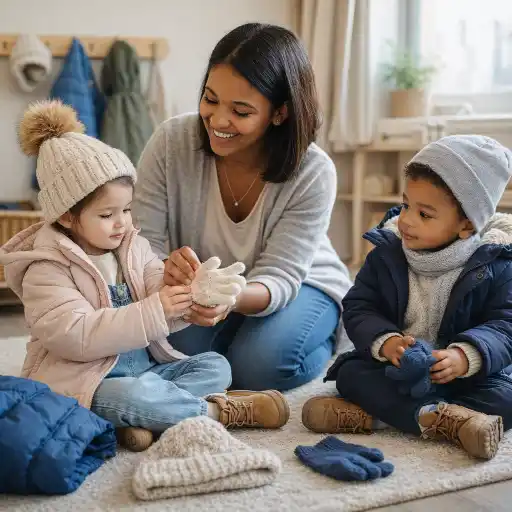
Teach the whole winter routine as a short, consistent sequence. Picture cues at child height can help children remember what comes next, especially when spoken directions become hard to follow in a busy cubby area. A routine might include coat, hat, boots, and gloves last so children can still use their hands while dressing. Adapt the sequence to the program’s clothing, weather plan, and children’s needs.
- Use photos or simple illustrations showing the actual garments and steps children use.
- Keep hats, gloves, and other belongings in identified, reachable spaces.
- Invite a few children to dress at a time; give children who are waiting a supervised activity.
- Check that clothing is dry, comfortable, and allows children to move safely.
Make sure visual supports are teaching aids, not substitutes for supervision. Check each child’s clothing before going outside and monitor comfort once outdoors. Head Start advises that children are more vulnerable to cold than adults and recommends using judgment about outdoor conditions and time outside; follow your program’s weather policy and local guidance.
When should you wait, prompt, or help?
Providers often face a real tension: children need time to practice, and the group still needs to get outside safely and on schedule. A simple sequence—observe, pause, cue, and assist—can help staff respond without either taking over automatically or leaving a child frustrated.
- Observe: Is the child safe, engaged, and attempting a step?
- Wait: If the child is trying, pause briefly and allow time to work it out.
- Prompt: If the child seems stuck, offer one concrete cue: “Find the opening,” or point to the picture showing the next step.
- Help: If the child asks, becomes distressed, or cannot continue, assist with the difficult part while keeping the child involved.
- Step back: Return the task as soon as the child can continue; acknowledge the effort specifically.
A collaborative script might be, “I’ll hold the bottom while you pull the zipper.” For gloves: “I’ll open the cuff; you push your hand in.” These phrases make assistance clear and preserve the child’s role. Avoid rapid-fire instructions and comments that can feel shaming, such as “You know how to do this.”
Children’s performance can change with fatigue, cold, sensory comfort, and clothing design. A child may manage a familiar zipper on a calm afternoon but need more help in a busy transition. Treat that variation as useful information. If difficulty is persistent across routines, record specific observations and talk with the family respectfully; do not diagnose from a dressing task. State requirements vary - check your state licensing agency when changing procedures, equipment, or safety practices.
How can the classroom setup make winter dressing easier?
Children’s success depends partly on what adults arrange before the transition. Hooks and cubbies within reach, clear labels or photos, and enough room to move can reduce dependence on adult retrieval. A stable bench gives children a place to sit while handling boots or fastening a coat. Keep pathways clear and maintain active supervision in the dressing area.
Prepare materials and timing as part of the routine, not as an afterthought. Check the forecast and program policy, make sure spare dry items are accessible, and announce the transition with a familiar cue. Staggering the group can reduce crowding and give staff a better chance to notice which child needs a demonstration, a prompt, or hands-on help. When staffing and schedules allow, offer a brief winter dressing practice during a calm part of the day rather than teaching every new skill at the exit.
Consistency across staff also helps. Agree on simple shared language and a common approach to waiting and prompting, while tailoring the amount of help to each child. Work with families to learn which clothing, words, and strategies feel familiar. If sensory preferences or motor needs affect dressing, consider practical adaptations together, such as a more comfortable practice garment or an easier-to-grasp fastener.
- 🧤 Keep a small, organized supply of labeled spare mittens and socks when available.
- Post a short visual sequence near the cubbies and refer to it as children dress.
- Separate practice from time pressure: use dress-up clothing or a spare garment for skill-building.
- Review cold-weather procedures, supervision plans, and clothing checks with staff and families.
How can you know whether your approach is working?
Look for meaningful participation rather than a perfectly fast routine. A child might first learn to find the sleeve, then hold the coat steady, pull a zipper after an adult connects it, or guide a hand into a mitten. Each action is evidence of growing competence. Notice which supports help and whether the child can use the skill with different garments or in a different setting.
Brief, objective notes can make planning more useful: “With the coat on the table, Maya held the fabric while the teacher started the zipper; she pulled the tab to the top.” This is more informative than “Maya can’t zip.” Share observations with families in a strengths-based way and invite their insight about what works at home. If a challenge persists across several everyday tasks or causes significant distress, families may choose to discuss it with the child’s health care provider or a relevant specialist.
Common pitfalls include practicing only during rushed departures, giving several directions at once, expecting gloves to be easy on the first try, and doing every step for a child who is ready to participate. A better approach is to choose one skill, simplify the task, provide brief calm practice, and share the work. Keep the child’s comfort and safety central: adults remain responsible for checking appropriate winter gear and responding to cold or wet clothing.
For further professional learning, Student Success: Expectations & Independence Buy Now $16.00 explores age-appropriate expectations and ways to offer support that fosters children’s confidence. To strengthen your understanding of inclusive observation and support, consider Recognize, Respond, Respect: Supporting Diverse Learners Buy Now $55.00. Review course details and verify local training requirements as needed.
Conclusion: What helps children master winter dressing skills?
Children learn buttons, zippers, and gloves when adults make the task visible, manageable, and safe. Teach one step at a time with easy-to-handle garments; practice when the group is not rushing; use visuals and child-sized spaces; and decide whether to wait, prompt, or help by observing the child’s cues. Give the child an active role even when you need to assist.
Most of all, define progress broadly. Finding a sleeve, pulling a started zipper, or getting a mitten partly on all count as useful practice. With predictable routines, respectful support, and collaboration with families, winter dressing can become more than a hurdle before outdoor play: it can be a practical daily opportunity for coordination, confidence, and self-help skills.
- 45 Hour Child Growth and Development
- What Makes Me Special: An Overview of Autism and ADHD
- The ABCs of Behavior: Turning Challenges into Learning Opportunities
- Birth to Five CDA Credential with Portfolio Review
- Pediatric RSV First Aid & CPR/AED
- 45 Hour School Age Methods and Materials
- CDA Bridge Bundle: Family Child Care without Portfolio Review
- CDA Bridge Bundle: Infant/Toddler without Portfolio Review
- CDA Bridge Bundle: Preschool without Portfolio Review
- Tips for Child Care Professionals: Adapting to Seasonal Changes
- CDA Certification en Español: Recursos y Consejos para Educadores Bilingües
- 🔍 ¿Qué ves cuando observas a un niño aprender?
- Proporciones de Cuidado Infantil y Tamaños de Grupo por Edad en Maryland (Guía Rápida para Centros y Hogares)
- Proporciones de Cuidado Infantil y Tamaños de Grupo por Edad en Nueva Jersey (Guía Rápida para Centros y Hogares)
- Proporciones de Cuidado Infantil y Tamaños de Grupo por Edad en Virginia (Guía Rápida para Centros y Hogares)
- Capacitación Previa al Servicio para Proveedores de Cuidado Infantil en Virginia
- How can North Dakota classrooms build toddler fine motor skills with simple activities?
- Celebrando la amistad en el cuidado infantil durante el Día de los Mejores Amigos
- Canciones, juegos y preguntas de círculo para niños
- How can child care programs prevent seasonal safety hazards like heat, cold, allergies, holiday risks, and outdoor play dangers?
- How Should Preschool Teachers Dress Children for Winter?
- Why Can Bulky Winter Coats Put Children at Risk in Car Seats?
- How Can Child Care Centers Create a Practical Winter Wellness Plan?
- How Can Child Care Teams Manage Winter Clothing and Family Handoffs Without Rushing?
- How Can Preschoolers Manage Fall Layers More Independently?
- How Can Child Care Providers Teach Young Children Winter Dressing Skills?
- How Can Child Care Providers Protect Young Children’s Skin During Winter?
- What Should Your Childcare Center’s January Parent Newsletter Include?
- How Can Childcare Providers Prevent Frostbite and Hypothermia During Winter Play?
