Children notice differences early, and the responses they receive from adults shape whether those differences become sources of curiosity, belonging, or exclusion. Child care providers can build respectful communities through intentional language, inclusive materials, responsive guidance, and meaningful family partnerships. For a deeper foundation in culturally responsive teaching, explore Diversity, Equity, and Inclusion in Education  Buy Now $16.00; the course can strengthen classroom practices and provide relevant professional learning, while state requirements vary—check your state licensing agency.
Why does teaching respect for differences matter in early childhood?
Respect is not an abstract value that children simply absorb with age. It develops through repeated experiences of being welcomed, listened to, represented, and supported. Young children are capable of noticing differences in skin tone, language, ability, family structure, clothing, communication, and interests. When adults avoid all discussion of difference, children may conclude that some differences are uncomfortable or unacceptable. When adults respond calmly and accurately, children gain vocabulary and confidence for engaging with the world.
NAEYC identifies individuality as a core consideration in developmentally appropriate practice. Children bring unique strengths, experiences, needs, and family contexts to the learning community. Inclusion therefore means more than placing children together; it means ensuring that each child can participate meaningfully and experience genuine belonging.
Respectful teaching also supports equity. Equal treatment gives everyone the same thing, whereas equitable practice provides the supports each child needs to participate. A visual schedule, additional processing time, home-language support, adaptive tool, or quiet space is not an unfair advantage. It is a way to remove barriers while maintaining high expectations.
- Children learn that differences are ordinary and valuable.
- Peers develop empathy, perspective-taking, and cooperation.
- Families see their identities and knowledge reflected in the program.
- Educators become more precise and less assumption-driven in their guidance.
How can educators examine their own assumptions first?
Children learn respect partly through what adults model. Before introducing a new activity or responding to behavior, educators benefit from examining their own expectations about communication, independence, eye contact, personal space, emotional expression, dress, family roles, and play. These expectations often feel universal because they were learned through our own families and communities, yet they may represent only one cultural pattern.
NAEYC emphasizes self-awareness, humility, and willingness to learn as essential to equitable practice. Reflection is not an accusation or a demand for perfection; it is a professional tool for noticing how assumptions influence decisions. For example, a child who avoids eye contact may still be listening attentively, and a child who stands close to peers may be following familiar social norms rather than intentionally invading personal space.
Use a brief reflection process after challenging interactions:
- Describe: What did the child say or do that was observable?
- Interpret: What meaning did I immediately assign to it?
- Question: Could language, culture, temperament, disability, stress, or context offer another explanation?
- Adapt: What support or clearer expectation might help the child participate?
- Collaborate: What can the family or a colleague teach me about the child’s strengths and needs?
Keep expectations for safety and kindness consistent, but remain flexible about how children demonstrate attention, participation, respect, and competence. This distinction helps providers avoid treating difference as defiance or deficit.
How can classroom materials make differences visible and valued?
The environment communicates who belongs before an adult says a word. Books, dolls, photographs, dramatic-play props, music, artwork, labels, and displays should reflect the children and families in the program as well as the wider community. Representation is strongest when it shows people in ordinary, joyful, capable roles—not only during holidays or when a story focuses on hardship.
Review materials with questions such as:
- Do books show varied skin tones, hair textures, abilities, languages, family structures, and occupations?
- Are children with disabilities portrayed as active participants rather than passive recipients of help?
- Do displays include children’s actual families and creations, with permission?
- Are home languages visible through greetings, labels, songs, or family-provided words?
- Do dramatic-play materials avoid stereotypes and costume-based representations?
Picture books are particularly useful because they provide mirrors for children’s identities and windows into experiences different from their own. Pause during reading to ask open questions: “What is similar here?” “What is different?” “How might this person feel?” “What could a friend do?” Avoid asking one child to represent an entire culture or community. Use multiple sources and invite families to decide what they want shared.
Hands-on activities can reinforce the message:
- 🎨 Offer mirrors and a broad range of skin-tone art materials for self-portraits.
- Use puppets to practice welcoming a child into play.
- Teach greetings or songs contributed by families, without requiring children to perform.
- Create a family-photo or “people who care for me” display that accommodates privacy preferences.
For additional activity ideas, see ChildCareEd’s celebrating differences activities.
How should teachers talk with children about differences?
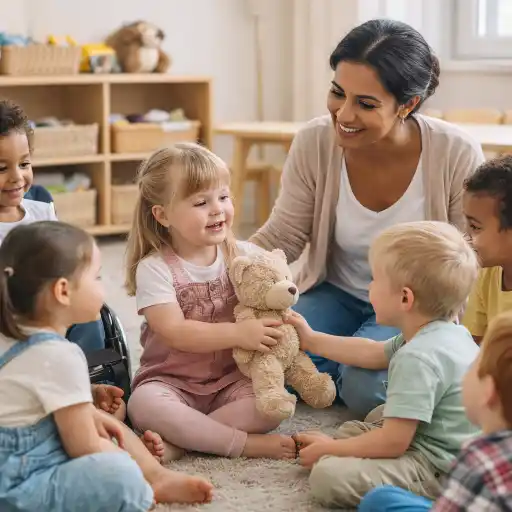
Children need honest, age-appropriate language rather than silence or vague reassurance. If a child points out a physical, cultural, or communication difference, respond calmly: “You noticed that Maya uses a wheelchair. Her wheelchair helps her move, just as your legs help you move.” Then connect the observation to respect: “People use different tools and ways to communicate, and everyone deserves to be included.”
Use accurate terms when children ask about race, disability, language, gender expression, or family structure. The goal is not to erase difference but to prevent difference from being ranked. Acknowledge unfairness directly when it occurs: “That statement could hurt someone. Families can look different, and every family deserves respect.” Keep explanations concrete and return to children’s ability to act kindly and fairly.
Helpful teacher language includes:
- “We can notice differences without making fun of anyone.”
- “Tell me what you need so you can join the play.”
- “There is more than one way to show you are listening.”
- “Fair does not always mean identical; fair means everyone gets what helps them participate.”
- “Let’s ask instead of guessing.”
When conflict occurs, intervene promptly and without shaming. Name the problem, restate the expectation, offer a repair, and teach a replacement phrase. For example: “You said her lunch was weird. Food can be different in different homes. You can say, ‘I have not tried that before,’ or choose not to comment.” Repeated conversations embedded in daily routines are more effective than a single diversity lesson.
How can families and directors sustain a culture of respect?
Families are experts on their children’s histories, relationships, routines, languages, strengths, and comfort strategies. Partnerships should be reciprocal rather than extractive: educators listen, families choose what to share, and both groups collaborate on meaningful goals. Ask questions that invite expertise without demanding personal disclosure, such as “What helps your child feel comfortable in a new group?” or “What words does your family use for important people and routines?”
Offer multiple communication formats, including translated messages, brief forms, phone conversations, and flexible meeting times. Never require a family to present a tradition or expect one child to speak for a cultural group. Respect a family’s decision not to share. When families do contribute a song, photograph, story, or word, acknowledge the contribution accurately and avoid turning it into a token activity.
Directors can support consistency by making respect a program-wide practice:
- Review enrollment forms and policies for assumptions about families, names, pronouns, food, holidays, and communication.
- Provide staff reflection time and professional learning on bias, inclusion, and culturally responsive practice.
- Audit discipline, referral, suspension, and participation patterns for inequities.
- Use common language for welcoming, conflict coaching, and equitable supports.
- Invite family feedback and respond visibly to concerns.
Track progress through small indicators: children inviting peers, using respectful language, seeking help, accepting different ways of participating, and referring positively to their families and classmates. Reflect with staff regularly; meaningful change is built through steady practice.
Conclusion: What is the central goal of teaching respect for individual differences?
The goal is not merely to help children tolerate difference. It is to help them recognize each person’s dignity, appreciate varied identities and abilities, challenge exclusion, and participate in a community where everyone belongs. Providers accomplish this through self-reflection, accurate representation, honest conversations, flexible participation, and reciprocal family partnerships.
Start with one practical change: add a broader range of books, learn a child’s preferred name pronunciation, revise a transition cue, or teach a sentence for inviting someone into play. Observe what changes, discuss the experience with colleagues and families, and continue refining your practice. For further professional learning, consider Strength in Differences: Cultural Diversity Buy Now $24.00, Recognize, Respond, Respect: Supporting Diverse Learners Buy Now $55.00, Planning for Every Child: Responsive Strategies in Action Buy Now $55.00, and Family Connections: Creating Inclusive Relationships Buy Now $55.00.
- 45 Hour Child Growth and Development
- Diversity, Equity, and Inclusion in Education: For Workforce Solutions
- From Play to Planning: Building Culturally Competent, Child-Centered Curriculum
- Teach with Respect!
- Recognize, Respond, Respect: Supporting Diverse Learners
- Diversity, Equity, and Inclusion in Education
- Diversity, Equity, and Inclusion in Education
- Texas Director Credential
- Families, Communities, and Classrooms: Working Together for Children
- 10 Ejemplos de Cómo la Cultura Influye en el Desarrollo Infantil
- Proporciones de Cuidado Infantil y Tamaños de Grupo por Edad en Maryland (Guía Rápida para Centros y Hogares)
- Proporciones de Cuidado Infantil y Tamaños de Grupo por Edad en Nueva Jersey (Guía Rápida para Centros y Hogares)
- Proporciones de Cuidado Infantil y Tamaños de Grupo por Edad en Virginia (Guía Rápida para Centros y Hogares)
- What Cultural Differences Can Be Mistaken for Behavior Problems in Child Care?
- From Mealtime to Manners: How Cultural Influences Show Up in Everyday Child Care
- Safe and Inclusive Learning Environment: Can Every Child Enter, Participate, Communicate, and Calm Down?
- What Does Compassion Look Like in Child Care? 10 Everyday Moments That Matter
- How Can Child Care Providers Support Individual Differences in Development?
- How Can Child Care Providers Teach Children to Respect Individual Differences?
- How Can Child Care Providers Include Children with Communication Differences?
- How Can Child Care Providers Use Learning Styles Responsibly in Early Childhood Classrooms?
- How Can Child Care Providers Teach Sharing Without Forcing It?
- Developmental Delay vs. Developmental Difference: What’s the Difference?
- How Can “All About Me” Activities Build a Stronger Classroom Community?
- How Can You Respond When a Family’s Expectations Differ from Your Classroom Routine?
- How Can Providers Explain Different Classroom Expectations to Families with Siblings?
- How Can Child Care Providers Respond When a Classroom Theme Misrepresents a Family’s Culture?
- How Can You Help an Infant Resume Exploring After Care Interrupts Play?
