Play is where children build friendships, negotiate ideas, and develop language—yet multilingual children may need intentional support to enter and sustain those interactions. Explore practical ways to make play more accessible with the Bienvenido! Welcoming All Families  Buy Now $16.00 course, which strengthens family-engagement practices and inclusive representation. For deeper strategies focused on dual language development, consider Building Bridges for Dual Language Learners Buy Now $16.00, which can help you create more responsive language-rich experiences.
Why does multilingual play deserve intentional support?
Play is not a break from learning; it is a primary context for communication, identity, problem-solving, and relationships. Children who use more than one language bring valuable knowledge, cultural experiences, and communicative resources to the classroom. Their language use may include English, a home language, gestures, facial expressions, drawing, movement, or a flexible combination of languages known as translanguaging.
Research and classroom studies suggest that children learning English may participate less often in cooperative play or rely more heavily on teachers to initiate peer interactions. This pattern should not be interpreted as a lack of interest, social ability, or competence. A child may be observing carefully, experiencing a normal silent period, or searching for the words needed to join an already-established play episode.
A responsive educator can remove that barrier without taking control of the play. The goal is not to replace the child’s home language with English, but to expand opportunities for communication across the child’s full linguistic repertoire. As NAEYC explains in its guidance on embracing linguistic diversity, children benefit when their languages and cultures are treated as strengths.
How can educators prepare a welcoming play environment?
The environment communicates who belongs before adults say a word. When children see familiar languages, family experiences, and culturally relevant materials in play centers, they have more entry points for participation. A multilingual environment also benefits children who speak only English by expanding curiosity and social understanding.
- Place picture-and-word labels in English and children’s home languages where families can verify accuracy.
- Include menus, signs, books, packaging, family photographs, maps, and writing materials in dramatic-play areas.
- Offer dolls, pretend foods, clothing, cooking tools, and household materials that reflect enrolled families without reducing cultures to stereotypes.
- Display visual routines for choosing materials, joining a group, requesting help, and cleaning up.
- Provide quiet spaces where children can observe before entering a busy play episode.
Commercial materials are helpful, but family contributions can make the space more authentic. Invite caregivers to share words, songs, photos, or safe empty packages connected to children’s lived experiences. The NAEYC discussion of superdiverse classrooms emphasizes family interviews, environmental supports, and ongoing collaboration as practical foundations.
Consider using Multilingual Play Support Cards for Educators as flexible invitations. A card might show “Can I play?”, “My turn,” “Help,” or “Let’s build,” paired with images and family-verified translations. Cards should supplement—not replace—relationships, gestures, modeling, and child choice.
What language strategies help children enter and sustain play?
Children often need language that is immediately usable in a social situation. Rather than giving long explanations, model short phrases connected to the child’s intention. If a child is holding a block near a group, an educator might say, “You want to build. Ask, ‘Can I play?’” The child may repeat the phrase, point, gesture, or use a home-language equivalent.
- Use parallel talk: “You are putting the blue block on top.”
- Use self-talk: “I am looking for a spoon for the restaurant.”
- Repeat and expand: “Car.” “Yes, a fast red car.”
- Pair words with objects, gestures, photographs, and demonstrations.
- Pause long enough for children to process and respond.
- Accept communication through speech, home language, gesture, drawing, sign, movement, or AAC.
The Hanen Centre’s “4 S’s”—say less, stress key words, go slowly, and show meaning—offers a useful reminder that comprehensible language does not mean impoverished language. Adults can use rich vocabulary while keeping sentences accessible and connected to the child’s focus.
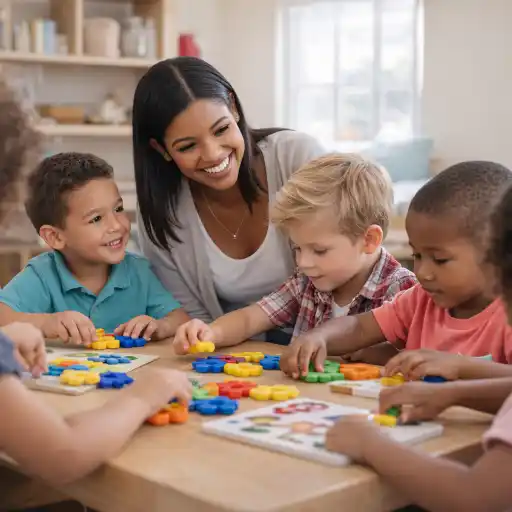
Use open-ended prompts when children are ready: “What are you making?” “How will the customer know?” or “What could we change?” Avoid pressuring children to perform English. A child who listens, watches, imitates, or responds in another language is participating meaningfully. The NAEYC conversation strategies recommend pairing language with joint activities, using small groups, responding to contributions, and treating home languages as resources.
How can teachers scaffold peer relationships without taking over?
Teachers are often the bridge between a child’s intention and a peer’s understanding. Begin by observing: What is the child trying to do? Who might be receptive? What support would make the interaction successful? Then enter briefly, interpret the intention, provide a usable phrase or gesture, and step back.
- “Sam is showing you the bakery. Sam wants to know if you want bread.”
- “You can point to the card or say, ‘My turn.’”
- “Mina asked, ‘Can I play?’ You can answer, ‘Yes,’ or show where she can help.”
- “You both want the same truck. Let’s think of two ways to solve it.”
Choose peers thoughtfully. Pair a multilingual child with a patient, socially confident peer who is willing to share materials—not necessarily the child who speaks the most. Small groups reduce language demands and provide repeated opportunities to practice the same phrases. Cooperative tasks such as building a bridge, preparing pretend food, caring for dolls, or creating a roadway give children a shared purpose.
Teach English-speaking peers that communication includes waiting, pointing, showing, repeating, and learning words from friends. This prevents multilingual children from being labeled as unfriendly when they are actually processing language. Eastern Connecticut State University’s study of DLL play found that adult scaffolding helped children initiate and sustain more positive peer interactions.
Step back when children begin communicating independently. Over-interpreting every exchange can unintentionally make the teacher the center of the relationship. Support should increase access to peer play, not create dependence on adult translation.
How can families strengthen multilingual play experiences?
Families are essential partners because they know the child’s communication patterns, interests, home routines, and preferred language practices. Ask questions that invite expertise: “What words does your child use when asking to join?” “Which pretend-play experiences are familiar at home?” “Are there regional words or pronunciations we should use?”
- Invite families to contribute translations for play phrases and object names.
- Ask caregivers to share songs, stories, recipes, photographs, or voice recordings.
- Create family-informed dramatic-play themes such as a market, bakery, bus station, clinic, or home kitchen.
- Send home one simple play invitation that can be enjoyed in the family’s preferred language.
- Use interpreters or translated communication for complex developmental, health, or safety discussions.
Encourage families to continue rich conversations in the home language. Strong home-language development supports children’s concepts, relationships, identity, and ability to make connections across languages. Ask families to correct classroom materials respectfully; accuracy matters more than a teacher appearing fluent.
The NAEYC example of using family stories demonstrates how children’s experiences can become meaningful classroom content. Family knowledge can guide play themes, vocabulary, props, and questions while helping children see their lives represented in the learning environment.
How can directors and educators evaluate progress and avoid common mistakes?
Observation is more useful than counting English words. Document how children enter play, communicate intentions, respond to peers, use materials, persist through misunderstandings, and draw on different languages or modes of communication. Include family perspectives and observations from staff who may understand the child’s home language.
- 😊 Notice strengths first: curiosity, imitation, humor, problem-solving, empathy, and willingness to participate.
- Record the context, not just the behavior: who was present, what materials were available, and what support helped.
- Look for growth across languages and communication modes.
- Revisit observations during planning and adjust partners, materials, group size, or visual supports.
Common mistakes include asking families to stop speaking their home language, treating code-switching as confusion, requiring children to speak English before joining play, and using inaccurate translations without family review. Avoid making one child responsible for interpreting sensitive information. Also avoid tokenism: a single cultural celebration cannot substitute for everyday representation.
State requirements vary - check your state licensing agency, particularly when documenting developmental progress, using interpreters, or selecting required curriculum and training. Directors can support staff by providing shared phrase cards, protected planning time, access to qualified language resources, and reflective coaching.
Additional professional learning may come from Building Bridges for Dual Language Learners Buy Now $25.00, Supporting Families and Caregivers in Language and Literacy Buy Now $16.00, and Family Voices Matter: Tools for Meaningful Collaboration Buy Now $55.00. These courses complement the daily use of Multilingual Play Support Cards by strengthening language development, family partnership, and culturally responsive practice.
Conclusion: What is the central goal of multilingual play support?
Supporting children who use more than one language during play means creating conditions in which every child can enter, influence, and enjoy shared activity. The most effective approach combines welcoming materials, visual and verbal supports, responsive adult scaffolding, carefully selected peer partners, and genuine family collaboration.
Begin with one play center. Add a few family-verified phrases, pictures, and culturally relevant props. Observe what children communicate through words, gestures, movement, and home languages, then refine the environment and your responses. When educators protect children’s linguistic identities while expanding opportunities for peer interaction, play becomes a powerful bridge to belonging, communication, and learning.
- Building Bridges for Dual Language Learners
- CDA Home Visitor Subject Area 3 Part 3 Birth to 5
- Building Bridges for Dual Language Learners: For Workforce Solutions
- From Play to Planning: Building Culturally Competent, Child-Centered Curriculum
- Recognize, Respond, Respect: Supporting Diverse Learners
- The Best Promotion is Play
- Play with Purpose: Supporting Children with Autism
- Creating Engaging and Meaningful Learning Experiences
- Language Development in Early Childhood
- Building Vocabulary
- CDA Certification en Español: Recursos y Consejos para Educadores Bilingües
- Canciones, juegos y preguntas de círculo para niños
- Talk, Listen, Connect: Build Stronger Child Care Relationships in 9 Hours
- What Makes a Great Home Daycare? 10 Things Parents Notice First
- First Week of Pre-K Lesson Plans: What Can You Learn About Your New Class?
- How Can Child Care Providers Support Memory Development in Young Children?
- How Can Child Care Providers Support Preschool Development Across the Whole Child?
- How Can Emergent Readers Support Vocabulary Growth?
- How Can Child Care Providers Turn Everyday Routines into Learning Opportunities?
- How Can Child Care Providers Strengthen Language and Literacy Development?
- How Can Child Care Providers Use Learning Styles Responsibly in Early Childhood Classrooms?
- How Can Child Care Providers Respond When Children Exclude Others From Play?
- How Can Child Care Providers Teach Young Children to Take Turns?
- How Can Child Care Providers Teach Sharing Without Forcing It?
- How Can Early Math Activities Build Young Children’s Mathematical Thinking?
- How Can Child Care Providers Assess Children Through Everyday Activities?
- What Speech and Language Milestones Should Child Care Providers Know?
- At What Age Do Children Start Playing Together?
- How Can Child Care Providers Support Kindergarten Emotions on the First Day of School?
- How Can Camping Themes Expand Preschool Vocabulary?
