Healthy meals and snacks can support children’s growth, learning, and sense of belonging without requiring elaborate recipes or unrealistic budgets. Strengthen your practical skills with Nutrition Essentials for Child Care Providers  Buy Now $16.00, which addresses balanced meal planning, food labels, preparation, storage, allergies, and feeding challenges while helping you build relevant professional knowledge.
Why Do Healthy Meals and Snacks Matter in Early Care?
Food is part of the learning environment. Young children need nutrient-dense foods to support healthy growth, brain development, physical activity, emotional regulation, and participation in classroom experiences. Early eating experiences also shape children’s familiarity with flavors, textures, routines, and social expectations around food. The CDC recommends offering a variety of fruits, vegetables, proteins, dairy foods, healthy fats, and whole grains while limiting added sugars and highly sweetened beverages (Good Nutrition Starts Early).
For providers, a thoughtful food program is more than a menu. It is an opportunity to create predictable routines, support autonomy, honor family culture, and notice children’s hunger and fullness cues. Positive mealtimes can also build language, motor skills, social competence, and confidence.
USDA’s Child and Adult Care Food Program (CACFP) nutrition standards encourage greater variety in fruits and vegetables, whole grains, lean meats and meat alternatives, and low-fat or fat-free dairy while minimizing added sugar and saturated fat. Programs participating in CACFP should use current federal guidance and their sponsor’s requirements when planning and documenting meals.
- Offer variety across the week rather than expecting every plate to be perfect.
- Include familiar foods alongside less familiar foods.
- Use age-appropriate portions, textures, and serving sizes.
- View meals as relationship-based learning opportunities, not just feeding occasions.
How Can Providers Build Balanced Menus?
Begin with a repeatable weekly structure. A simple rotation reduces decision fatigue, controls purchasing, and gives children repeated exposure to foods. The Institute of Child Nutrition’s Menu Planning Basics provides sample menus, shopping lists, recipes, and planning tools for CACFP operators.
For snacks, CACFP generally requires two of five components: fluid milk, meat or meat alternates, vegetables, fruits, or grains. Requirements vary by age and program type, so providers should consult the current CACFP snack meal pattern and local guidance. A practical pairing might be fruit with yogurt, vegetables with hummus, or whole-grain crackers with cheese.
For meals, aim to represent the required components while keeping flavors and textures familiar. Rotate colors, cultural foods, seasonal produce, and preparation methods. Fresh, frozen, and appropriately selected canned fruits and vegetables can all be useful; choose options without added sugar and, where possible, lower in sodium.
- Monday: oatmeal, banana, and milk; turkey, brown rice, peas, and fruit.
- Tuesday: whole-grain toast, egg, and fruit; beans, corn tortillas, vegetables, and yogurt.
- Wednesday: yogurt, berries, and whole-grain cereal; chicken, whole-grain pasta, vegetables, and milk.
- Thursday: cheese, fruit, and whole-grain crackers; tofu or beans, sweet potato, greens, and fruit.
- Friday: vegetable-and-cheese quesadilla, fruit, and milk; a family-style meal featuring a culturally familiar recipe.
State requirements vary - check your state licensing agency before adopting a menu or serving policy.
How Can Mealtimes Encourage Responsive Feeding?
Responsive feeding divides responsibility between the adult and the child. Adults decide what food is offered, when it is offered, and where it is served. Children decide whether to eat and how much to eat from the available choices. Head Start’s child feeding guidance emphasizes that staff should not force children to eat, require them to clean their plates, or use food as a reward or punishment.
This approach respects children’s developing self-regulation. A child may be hungry one day and eat very little the next. That variation is not automatically a concern. Providers can offer regular meals and snacks, sit with children, model enjoyment of nutritious food, and calmly acknowledge cues such as “hungry,” “full,” or “all done.”
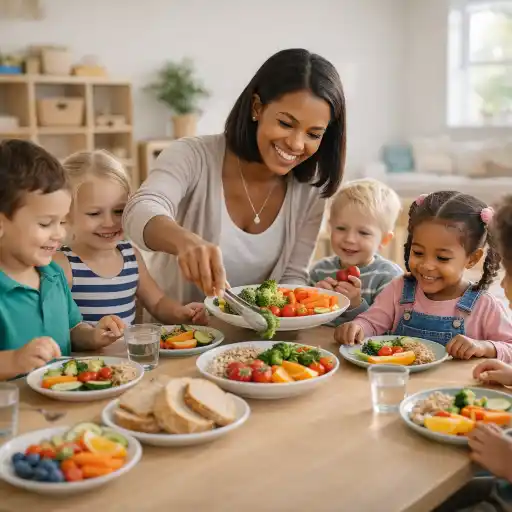
Family-style dining can make meals more social and educational. When developmentally appropriate and safe, children can help pass bowls, serve small portions, use utensils, pour water with assistance, and clean their spaces. Teachers can introduce vocabulary such as crunchy, smooth, warm, sour, and sweet without pressuring children to taste.
- Offer a familiar food with a small portion of a new food.
- Allow children to look at, smell, touch, or leave a new food.
- Use neutral descriptions instead of calling foods “good,” “bad,” or “junk.”
- Give enough time for children to eat without rushing.
- Never compare children’s eating habits publicly.
How Can Programs Address Allergies, Choking, and Food Safety?
Nutritious food must also be served safely. Directors should maintain current enrollment records, written allergy action plans, parent communication procedures, and staff training. Labels should be read each time food is purchased or donated because ingredients and manufacturing practices can change.
Prevent cross-contact by washing hands, cleaning and sanitizing eating surfaces, separating allergy-safe foods when required, and using appropriate utensils. Teach children a simple no-sharing rule. Staff should know how to recognize symptoms of an allergic reaction and follow the program’s emergency procedures. ChildCareEd’s Prevention of and Response to Allergic Reactions Buy Now $8.00 course offers focused training on prevention and emergency response.
Choking prevention requires close supervision, upright seating, and developmentally appropriate preparation. Cut grapes and cherry tomatoes lengthwise and into small pieces, soften hard vegetables, and avoid whole nuts, popcorn, large chunks of cheese, sticky globs of seed butter, and other high-risk shapes for young children. Infants and toddlers require individualized feeding plans; honey should not be served to children younger than 12 months.
- 🧼 Wash hands before and after food preparation and eating.
- Check temperatures and storage procedures for perishable foods.
- Use separate cutting boards and utensils when cross-contact is a concern.
- Keep emergency contacts and action plans accessible to authorized staff.
- Document substitutions so every classroom follows the same plan.
How Can Healthy Food Become Meaningful Curriculum?
Nutrition education works best when it is hands-on, culturally responsive, and free from pressure. Children can sort foods by color, count berries, compare textures, plant seeds, wash produce, or create a classroom cookbook with family recipes. Such experiences support math, science, language, motor development, and social learning while making food familiar. For a playful introduction to digestion and nutritious foods, providers may also find this guide to feeding the “gut gnomes” in children’s tummies useful.
Use mealtimes to build conversation rather than deliver lectures. Ask, “What do you notice?” or “How does the cucumber feel?” Invite children to identify colors, describe smells, and discuss where foods come from. Gardening, pretend farmers’ markets, and food-related stories can extend learning without requiring children to eat a particular item.
Family partnership is equally important. Share menus in advance, invite information about cultural foods and dietary practices, and communicate substitutions respectfully. Avoid describing families as noncompliant when food access, work schedules, culture, or medical needs affect eating patterns. A strengths-based approach asks what already works and how the program can build on it.
Common mistakes include offering too much novelty, pressuring children to taste, relying on sugary drinks, overlooking labels, and creating menus staff cannot realistically prepare. A better system is modest and consistent:
- Use a four- or five-week rotating menu.
- Keep familiar backup foods available.
- Assign responsibility for label and temperature checks.
- Review menus with staff and families.
- Evaluate what children eat, what gets wasted, and what routines need adjustment.
Conclusion: What Is the Best Approach to Healthy Meals and Snacks?
The strongest approach combines balanced food choices, responsive feeding, reliable safety procedures, and meaningful learning. Healthy menus do not need to be expensive or complicated: pair food groups, rotate ingredients, limit added sugars, adapt textures, and plan substitutions before problems arise.
Providers are already doing important work when they create calm routines, model positive eating, collaborate with families, and respect children’s individual cues. Use USDA and CACFP resources to confirm current meal-pattern expectations, and remember that state requirements vary - check your state licensing agency. For broader professional development, explore these relevant ChildCareEd courses. For a broader look at child health and nutrition—including breastfeeding, healthy eating, and parents’ role in early childhood education—read CDA and Child Health and Nutrition.
- Food Preparation and Nutrition Buy Now $32.00 — planning, preparing, storing food, and preventing foodborne illness and allergies.
- Healthy Starts: Safety, Nutrition, and Wellness in Child Care Buy Now $55.00 — nutrition, wellness, supervision, chronic health needs, and allergies.
- On My Plate: Children’s Nutrition Buy Now $24.00 — MyPlate, portions, meal planning, and practical nutrition strategies.
- CDA Home Visitor Subject Area 3 Part 3 Birth to 5
- CDA Home Visitor Subject Area 2 Part 3 Birth to 5
- Nutrition Essentials for Child Care Providers
- CDA Bridge Bundle: Family Child Care without Portfolio Review
- CDA Bridge Bundle: Infant/Toddler without Portfolio Review
- CDA Bridge Bundle: Preschool without Portfolio Review
- Positive Attention: Interactions & Supervision for Infants & Toddlers
- Texas Director Credential
- On My Plate: Children's Nutrition
- CDA Infants/Toddlers: Smart Nutrition & Feeding
- Ohio Healthy Programs (OHP)
- Cocoa, Cookies, and Cognitive Development: The Holiday Nutrition Guide for Little Learners
- A Nutcracker’s Guide to Nutrition: Teaching Healthy Holiday Eating Habits
- Kickstart a Healthy Routine for Kids That Actually Sticks Past January
- Pizza or Kale Chips? Kid-Friendly Nutrition Tips to Start the Year Right
- CDA Certification en Español: Recursos y Consejos para Educadores Bilingües
- Proporciones de Cuidado Infantil y Tamaños de Grupo por Edad en Maryland (Guía Rápida para Centros y Hogares)
- Proporciones de Cuidado Infantil y Tamaños de Grupo por Edad en Nueva Jersey (Guía Rápida para Centros y Hogares)
- Proporciones de Cuidado Infantil y Tamaños de Grupo por Edad en Virginia (Guía Rápida para Centros y Hogares)
- How can preschool programs build healthy eating habits for young children?
- Diversión fresca de verano: actividades del Día Nacional del Helado para niños
- Canciones, juegos y preguntas de círculo para niños
- Snack Ideas for Daycare: Healthy Options Children Will Enjoy
- How can Michigan child care programs use CACFP and Summer Meals to keep children nourished when school is out?
- How can SUN Meals and CACFP keep North Dakota children fed all summer?
- Snack Time in Daycare: Healthy Foods and Safety Tips
- What Healthy Snack Ideas Will Kids Actually Love?
- What’s for Snack Again? Easy Daycare Ideas Kids Won’t Get Bored With
- Food Program for Childcare Providers: Are You Missing Out on Meal Reimbursement?
- How Can Child Care Providers Serve Healthy Meals and Snacks That Children Enjoy?
