When the same crackers and bananas start inspiring more yawns than smiles, a simple rotation can refresh snack time without creating extra work. Explore Nutrition Essentials for Child Care Providers  Buy Now $16.00 to strengthen menu planning, food-label reading, allergy awareness, and feeding practices while earning professional training hours. For a broader wellness perspective, Healthy Starts: Safety, Nutrition, and Wellness in Child Care Buy Now $55.00 connects snacks with children’s health, supervision, and inclusive care.
Snack planning can feel like a small task that somehow occupies a large portion of a provider’s mental energy. Children want novelty, families want nutritious choices, staff need realistic preparation, and directors must account for allergies, choking risks, budgets, and program requirements. The good news is that variety does not require a completely new recipe every day.
A reliable snack system combines familiar foods in different formats, adds occasional playful presentation, and keeps safety routines consistent. The goal is not to make every snack “Pinterest perfect.” It is to create predictable opportunities for nourishment, independence, conversation, and positive food exploration.
Why does snack variety matter in early care?
Young children have small stomachs and high activity levels, so snacks can help bridge the time between meals. Nutritious choices provide energy and important nutrients that support growth, attention, play, and participation. The CDC emphasizes offering a range of vegetables, fruits, proteins, dairy foods, healthy fats, and whole grains rather than relying on one type of food. For providers pursuing the CDA, this overview of child health and nutrition connects healthy eating with the role families play in early care.
Variety also supports learning. Children compare colors, textures, smells, shapes, and tastes while practicing vocabulary, counting, turn-taking, self-help skills, and decision-making. A child who does not eat a new food may still be learning by touching it, smelling it, or seeing a trusted adult enjoy it.
- ✅ Offer familiar foods alongside less familiar foods.
- Use neutral language such as “crunchy,” “soft,” or “cold” instead of labeling foods “good” or “bad.”
- Respect hunger and fullness cues; children do not need to clean their plates.
- Keep portions small enough to feel manageable, with additional servings available when appropriate.
Snack time is therefore more than a nutrition break. It is a relationship-based routine in which children can feel competent and included. A calm, responsive approach matters especially for #preschoolers who are selective eaters or sensitive to particular textures.
How can providers build a simple snack rotation?
Start with a five-day pattern rather than an endless list of recipes. A rotation reduces decision fatigue, simplifies purchasing, and gives children enough repetition to become comfortable with foods. Rotate the pairing, texture, shape, or presentation while keeping at least one familiar element.
- Monday—fruit and dairy: apple slices with yogurt, berries with cottage cheese, or banana with milk.
- Tuesday—vegetable and protein: cucumber rounds with hummus, soft peppers with bean dip, or steamed vegetables with cheese.
- Wednesday—whole grain and fruit: whole-grain crackers with applesauce, oatmeal with pears, or toast with sliced strawberries.
- Thursday—protein and grain: egg with toast strips, cheese quesadilla with fruit, or yogurt with whole-grain cereal.
- Friday—build-your-own: mini pita pizzas, yogurt parfaits, or a small snack plate with two choices.
These pairings reflect the practical principle of combining two food groups. If your program participates in CACFP, consult current meal-pattern guidance and your sponsoring organization before finalizing menus. USDA standards encourage variety, whole grains, fruits and vegetables, lean proteins, and limits on added sugar and saturated fat.
Post the rotation where staff can see it, and share it with families. Include planned substitutions, allergy notes, and whether food is served chilled, cooked, or ready to eat. State requirements vary - check your state licensing agency.
What easy snack ideas can prevent boredom?
The most useful ideas are flexible combinations rather than complicated recipes. Change the format while keeping ingredients familiar. For example, apples can be served as thin slices, applesauce, baked pieces, or paired with cheese. Yogurt can become a dip, parfait, or frozen fruit mixture that is softened before serving.
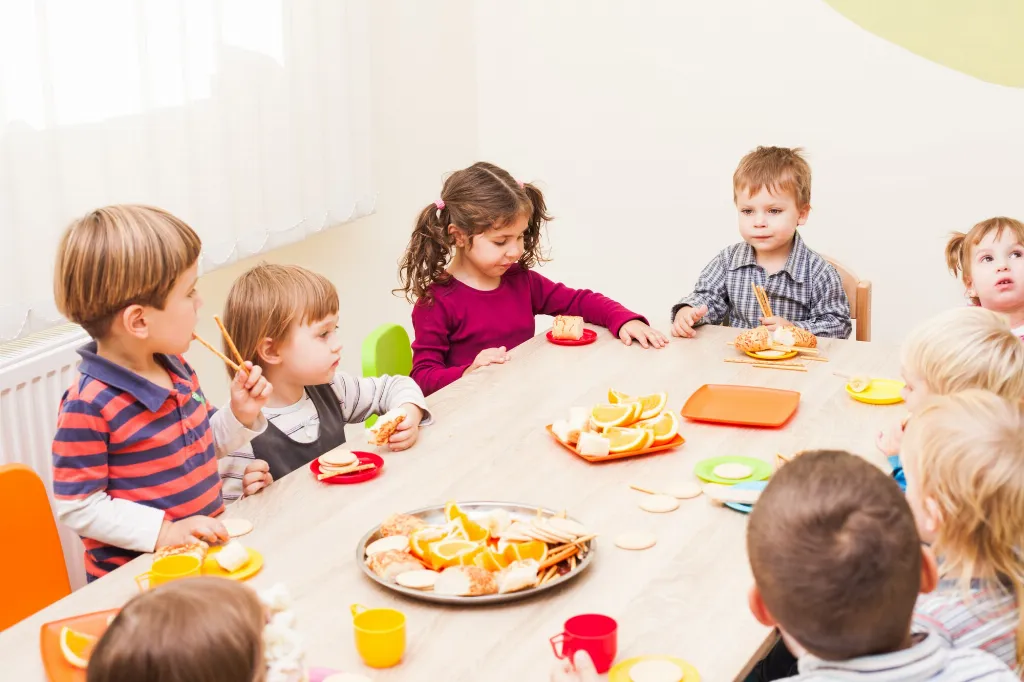
- 🍎 Apple slices with sunflower-seed butter or cream cheese.
- Banana coins with plain yogurt and cinnamon.
- Quartered grapes with cheese, prepared according to age and safety guidance.
- Cucumber rounds with hummus or a yogurt-based dip.
- Whole-grain pita triangles with mashed beans or hummus.
- Rice cakes with cream cheese and soft berries.
- Mini whole-wheat pita pizzas with tomato sauce and mozzarella.
- Hard-boiled egg with soft peaches or pears.
- Yogurt parfaits with berries and a nut-free, age-appropriate grain topping.
- Whole-grain crackers with tuna or egg salad when permitted and appropriately prepared.
For no-cook classroom activities, children can layer yogurt and fruit, spread soft toppings, sort fruit by color, or assemble a “rainbow cup.” Adults should handle knives, appliances, skewers, and any hot food. Keep a backup bin with shelf-stable items such as applesauce cups, whole-grain crackers, and approved milk products for unexpected schedule changes.
Playful presentation can invite curiosity, but it should never become pressure. A cucumber “smile” or fruit color chart is an invitation—not a demand to eat. This distinction helps preserve trust and supports #curiosity around food.
How do nutrition and safety guide the menu?
A snack can be appealing and still require careful evaluation. Before serving, consider the child’s age, developmental feeding skills, allergies, cultural or family preferences, storage needs, and the program’s written policies.
The CDC advises preparing food in developmentally appropriate shapes, sizes, and textures. Young children should sit upright, remain supervised, and eat in a calm setting. Foods such as whole grapes, uncut cherry tomatoes, hard raw vegetables, whole nuts, sticky globs of seed butter, popcorn, tough meat, and large cheese pieces may present choking risks. Preparation and serving practices must be adapted rather than assumed to be safe because a food is nutritious.
- Read ingredient labels every time; manufacturers may change formulations.
- Document food allergies and keep emergency action plans accessible to authorized staff.
- Prevent cross-contact with clean hands, sanitized tables, labeled foods, and separate utensils when needed.
- Teach a clear, age-appropriate “we do not share food” routine.
- Keep perishable foods at appropriate temperatures and follow local food-safety procedures.
Nut-free does not automatically mean allergen-free. Sesame, milk, egg, wheat, soy, and other ingredients may also require accommodations. Directors should ensure that every staff member understands the program’s allergy procedures and emergency response expectations. The companion snack safety guidance offers additional practical reminders for cleaning, cutting, labeling, and supervision.
How can snack time support picky eaters and classroom learning?
Selective eating is common in early childhood and is not necessarily misbehavior. Children may respond to texture, smell, temperature, color, developmental change, or a desire for control. Pressure, bribery, and forced tasting can increase stress and make food refusal more entrenched.
Instead, provide a familiar food with a small portion of the new food. Let children decide whether to touch, smell, taste, or leave it. Repeated low-pressure exposure is more supportive than expecting immediate acceptance. Adults can model curiosity by describing their own sensory experience: “This pear is juicy,” or “The cracker is crisp.”
- Invite children to wash produce, pour yogurt, stir, sort, or arrange foods.
- Offer two acceptable choices: “Would you like cucumber or banana?”
- Use food-related learning without requiring children to eat during the activity.
- Ask families about cultural foods, sensory preferences, and successful strategies at home.
- Observe patterns and communicate concerns without diagnosing; consult families and appropriate health professionals when needed.
Snack can also become a mini curriculum experience: count crackers, compare sizes, identify colors, graph favorite dips, or practice words such as “smooth,” “crunchy,” and “juicy.” The free Snack Station Buy Now $0.00 resource can help organize children’s participation and independence. With thoughtful support, #snacktime becomes a place where children practice autonomy while feeling safe and respected.
What common snack-planning mistakes should programs avoid?
Even experienced teams can fall into routines that create unnecessary stress or risk. A short review of common pitfalls can improve consistency across classrooms and shifts.
- Trying to invent something new daily: Use a rotating template and vary presentation instead.
- Serving only highly preferred foods: Pair a familiar choice with a small, low-pressure exposure to another food.
- Forgetting substitutions: Plan an approved alternative before the menu is posted.
- Skipping label checks: Assign responsibility for checking every delivery and donated item.
- Using unsafe shapes: Review CDC choking guidance and adapt foods to each developmental level.
- Turning tasting into a contest: Avoid rewards, shame, or public comparisons between eaters.
- Overcomplicating preparation: Keep no-cook choices available for busy days and staff coverage changes.
Directors can strengthen implementation with a one-page snack checklist: menu and components, allergy substitutions, preparation notes, temperature requirements, supervision assignments, and cleanup responsibilities. Review the checklist during staff orientation and periodically during team meetings.
Use CACFP resources when applicable, but do not assume that a menu found online automatically meets your program’s requirements. Crediting rules, portions, infant patterns, and state regulations may change. State requirements vary - check your state licensing agency and your CACFP sponsor or administering agency.
Finally, invite staff feedback. The person preparing snack may know which foods create waste, which containers children cannot open, or which textures are difficult for a particular group. Treat that information as program improvement data, not criticism.
Conclusion: How can daycare snacks stay fresh without becoming complicated?
The answer is a repeatable system with room for creativity. Build snacks around two complementary food groups, rotate familiar ingredients, and change the format rather than starting from scratch. Include children in safe preparation and conversation, while respecting hunger cues and avoiding pressure.
Safety remains the foundation: adapt textures and shapes, supervise children while eating, prevent cross-contact, read labels, and communicate clearly with families. Nutrition standards and licensing expectations should guide the menu; state requirements vary - check your state licensing agency.
Three actions to try this week:
- Create a five-day snack rotation with one planned substitution for each major allergen concern.
- Prepare a backup bin and a classroom snack checklist.
- Choose one snack for children to assemble, sort, describe, or vote on without requiring anyone to taste it.
When snack time is predictable for adults but varied for children, everyone benefits. Providers gain a calmer workflow, directors gain clearer systems, and children gain nourishing opportunities to explore food, build independence, and enjoy being together.
Helpful ChildCareEd training options:
- CDA Family Child Care Credential
- Birth to Five CDA Credential with Portfolio Review
- CDA Family Child Care Credential with Portfolio Review
- CDA Bridge Bundle: Preschool
- CDA Bridge Bundle: Family Child Care
- 24 Hour Texas Pre-Service
- Potty Training Made Simple
- CDA Bridge Bundle: Infant/Toddler
- Texas Director Credential
- Confidence Boosters for Preschoolers
- Recursos en Español sobre el Sueño Seguro del Bebé
- Que es Título 22 en California?
- ¿Cuáles son los pasos, requisitos y opciones en línea para la certificación de 90 horas en cuidado de Infantes/Toddlers en Maryland?
- ¿Cómo afecta la dopamina a los niños: señales, efectos e influencias diarias?
- ¿Cómo solicito la licencia para una guardería en California?
- Lista para Abrir una Guardería en Casa en Dakota del Norte: Cómo Empezar
- Lista para Guardería en Casa en Illinois: Cómo Iniciar una Guardería en el Hogar
- Lista para Guardería en Casa en Texas: Cómo Iniciar una Guardería en el Hogar
- Cómo Trabajar en el Cuidado Infantil en California: Requisitos y Pasos
- Daycare Center Requirements in Texas
- How to Celebrate Cinco de Mayo in Your Center or Daycare
- Team-Building Activities for Daycare: Helping Children Learn Together
- Safe Temperature Regulations in Daycare: Georgia Rules for Child Care Providers
- Secure Classroom Technology: Protecting Children While They Learn
- What indoor activities work best for school-age children in daycare?
- What Healthy Snack Ideas Will Kids Actually Love?
- Why Is Repeating Favorite Books So Valuable for Young Children?
- What’s for Snack Again? Easy Daycare Ideas Kids Won’t Get Bored With
