What happens when children color 5, 10, 15, 20, 25... on a hundreds chart? A clear pattern begins to appear—and that visual pattern can make skip-counting easier to understand. In this article, we’ll explore how educators can help children recognize multiples of five, build number-pattern awareness, and strengthen early math reasoning with ideas from No Such Thing as Boring Math  Buy Now $24.00 and the Color the Multiples of 5: Hundreds Chart Coloring Activity Buy Now $1.49.
Why does recognizing multiples of five matter?
Recognizing multiples of five is more than memorizing a sequence such as 5, 10, 15, and 20. Children are beginning to notice relationships among numbers, connect quantities to written symbols, and understand that equal groups can be represented in several ways. These ideas support later multiplication, division, money, time, measurement, and mental calculation.
A number chart makes these relationships visible. Rather than presenting a disconnected list, the chart allows children to observe where multiples occur, compare them with neighboring numbers, and describe the rule that organizes them. Research on early patterning suggests that children’s ability to identify and extend patterns is associated with later mathematics knowledge (Reference 19).
This work also matters because it gives providers meaningful opportunities to observe mathematical thinking. A child may know the verbal sequence but not identify 35 on a chart, or may recognize numbers ending in 0 but overlook numbers ending in 5. Those differences help teachers plan responsive support.
What should children understand about multiples of five?
Begin with a clear, accessible definition: multiples of five are numbers made by adding five repeatedly or by making equal groups of five. On a 1–100 chart, the sequence is 5, 10, 15, 20, 25, 30, and so forth. Children should eventually see that each number is five more than the previous number.
Use multiple representations before expecting children to work only with symbols:
- Five counters, five fingers, or five objects represent one group of five.
- Two groups of five represent 10; three groups represent 15.
- A number line shows equal jumps of five.
- A number chart shows the repeated location and final-digit pattern.
Invite children to use precise language: “I started at 5 and added 5,” “25 is a multiple of 5,” or “40 is eight groups of 5.” Be careful not to imply that every number ending in 0 or 5 is automatically understood as a multiple; children need opportunities to explain why the pattern works.
The relationship between fives and tens is especially useful. Every multiple of 10 is also a multiple of 5, but not every multiple of 5 is a multiple of 10. Representing one group of 10 as two groups of 5 helps prevent this common misconception.
How can teachers introduce a number-chart investigation?
Use a traditional 1–100 chart so children can see both the selected numbers and the numbers being skipped. The Color the Multiples of 5: Hundreds Chart Coloring Activity Buy Now $1.49 offers a low-preparation option in which children color every multiple of five and observe the resulting pattern.
Introduce the task gradually:
- Place a large chart where children can reach it. Begin at 5 and touch each number while counting aloud: “5, 10, 15, 20.”
- Ask children what changes each time. Accept observations such as “It goes up by five” or “It ends in 5 or 0.”
- Invite children to place a marker on each multiple. Use buttons, sticky notes, or reusable counters before adding coloring.
- Ask children to predict the next location before moving forward.
- Return to the chart from different starting points, such as 25, 40, or 65, so learning does not become purely rote.
Reference 5 similarly emphasizes oral skip-counting, touching numbers, varying starting points, and using missing-number challenges to encourage flexible thinking. Keep the tone exploratory: children are investigating a pattern, not being tested for speed.
Which playful activities strengthen recognition and reasoning?
Children benefit from repeated encounters with the same concept through different modalities. Rotate short activities rather than assigning one long worksheet.
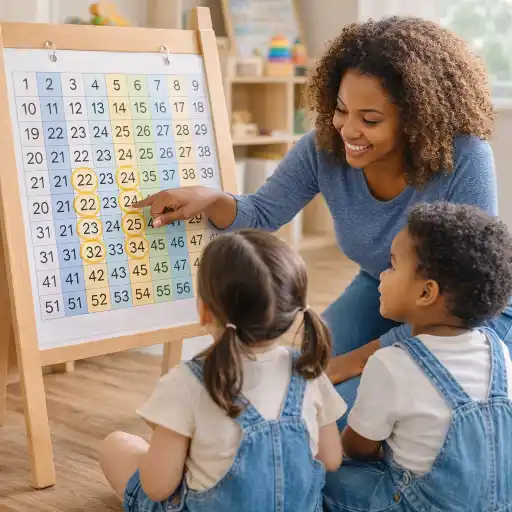
- Chart detectives: Cover several multiples with sticky notes. Children identify the missing numbers and explain how they know.
- Number-chart jumps: Place a floor chart on the ground. Call a multiple of five and invite children to jump to it while saying the related addition or multiplication fact.
- Build the groups: Give children counters in groups of five. After building three groups, ask them to locate 15 on the chart.
- Pattern prediction: Mark 10, 15, 20, and 25. Ask, “Where should the next marker go?”
- Partner challenge: One child marks a sequence beginning at a chosen multiple; the partner finds the missing markers.
- 🎵 Movement and rhythm: Clap, tap, or march once for each multiple while the group counts aloud.
Use the skip-counting charts from Math Worksheets 4 Kids as visual references, and adapt the activity to children’s developmental levels. A child who is still learning one-to-one correspondence may work with groups of five and a smaller chart, while another child may begin at 35 and count forward.
How can providers differentiate, assess, and extend learning?
Differentiation is not about lowering expectations; it is about providing an accessible entry point and a meaningful next step. Observe whether a child can recognize numerals, count objects in groups, identify the pattern, and explain the relationship between numbers.
- Emerging learners: Use quantities up to 20, large markers, tactile counters, and adult modeling. Count aloud together.
- Developing learners: Use the full chart, cover selected numbers, and ask children to complete missing multiples.
- Extending learners: Start at 30 or 45, count backward, compare multiples of 5 and 10, or write equations such as 4 × 5 = 20.
- Children needing motor support: Offer magnetic markers, larger objects, verbal responses, or partner assistance.
- Dual language learners: Pair gestures, numerals, visuals, and number words in the child’s home language when possible.
Assessment can be brief and embedded. Ask, “Show me a multiple of five,” “What comes after 35?” and “How do you know 42 is not in our pattern?” Record the strategy, not only the answer. For example: “Jordan located 25 by counting from 5 but did not yet explain the final-digit pattern.” This observation suggests a useful next step: compare 25 with nearby numbers such as 24 and 26.
State requirements vary - check your state licensing agency when connecting this activity to documentation, curriculum standards, or professional development expectations.
What common mistakes should teachers avoid?
Several instructional choices can unintentionally make multiples of five harder to understand. Avoid presenting only a pre-highlighted sequence, because children may memorize the visible answers without learning to locate or generate them. Traditional charts are valuable because they show the numbers that are skipped and invite children to make decisions (Reference 5).
Also avoid requiring speed. Fluency develops through accurate, meaningful repetition; rushing can increase anxiety and conceal misconceptions. Do not correct every response immediately. Instead, ask, “How did you decide?” and use the explanation to determine whether the child needs concrete materials, a number line, or a smaller range.
Finally, avoid treating coloring as the learning objective. Coloring can support visual pattern recognition, but it should be paired with conversation, movement, grouping, and prediction. Ask children to connect the chart to authentic contexts:
- counting nickels or groups of five objects;
- reading the clock in five-minute intervals;
- organizing materials into groups of five;
- sharing how many objects are in several equal groups.
When teachers combine visual structure with hands-on reasoning, children are more likely to understand what the pattern means rather than simply reproduce it.
Conclusion: How can children become confident with multiples of five?
Children recognize multiples of five most effectively when they repeatedly connect concrete groups, spoken counting, movement, written numerals, and the visual structure of a number chart. Begin with equal groups of five, model counting by adding five, highlight the sequence on a full 1–100 chart, and invite children to predict, explain, and find missing numbers.
Use playful practice, vary starting points, and document children’s strategies so instruction can respond to individual needs. The goal is not merely for children to recite 5, 10, 15, and 20. The goal is for them to recognize the pattern, explain the relationship, apply it in everyday situations, and approach early mathematics with curiosity and confidence.
For continued professional learning, consider Math Foundations in Early Childhood Buy Now $16.00, which focuses on hands-on, play-based math experiences that help providers strengthen classroom practice.
- 45 Hour Child Growth and Development
- Early Mathematics Through Play
- CDA Home Visitor Subject Area 3 Part 3 Birth to 5
- Professional Presence in Early Childhood
- 45 Hour Preschool Methods and Materials
- Power of Art: Bldg Self-Esteem & Positive Behavior for ALL Abilities
- Birth to Five CDA Credential with Portfolio Review
- Recognize, Respond, Respect: Supporting Diverse Learners
- 45 Hour School Age Methods and Materials
- Creating Environments that Nurture Growth and Community
- Counting Candy Canes: The STEM of Holiday Fun for Early Learners
- 🤯 ¿Por qué este niño está teniendo un comportamiento difícil de repente?
- ¿Cómo incluir a niños con necesidades especiales en cuidado infantil? Guía práctica y sencilla
- ¿Cómo empiezo mi certificación CDA en Florida en línea?
- ¿Qué Preguntas Vienen en el Examen CDA de Nacimiento a los Cinco Años?
- How can positive guidance help manage big feelings during indoor play in Oklahoma classrooms?
- How Can Positive Guidance Build Respectful Classroom Routines in Texas Child Care Programs?
- Understanding Post-Nap Tantrums in Toddlers
- How Can Child Care Programs Support Children’s Mental Health?
- What Positive Behavior Guidance Techniques Work in Child Care?
- How can child care providers support emotional regulation in young children?
- How Can Early Childhood Programs Support Mental Health?
- How Can Oklahoma Providers Use Connection-Centered Care to Build Calm Classrooms and Stronger Relationships?
- How can we create calm-down spaces that truly support children?
- How do you set up a calm-down space in your classroom?
- What Should Every Child Care Provider Know About Decision Fatigue?
- Time-In or Time-Out? 7 Real Classroom Scenarios and What to Try
- What Happens Before Biting—and How Can Child Care Teams Find the Pattern?
- How Can Toddler Classroom Jobs Build Early Math Beyond Counting?
