Storytime can do more than introduce a new book—it can give children meaningful chances to hear, understand, and use new words. Explore practical ways to make read-alouds more conversational and inclusive, and consider Reading Aloud and Storytelling  Buy Now $16.00 for focused training in interactive reading techniques. For a deeper look at intentional word teaching, the Building Vocabulary Buy Now $16.00 course offers additional strategies you can bring into your classroom.
Why does vocabulary-rich storytime matter?
Children need repeated, meaningful encounters with words to build durable knowledge. A story provides more than a definition: illustrations, plot, gestures, and conversation help children connect a word to what it means and how it is used. Vocabulary supports communication and understanding, and early word knowledge is associated with later reading comprehension. But simply reading aloud is not the whole strategy. Children benefit when adults make room for active participation and purposeful talk.
Providers already create many of the conditions that help words grow: warm relationships, familiar routines, and opportunities to wonder together. During storytime, a child may point to a tiny creature, guess what a character will do, or connect a page to an experience outdoors. Each response gives the adult a chance to affirm the child’s thinking and extend it with language.
Keep the goal realistic: not memorizing a long list after one reading, but building familiarity through repetition and varied contexts. A few well-chosen words revisited across books, conversation, and play can be more useful than explaining every unfamiliar term. This approach keeps storytime enjoyable while strengthening children’s #vocabulary, #language, #books, #conversation, and #literacy.
How should providers choose words and books?
Preview the book before sharing it. Look for words that are useful, interesting, and important to understanding the story—perhaps an action word such as tumble, a feeling such as frustrated, or a descriptive word such as enormous. Select a small number, often two or three for a preschool read-aloud, rather than stopping for every unfamiliar word.
Choose books with clear illustrations and engaging ideas, while also offering children varied genres and topics. A familiar favorite can encourage participation; an information book can introduce precise words about animals, weather, or construction.
- Prioritize words that help children follow the main idea or notice an important detail.
- Consider what children already know and which words may be useful in other classroom experiences.
- Check that the book’s images and context help make meanings understandable.
- Include stories and informational books that reflect children’s interests, families, and communities.
For infants and toddlers, choose sturdy books with vivid pictures, rhythm, and repeated phrases. With preschoolers, books containing richer story language can invite discussion and inference. The right choice is not necessarily the longest or most complex book; it is one that gives children accessible ways to connect, respond, and explore.
What can educators do before, during, and after reading?
A simple before-during-after routine makes word learning intentional without turning storytime into a vocabulary quiz. Before reading, introduce one or two selected words with a picture, gesture, object, or child-friendly explanation. For example: “Enormous means very, very big. Let’s stretch our arms wide.” Then return to the story so children can meet the word in context.
During the first reading, keep the story’s flow and pause briefly at meaningful moments. Point to the illustration, say the target word naturally, and invite children to notice what is happening. You might say, “The rabbit dashed away. Dashed means ran quickly. What do you notice about how it moves?” Keep the explanation concise; repeated, connected encounters matter more than a lengthy interruption.
After reading, revisit the word in conversation or play. Ask children to find an example, act it out, draw it, or use it while retelling. Re-reading the same book over several days gives children another chance to hear and use target words as their understanding deepens. NAEYC’s ideas for helping children learn new words similarly emphasize meaningful context, conversation, and multiple exposures.
- Before: introduce the word with a clear example or gesture.
- During: repeat it in the story and briefly explain it when useful.
- After: invite children to recall, demonstrate, or apply it in a new context.
- 😊 Celebrate attempts and approximations; model the word naturally instead of demanding a perfect response.
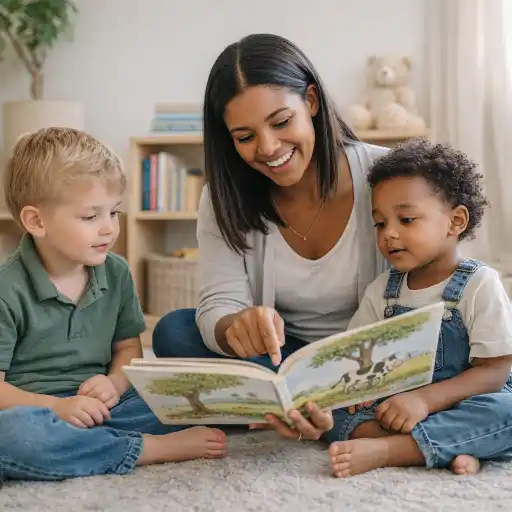
How can questions and conversation deepen word learning?
Children learn language through back-and-forth interaction, not only by listening. Ask a question, give children time to think, and respond to what they communicate—whether with a word, gesture, sound, or longer explanation. Reading Rockets describes the PEER sequence for dialogic reading: prompt the child, evaluate or acknowledge the response, expand it, and repeat or invite the child to try the expanded idea.
For example, if a child says, “Bird,” you might respond, “Yes, a bird. It is perched on the branch. What do you think it sees?” The adult affirms the child’s contribution, adds a precise word, and opens space for more thinking. Use varied prompts, including “What do you notice?”, “What might happen next?”, and “Have you seen something like this?” .
Questions should match children’s developmental and language needs. Some children may answer more easily by pointing to a picture or choosing between two options. Others may be ready to explain a character’s motivation or connect the story to an experience. NAEYC’s guidance on conversations with children encourages teachers to ask a range of questions and listen closely to children’s ideas. Leave space for responses: wait time communicates that children’s thinking is valued.
Keep the exchange warm, not pressured. Too many interruptions can break the story’s rhythm, so choose a few purposeful pauses and follow children’s interests. As research on repeated interactive read-alouds explains, rereading with thoughtfully varied discussion can build vocabulary and deeper talk over time.
How can storytime include multilingual children and different learners?
Every child should have meaningful ways to join the reading, whether they are speaking fluently, learning more than one language, communicating nonverbally, or still becoming comfortable in a group. Use illustrations, real objects, facial expressions, gestures, and movement to make word meanings visible. A child can demonstrate understanding by pointing, acting, using a familiar word in a home language, or listening closely.
Honor home languages as resources for making meaning. Invite children to share a word if they choose, and partner with families to learn accurate pronunciations or familiar expressions connected to a story. Do not ask a child to translate on demand or speak for an entire language community. When appropriate, connect an English word with a related home-language word while keeping the child’s participation voluntary. The ChildCareEd resource on home-language words in shared reading offers ideas for building these connections respectfully.
- Offer response options: speaking, pointing, choosing, signing, drawing, or acting.
- Use short phrases and repeat key words in meaningful contexts.
- Allow extra processing time and avoid interpreting silence as lack of understanding.
- Choose books that reflect varied cultures, abilities, family structures, and experiences.
Adapt the experience to children’s attention and sensory needs. A short reading, smaller group, movement break, or familiar prop can help children participate comfortably. Directors can support staff by ensuring access to diverse books, visual materials, and planning time for family collaboration. Inclusion is not a separate activity; it is the way the story is shared so every child has an entry point.
How can providers carry new words beyond the book?
Children are more likely to understand a word deeply when they meet it again in different situations. After storytime, make target words available in dramatic play, blocks, art, outdoor exploration, and daily routines. If a story includes sturdy, describe a block tower as sturdy when it stands firm. If children encountered burrow in an animal book, add a small tunnel to play and talk about where an animal might hide.
Repeated interactive readings can follow a gentle progression: focus first on enjoying and understanding the story; on a later reading, pause to explain and discuss selected words; then invite children to reconstruct the story, retell, or dramatize it. The approach described by Reading Rockets in repeated interactive read-alouds uses rereading to support vocabulary, comprehension, and increasingly analytical talk.
Keep observation simple and useful. Note whether children recognize a word, use it spontaneously, or apply it in a new context. These brief observations can help you decide whether to repeat a word, provide another example, or choose a different target next time. Share a few words with families and suggest playful ways to notice them at home—without making home practice feel like homework.
Common pitfalls are easy to avoid: introducing too many words at once, offering definitions without examples, asking questions without wait time, or correcting children in a way that discourages participation. Instead, select a few useful words, explain them clearly, revisit them through play, and respond to children’s attempts with encouragement. State requirements vary - check your state licensing agency.
Conclusion: What is the simplest way to build vocabulary during storytime?
To build stronger vocabulary during storytime, choose a small number of useful words, make their meanings clear through context and visuals, and invite children into genuine conversation. Reread engaging books, ask questions that fit each child, and carry the words into play and everyday routines. Children do not need a flawless performance; they need responsive adults who notice their ideas and give them many joyful chances to hear and use language.
Start with one book this week. Select two words, plan a brief explanation and one open-ended prompt, then listen for how children respond. Those small, consistent moments help transform storytime into an inviting space for language growth. For more structured professional learning, explore Reading Aloud and Storytelling Buy Now $16.00, Building Vocabulary Buy Now $16.00, Classroom Tools for Emergent Literacy Buy Now $25.00, Language Development in Early Childhood Buy Now $16.00, and Setting the Stage: Story Time Buy Now $25.00. Check your state’s requirements before relying on any course for required training hours.
- CDA Home Visitor Subject Area 3 Part 3 Birth to 5
- Reading Aloud and Storytelling
- Language and Literacy Foundations in Pre-K
- From Play to Planning: Building Culturally Competent, Child-Centered Curriculum
- Setting the Stage: Story Time
- Pediatric RSV First Aid & CPR/AED
- Connections That Count: Building Relationships in Child Care
- Texas Director Credential
- Supporting Families and Caregivers in Language and Literacy
- Professional Integrity in Child Care
- Nature’s Classroom: Why Fall Is the Best Season for Sensory Learning Outdoors
- 👶 ¿Cuáles son las proporciones y grupos requeridos en Dakota del Norte? 🏫
- Curso de Comunicación de 9 Horas de Maryland
- Proporciones de Cuidado Infantil y Tamaños de Grupo por Edad en Maryland (Guía Rápida para Centros y Hogares)
- Proporciones de Cuidado Infantil y Tamaños de Grupo por Edad en Virginia (Guía Rápida para Centros y Hogares)
- Cómo Trabajar en el Cuidado Infantil en Wisconsin: Requisitos y Pasos
- How can storytelling be used as a teaching tool?
- How can storytelling support teaching in North Dakota early childhood classrooms?
- How can Georgia child care providers turn storytime into a school-readiness superpower?
- Cómo simplificar la capacitación para sus empleados de daycare
- What simple early literacy activities really work for preschoolers?
- How can preschool programs build early literacy every day?
- What simple early literacy activities really help children learn?
- Is the Lost Art of Storytelling the Key to Building Language in Young Children?
- How can child care programs build strong readers before kindergarten?
- Feelings Activities for Toddlers: Building Social and Emotional Skills
- How Can Child Care Providers Integrate Social-Emotional Learning into Daily Activities?
- How Can Read-Aloud Questions Help Children Who Give One-Word Answers?
- How Can Child Care Providers Build Stronger Vocabulary During Storytime?
