SEL becomes most meaningful when children practice it during real moments—arrival, play, meals, transitions, and conflict—not only during a planned lesson. Explore Social Foundations and Responsive Classrooms Buy Now $24.00 to strengthen practical strategies for relationships, self-regulation, positive guidance, and problem-solving; providers seeking deeper emotional-development knowledge may also benefit from Opportunity for Growth: Emotional Development  Buy Now $16.00, which can support professional learning in CDA Subject Area 3.
Why does SEL belong in everyday child care routines?
Social-emotional learning helps young children understand feelings, manage strong emotions, develop relationships, solve problems, and make increasingly responsible choices. These capacities are not separate from learning; they influence whether children can participate, communicate, persist, and feel secure enough to explore. Head Start identifies relationships, supportive environments, explicit social-emotional skills, and meaningful behavior support as interconnected foundations for development.
For providers and directors, the practical implication is reassuring: SEL does not require adding a demanding subject to an already full schedule. Instead, educators can intentionally use moments that already occur. A greeting can build belonging, snack can invite conversation, block play can provide collaboration practice, and cleanup can become an opportunity to follow directions and contribute to the group.
NAEYC emphasizes that trusting relationships and intentional teaching are central to social-emotional health. Warmth, respectful listening, emotion coaching, modeling, books, role-play, and descriptive encouragement are all teachable practices. Behavior also communicates meaning; a child who grabs, withdraws, or hits may lack words, regulation, or an effective way to seek help. Teaching the missing skill is more constructive than treating behavior only as disobedience.
How can educators build SEL into arrival and morning meeting?
Arrival is an emotionally significant transition. Some children enter ready to play, while others are tired, worried, or separating from a familiar adult. A predictable welcome communicates, “You belong here, and I will help you begin.” Greet each child by name, move to the child’s level, and use a consistent visual or verbal check-in.
- Offer two or three emotion pictures and invite children to point, gesture, or name how they feel.
- Use a family photo, name card, or classroom job to reinforce belonging and participation.
- Model your own regulation briefly: “I feel rushed, so I am taking one slow breath.”
- Preview the schedule with pictures and give advance notice of the first transition.
During morning meeting, keep discussion brief and developmentally appropriate. Sing a greeting song, practice one feeling word, and rehearse one strategy such as asking for help or taking a breath. Children do not need to disclose personal experiences publicly; pointing, drawing, or observing are valid forms of participation. For multilingual learners and children with limited verbal language, pair words with gestures, photos, objects, and home-language terms.
Directors can support consistency by selecting a small set of shared phrases—for example, “You are safe,” “I see you are frustrated,” and “Let’s find a solution.” Consistent adult language helps children generalize skills across classrooms and caregivers.
How can play and learning centers teach relationship skills?
Play offers repeated, authentic practice with sharing, turn-taking, negotiation, empathy, and flexible thinking. Rather than interrupting every disagreement, observe first, determine what children are attempting to communicate, and step in with just enough support. The goal is not to make every interaction conflict-free; it is to help children experience themselves as capable problem-solvers.
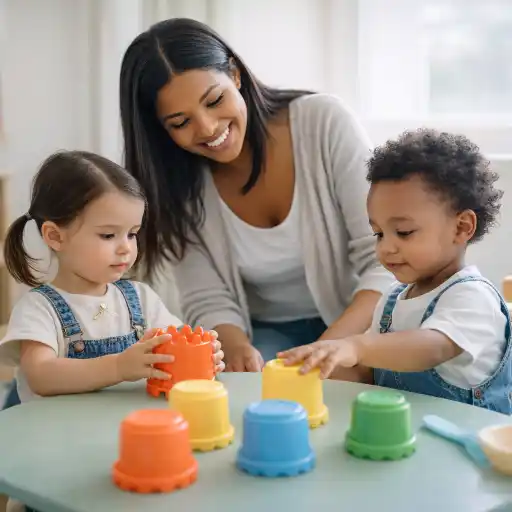
Design centers to invite cooperation without forcing it. Provide enough materials to reduce unnecessary competition, but also include activities that require two or more participants:
- In blocks, invite children to plan a shared structure and assign roles.
- In dramatic play, add visual scripts such as “Can I join?” and “What can we do next?”
- In art, offer partner painting or a shared collage with space for different ideas.
- In games, practice waiting, noticing rules, coping with disappointment, and congratulating others.
- With puppets, act out a conflict and invite children to suggest several possible solutions.
Use descriptive feedback rather than vague praise: “You waited while Maya finished,” or “You both wanted the truck and used words to make a plan.” This language helps children identify the specific behavior they can repeat. CSEFEL resources, including scripted stories, emotion visuals, problem-solving steps, and the Turtle Technique, can provide accessible supports for rehearsal.
Make adaptations without lowering expectations. Some children may need a visual turn-taking card, a quieter location, a sensory tool, or an adult model before joining a group. Inclusive SEL recognizes that communication and regulation can look different across children.
How can routines and transitions support self-regulation?
Transitions often expose the gap between what adults expect and what young children can manage. Moving from energetic outdoor play to lunch or from free choice to rest requires children to shift attention, body state, and expectations. Predictability, preparation, and co-regulation make these shifts more successful.
Before a transition, offer a short warning, show what comes next, and use a consistent cue such as a song, chime, or visual card. During the transition, narrate the sequence: “First we put the cars away; then we wash hands.” Keep directions concrete and acknowledge effort. If the group becomes dysregulated, reduce language, slow your pace, and model the calm you want children to develop.
- 🌬️ Practice “smell the flower, blow the candle” breathing when children are already calm.
- Use animal movements, stretching, or a short rhythm pattern to shift energy.
- Offer a cozy regulation space that is supportive, never punitive.
- Keep two or three familiar tools available, such as a soft book, visual breathing card, or squeeze object.
Children initially regulate through relationships; independent self-regulation develops gradually. Stay nearby, acknowledge the feeling, and offer a manageable choice: “You are upset. Would you breathe with me or sit on the cushion?” After the child is calm, briefly revisit the skill and practice what could help next time. Avoid requiring conversation at the peak of distress.
Good2Know and early childhood guidance similarly highlight breathing, movement, and mindfulness as useful transition supports when they remain brief, playful, and appropriate for young children.
How can storytime, meals, and caregiving moments deepen SEL?
Books and daily caregiving provide natural contexts for emotional vocabulary and perspective-taking. During storytime, pause to identify facial expressions, body clues, intentions, and possible solutions. Questions should invite thinking rather than test a single correct answer: “What might the character be feeling?” “What could a friend do?” or “Have you ever wanted help like that?” Accept children’s interpretations and connect them to observable evidence in the illustrations or plot.
Choose books that reflect the children and families in your program, including varied cultures, abilities, family structures, languages, and emotional experiences. Revisit favorite stories across several days; repetition allows children to notice new details and practice vocabulary. Puppets and props can make discussion accessible for children who communicate more comfortably through play.
Meals, diapering, toileting, handwashing, and rest also carry SEL opportunities. One-on-one caregiving allows adults to listen, label emotions, offer choices, and build trust. At snack, children can request items, notice preferences, wait, and help a peer. During cleanup, teachers can frame responsibility as contribution: “Our room belongs to all of us, and everyone can help.”
- Teach emotion words alongside body cues: “Your fists are tight; you may be frustrated.”
- Use respectful choices: “Would you like the blue cup or the green cup?”
- Invite children to notice others without demanding physical affection.
- Connect home and school language by asking families which feeling words and calming practices are familiar.
Family partnership strengthens continuity. Share one simple strategy at a time and invite family insight rather than presenting school practices as the only correct approach.
How should programs plan, observe, and improve SEL implementation?
Effective SEL is a program practice, not an individual teacher’s private project. Directors can begin by selecting two or three shared goals, such as naming feelings, asking for help, and solving peer conflicts with adult support. Staff should identify where each goal appears in the daily schedule and agree on common language, visuals, and response steps.
Observation makes implementation more concrete. Record strengths and patterns rather than labeling children. Note the context, what happened before the behavior, the child’s communication, the adult response, and what helped. Use observations to adjust the environment, teach a missing skill, or seek additional support—not to punish or stigmatize.
- Plan universal routines for all children.
- Provide small-group practice for skills needing additional rehearsal.
- Coordinate individualized supports with families and qualified specialists when concerns persist.
- Schedule brief staff reflection and coaching rather than relying on one-time training.
Research on childcare professional development indicates that instruction paired with coaching, administrative support, practice, and follow-up is more likely to influence teaching quality than isolated exposure. Directors can model the same reflective stance expected of teachers: identify what is working, choose one manageable adjustment, and revisit it.
Common pitfalls include using a calm corner as punishment, expecting children to regulate without adult support, teaching SEL only after challenging behavior occurs, and using culturally narrow examples of appropriate emotion. Avoid these by teaching proactively, preserving dignity, offering multiple communication pathways, and partnering with families. If screening or observation suggests persistent concern, follow referral procedures and consult appropriate professionals. State requirements vary - check your state licensing agency.
Conclusion: What does successful daily SEL integration look like?
Integrating SEL into daily activities means treating relationships, routines, play, and caregiving as intentional learning environments. A successful approach is warm and predictable: children are greeted with belonging, supported to name feelings, given repeated opportunities to cooperate, coached through transitions, and helped to repair relationships after conflict.
Start with a manageable plan:
- Add a brief arrival check-in using pictures or gestures.
- Teach one calming strategy during a calm moment and practice it daily.
- Embed descriptive emotion and relationship language into play and meals.
- Use one story, puppet scenario, or cooperative activity each week.
- Observe patterns, share strengths with families, and coach staff toward one next step.
The central question is not whether a program has time for SEL. It is how each ordinary moment can help children feel safe, understand themselves, connect with others, and participate more fully. Consistent, responsive adults make those moments count.
Additional ChildCareEd courses for professional learning
- CDA Subject Area 3 Buy Now $80.00 — a 10-hour course focused on emotional development, self-regulation, predictable care, positive interactions, and culturally responsive environments.
- Early Emotional Wellness Buy Now $16.00 — explores children’s emotional needs and ways to foster a positive emotional climate.
- From Tantrums to Triumphs: Equipping Preschoolers with Self-Regulation Skills Buy Now $25.00 — offers strategies for calming, confidence, self-control, and challenging behavior.
- CDA Home Visitor Subject Area 3 Part 3 Birth to 5
- Positive Attention: Interactions and Supervision of Infants and Toddlers: For Workforce Solutions
- Social Foundations and Responsive Classrooms
- Opportunity for Growth: Emotional Development
- The Best Promotion is Play
- Positive Attention: Interactions & Supervision for Infants & Toddlers
- Texas Director Credential
- Montessori Cultural Activities: Exploring the World Through Play and Learning
- Enriching Education: Field Trips
- Every Moment Matters: Schedules and Transitions
- Stress Management and Mental Health
- Bye Bye Winter: The Role of Outdoor Play in Early Childhood Development
- Supporting Social Relationships Among Young Children
- Tiny Tots, Big Learning: Crafting Curriculums for the Littlest Learners!
- Tiny Hands, Big Dreams: Fostering Creativity in Preschoolers
- Frosty Fun: Trauma-Informed Play for Resilient Young Learners
- How motor skills shape child development and creative ways educators can foster them.
- A Path to Engaged Learning: Play!
- Capacitación en Salud y Seguridad Preventiva en Línea para Proveedores de Cuidado Infantil
- Proporciones de Cuidado Infantil y Tamaños de Grupo por Edad en Virginia (Guía Rápida para Centros y Hogares)
- How can child care programs best support school-age children’s social and emotional development?
- How can child care providers manage holiday excitement and big emotions in young children?
- What Does Sesame Street Still Teach Us About Early Learning?
- What Should Every Child Care Provider Know About Children's Sense of Humor?
- How Can Child Care Providers Support Young Children’s Attention Span?
