Introduction
Many families ask: how can we help children be ready for school while learning at home? This article gives simple, practical ideas for child care providers and program directors to share with families. Use small steps that fit the family’s day. This helps children feel safe, confident, and curious.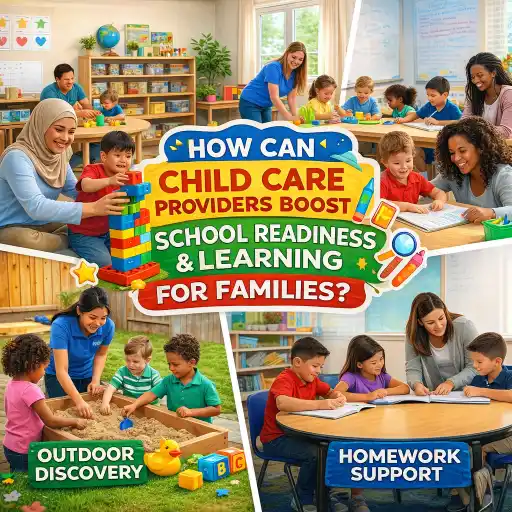
Why it matters: Early habits and daily moments build strong skills. When adults add words, books, play, and gentle routines, children grow fast. Strong early experiences improve later learning, behavior, and friendships.
Quick note: state requirements vary - check your state licensing agency.
Five words to remember: #routines #literacy #play #families #readiness
1) What simple daily routines help build school readiness at home?
- 📅 Start with 3 daily anchors: morning, after-nap/afternoon, and bedtime. Use short activities at each anchor (read, play, talk).
- 🧼 Make self-care practice part of routine: washing hands, dressing, brushing teeth. These build independence and motor skills.
- 🍽️ Turn meals into language time: ask open questions, count pieces of fruit, name colors on the plate.
- 🧸 Add a short learning moment during transitions: sing a song, read one page, or do a five-minute counting game.
- 🧭 Use visual cues and checks: picture schedules, simple checklists, or a “what’s next” board help children know expectations.
Tips for sharing with families:
- Offer a one-page routine sample for parents to try this week.
- Suggest small changes—add one routine, then build.
- Celebrate progress: share a quick note when a child completes a new self-help skill.
2) How can I support early literacy and math learning every day?
Try these easy steps families can use at home:
- 📚 Read daily: just 5–10 minutes works. Use dialogic prompts: ask a question, listen, then add a new word.
- ✍️ Provide writing tools: crayons, clipboards, sticky notes. Invite the child to draw or sign a simple list.
- 🔢 Count with purpose: count steps, spoons, or toys. Make it playful and part of a routine.
- 🎵 Sing rhymes and clapping games to build sound awareness. Short rhymes are powerful for phonological skills.
- 🔍 Make print visible: label a toy bin, a cubby, or a snack shelf. Seeing print in real places helps print awareness.
Use free family tools and kits when possible (for example, school readiness kits like those from Scholastic can add bilingual books and easy activities: School Readiness Kits).
Research shows that home learning environments and everyday literacy activities support language and later reading success. For an overview of predictors for readiness in literacy and math, see this review: Predictors of School Readiness in Literacy and Mathematics.
3) How do I involve families and match learning to each child?
- 🤝 Invite families to try 1 home activity each week: a short read-aloud, a counting walk, or a pretend-play “school day.”
- 📣 Communicate clearly: send short notes, photos, or a two-line tip about what to practice at home.
- 🌍 Honor home languages and cultures: encourage families to read and talk in the home language. Dual language is a strength.
- ✅ Personalize learning: share one easy idea tuned to the child’s current skill—e.g., practice buttoning, name tracing, or rhyme games.
Research from many countries shows that the home learning environment matters. A meta-analysis of home practices and literacy found that adult reading practices and books-at-home relate to stronger skills (Nag et al., 2024). Low-cost, consistent supports are effective.
Remember: families face different stresses and resources. Start small, offer flexible ideas, and follow up with encouragement. Share resources and courses for parents when available (for example, ChildCareEd has family-facing courses and handouts you can recommend).
4) How do I avoid common mistakes, and what tools or training can help?
Common pitfalls and how to fix them:
- ⚠️ Mistake: Too many new activities at once. Fix: Introduce one small change at a time and repeat it for a week.
- ⚠️ Mistake: Expecting long attention spans. Fix: Keep activities short (1–10 minutes) and tied to routines.
- ⚠️ Mistake: Skipping family voices. Fix: Ask families about their day and suggest low-prep ideas they can fit in.
- ⚠️ Mistake: One-size-fits-all lessons. Fix: Observe and adapt—use visuals, shorter steps, and play-based options for different learners.
Helpful tools and training:
- 📘 ChildCareEd courses for staff: curriculum, growth & development, and methods and materials can boost classroom practice. See: 45-Hour Preschool Curriculum
 Buy Now
 $399.00$275.00, 45 Hour Growth and Development, and the instructor-led option: 45 Hour Methods & Materials Buy Now $399.00. - 🧰 Use easy activity packs like Montessori Practical Life ideas to build independence: Montessori Practical Life Activity Buy Now $0.00.
- 🔁 Plan transitions: use evidence-based transition strategies to reduce behavior issues and increase learning time (see CSEFEL transition brief: Helping Children Make Transitions).
How to coach families: offer short demos, model an activity, or record a 1-minute video showing a read-aloud or a counting walk. Small, repeated coaching helps families feel confident and supported.
Conclusion
Key actions you can use tomorrow:
- 🔹 Share one simple routine sheet with each family (morning, snack, bedtime).
- 🔹 Encourage families to read one short book daily and sing one rhyme during a routine.
- 🔹 Send one personalized tip for each child (one skill to practice) and celebrate small wins.
With short, steady steps and partnership with families, child care providers can make a big difference for school success. Use play, #routines, and small learning moments to help children thrive.
FAQ
- Q: How long should a family read with a preschooler each day? A: 5–15 minutes of interactive reading is great. Keep it fun and ask simple questions.
- Q: What if a family has little time? A: Suggest short routines: one song at handwashing, one page of a book at bedtime, or a 2-minute counting game during snack.
- Q: How can providers help non-English families? A: Encourage reading in the home language and share bilingual resources. Dual language skills help learning.
- Q: When should we suggest screening or support? A: If a child is far behind expected milestones or loses skills, talk with the family and suggest screening. Use tools like CDC milestones for guidance: CDC Milestones.
- Roots & Resilience: Understanding What Shapes a Child
- CDA Family Child Care Credential
- Bienvenido! Welcoming All Families
- CDA Family Child Care Credential with Portfolio Review
- 45 Hour School Age Methods and Materials
- Texas Director Credential
- Bridging Cultures: Family Communication & Collaboration
- Supporting Families and Caregivers in Language and Literacy
- Supporting Children's Independence
- CDA Certification en Español: Recursos y Consejos para Educadores Bilingües
- Boosting Language Through Play
- What Skills Really Matter for Kindergarten Readiness (and Why Worksheets Aren't the Answer)?
- Regulaciones de Licenciamiento de Cuidado Infantil en California para Centros y Hogares de Cuidado Infantil Familiar
- Proporciones de Cuidado Infantil y Tamaños de Grupo por Edad en Maryland (Guía Rápida para Centros y Hogares)
- Proporciones de Cuidado Infantil y Tamaños de Grupo por Edad en Virginia (Guía Rápida para Centros y Hogares)
- Lista para Guardería en Casa en Texas: Cómo Iniciar una Guardería en el Hogar
- Capacitación Previa al Servicio para Proveedores de Cuidado Infantil en Georgia
- How can we teach children through play?
- How Can Child Care Centers Join Texas' Growing Pre-K Partnership Movement?
- What Kindergarten Readiness Skills Do Children Need?
- What are the most important school readiness skills for preschoolers?
- How can Florida educators build strong foundations for infants, toddlers and K–3 readiness together?
- What skills do preschoolers need to be ready for school?
- How Does Guided Play Build School-Ready Skills in New York Preschoolers?
- How Can Child Care Programs Build Meaningful School Readiness?
- How Can Teachers Support Children Starting Kindergarten This Fall?
- What Should a 4-Year-Old Know Before Pre-K?
- How Can Child Care Providers Support Kindergarten Emotions on the First Day of School?
