Appreciation activities can help children notice the care, patience, and support they receive—but a card labeled only “Mom” or “Dad” may not fit every child’s life. When planning an activity such as Tie-rific Father’s Day Buy Now $0.00, invite children to choose whom they want to celebrate, use the names their families use, and offer a blank-card alternative when the theme does not fit. For deeper professional learning, explore Family Connections: Creating Inclusive Relationships  Buy Now $55.00, which addresses culturally responsive partnerships, family expectations, confidentiality, and inclusive practice. Read on for practical ways to make appreciation activities welcoming and meaningful for each child.
Why does caregiver language matter in appreciation activities?
The name a child uses for a caregiver is part of the child’s everyday world. A beloved adult may be called Nana, Abuela, Papa, Auntie, foster parent, parent, guardian, or another family-specific name. Using a child’s own words signals that educators see the relationship as the child experiences it—not through assumptions about what a family should look like.
Appreciation activities can be meaningful opportunities to build connection, identity, and social-emotional learning. But when forms, crafts, or invitations assume every child has the same family structure, a celebration intended to be warm can instead create uncertainty or pressure. Children may live with relatives, move between households, have two mothers or two fathers, be in foster care, or have experienced separation or loss. As ZERO TO THREE’s guidance on inclusive approaches to caregiver celebrations notes, advance communication and flexible alternatives can help educators respond with sensitivity.
Respectful planning need not erase Mother’s Day or Father’s Day. The goal is to preserve the spirit of appreciation while allowing every child to choose whom they recognize and how they participate. That flexibility helps cultivate #belonging, trust, and meaningful family partnerships.
How can educators learn and use each family’s preferred names?
Ask families directly, privately, and without implying that one naming convention is more correct than another. A brief enrollment update or conversation can establish what a child calls each important adult and how staff should refer to that person. For example: “What names does your child use for the adults who care for them?” or “How would you like us to refer to your family members in classroom conversations and projects?”
Record preferences in the program’s appropriate, confidential communication system so the whole team can use them consistently. If a family’s answer changes, update the information respectfully. Avoid turning the question into an invitation for families to disclose sensitive history; they can share only what is useful for the child’s care.
- Use children’s and families’ preferred names in cards, labels, messages, and displays.
- Offer broad wording—such as “someone special,” “a caring adult,” or “the people who care for you”—when a specific relationship is not known.
- Use the child’s home-language terms when families share them; confirm pronunciation when possible.
- Communicate with the adult who has authority and responsibility for the child, and follow program procedures for contact and consent.
As Early Pride Matters’ guidance on inclusive communications emphasizes, the aim is not simply to replace every specific term with a generic one. It is to learn what words fit each family, then use them thoughtfully. NAEYC similarly describes respectful, two-way partnerships as essential to developmentally appropriate practice in its guidance on engaging families.
What kinds of appreciation activities let children make their own choices?
Choose open-ended activities with a clear invitation and no required recipient. Children can decide whether to make something for one caregiver, several people, a trusted adult at the center, or no one at all. Keep the purpose focused on noticing care rather than producing a polished gift or performing gratitude on demand.
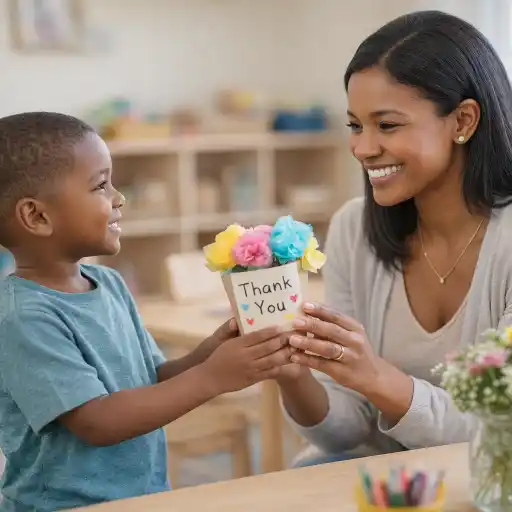
- 💌 “Thank you for…” cards: Children draw or dictate a message. Staff can write exactly what the child says, including the caregiver’s preferred name.
- Care-in-action portraits: Invite children to draw someone who helps them, then describe or dictate one caring action.
- Appreciation coupons: Children create simple offers such as “Let’s read together” or “I can help put away toys,” while adults ensure the activity remains developmentally appropriate.
- Classroom gratitude mural: Children add a drawing or phrase about helpful actions without requiring them to identify a family member publicly.
- Take-home choice kit: Offer blank cards, art materials, or a small booklet children can complete for a person or people they choose.
Use varied materials and ways to communicate—drawing, dictation, collage, gesture, home-language words, or assistive communication. Let children pass, make a general message, or create a piece for themselves. Illinois Early Learning’s family-structure guidance recommends using terms that do not assume a “Mom + Dad” household and ensuring classroom materials reflect a range of families.
Make participation equitable: provide materials so no family must purchase supplies, and avoid public displays unless the child and family have agreed. A private take-home item may feel more comfortable than a classroom gallery.
How can programs plan celebrations without creating pressure?
Start by clarifying the purpose. Is the activity intended to recognize caregivers, explore kindness, or create a family keepsake? A clear purpose makes it easier to choose language and avoid unnecessary expectations. Send a short, neutral note in advance explaining what children will do and offering a private way for families to share relevant preferences.
For example: “Our class will make a small appreciation project. Children may choose a person or people who care for them, use a name meaningful to their family, or make a general classroom thank-you. Please let us know privately if there is a name or participation option that would support your child.”
- Keep participation optional; do not treat attendance, a returned form, or a finished gift as evidence of family commitment.
- Offer in-class and take-home choices, as well as ways for children to observe rather than join.
- Schedule activities within the regular day when possible, so families do not need to rearrange work or transportation.
- Prepare staff to support children who may experience grief, separation, foster-care transitions, or other sensitive circumstances.
- Protect privacy: obtain permission before sharing photographs, names, or children’s work outside the classroom.
NAEYC’s developmentally appropriate practice guidance calls for reciprocal communication and multiple ways for families to participate. That principle helps directors design events around children’s needs rather than around a single attendance model. State requirements vary - check your state licensing agency when planning visitors, photographs, food, or other event logistics.
What common pitfalls should providers avoid?
Good intentions do not always prevent exclusion. A few predictable missteps can be avoided through advance planning, flexible materials, and a calm, affirming response when a child or family shares a preference.
- Assuming one family structure: Avoid “Everyone make a card for Dad” or “Bring your mom.” Instead, let children choose a recipient and use open-ended instructions.
- Correcting a child’s family language: Do not replace “Pop-Pop” or “Mamá” with a staff-preferred label. Confirm the name with the family if needed.
- Pressuring children to explain: Never ask publicly why a caregiver is absent or why a child chose a particular person. Accept the choice without an interview.
- Making public recognition compulsory: Do not require children to present a gift, share a family story, or appear in a photo.
- Using “inclusive” language that becomes impersonal: Generic terms are useful when needed, but children also deserve to hear the specific names and roles that matter to their families.
If a child expresses uncertainty, respond warmly and keep choices open: “You can make something for someone who cares for you, make a thank-you for our classroom, or decide later.” If a family raises a concern, listen without defensiveness, acknowledge the impact, and discuss a practical adjustment. The aim is not flawless wording every time; it is a dependable willingness to learn and respond.
How can directors make appreciation part of everyday practice?
A single seasonal project can be a starting point, but consistent respect is built through daily routines. Review enrollment forms, classroom books, dramatic-play materials, family communications, and displays for language that may unintentionally exclude caregivers or family structures. Consider whether staff can correctly identify each child’s key adults and pronounce the names families use.
Directors can support consistency by sharing a simple team protocol: ask families for preferred terms, document them appropriately, use them in conversation, and check before publishing a child’s work or image. Include this practice in staff orientation and revisit it during team reflection. The ChildCareEd course Family Connections: Creating Inclusive Relationships Buy Now $55.00 offers further learning on culturally responsive partnerships, family expectations, confidentiality, and inclusive environments. Other relevant professional learning includes Bridging Cultures: Family Communication & Collaboration Buy Now $55.00, Family Voices Matter: Tools for Meaningful Collaboration Buy Now $55.00, Open Ears: Listening in Child Care Buy Now $16.00, and Strength in Differences: Cultural Diversity Buy Now $24.00.
After an activity, ask families and staff what felt welcoming and what could improve. Use responses to refine next time, not to judge individual families. A strengths-based approach recognizes that families know their children best and that small, thoughtful choices—like using the right name—can build trust over time.
Conclusion: What makes caregiver appreciation activities genuinely inclusive?
Inclusive appreciation begins with a simple question: whom does this child want to recognize, and what name feels right for that relationship? Ask families rather than guess, offer children open-ended choices, protect privacy, and make participation flexible. These practices honor families who use different names and structures without asking any child to explain their home life.
When directors support staff in using preferred language consistently, appreciation becomes more than a seasonal craft: it becomes part of a program culture where children’s important relationships are respected. Start with one practical step—confirm the names children use for caregivers—and build from there.
- 45 Hour Child Growth and Development
- 45 Hour Preschool Methods and Materials
- CDA Family Child Care Credential with Portfolio Review
- 45 Hour School Age Methods and Materials
- CDA Bridge Bundle: Family Child Care
- Positive Attention: Interactions & Supervision for Infants & Toddlers
- Texas Director Credential
- Preventative Health and Safety
- Tiny Hands, Big Dreams: Fostering Creativity in Preschoolers
- CDA Certification en Español: Recursos y Consejos para Educadores Bilingües
- Recursos en Español sobre el Sueño Seguro del Bebé
- Actividades de Motricidad Gruesa que Desarrollan el Equilibrio, la Coordinación y la Fuerza
- Normas de Licenciamiento de Cuidado Infantil en Virginia para Centros Diurnos Infantiles y Hogares Diurnos Familiares
- Proporciones de Cuidado Infantil y Tamaños de Grupo por Edad en Maryland (Guía Rápida para Centros y Hogares)
- Proporciones de Cuidado Infantil y Tamaños de Grupo por Edad en Nueva Jersey (Guía Rápida para Centros y Hogares)
- Proporciones de Cuidado Infantil y Tamaños de Grupo por Edad en Virginia (Guía Rápida para Centros y Hogares)
- Lista para Guardería en Casa en Texas: Cómo Iniciar una Guardería en el Hogar
- Por Qué la Supervisión Activa Es Clave para la Seguridad en el Cuidado Infantil
- Celebrando la amistad en el cuidado infantil durante el Día de los Mejores Amigos
- Canciones, juegos y preguntas de círculo para niños
- Cómo simplificar la capacitación para sus empleados de daycare
- How Can We Celebrate Every Family and Create a Classroom Where Everyone Is Represented?
- How Can Child Care Providers Create Inclusive Father’s Day Activities for Diverse Family Structures?
- How Can Children Recognize and Appreciate the Supportive Adults in Their Lives?
- How Can Child Care Programs Plan Appreciation Activities When Families Use Different Names for Caregivers?
- How Can You Plan a November Preschool Curriculum Around Gratitude and Community?
- How Can Gratitude Activities Build Kindness and Teamwork in School-Age Children?
- How Can Gratitude Activities Support Kindergarten Readiness?
