As a child care provider or director you already know that inclusion is practical work as much as it is a value. This article offers concrete, numbered steps you can use today to make your #classroom more accessible, welcoming, and effective for every #child. The guidance draws from practical ChildCareEd resources and public health guidance so you can pair day-to-day strategies with referral and training options. Remember: state requirements vary - check your state licensing agency.
What does true inclusion look like in early childhood settings — and why does it matter?
Inclusion means more than placement: it means design, practice, and relationships that let every child participate, learn, and belong. Key reasons this matters:
- 😊 Social and emotional growth: children who belong develop #empathy, confidence, and cooperative skills (see Creating Inclusive Classrooms Where Every Child Belongs). For more on fostering emotional and social development in preschool settings, see insights on nurturing preschool social and emotional development.
- 🔵 Better learning: safe, predictable environments free up cognitive resources for exploration and problem solving (Inclusive Practices in Early Childhood Education).
- 🟣 Public health & rights: disability inclusion is an equity and health issue — see CDC guidance on Disability Inclusion.
Why it matters now: inclusive programs reduce behavior problems, improve family trust, and expand your program’s reach. For an overview of practical entry points, review ChildCareEd’s primer on How can we create truly inclusive classrooms for children of all abilities?.
How can we design the physical environment so every child can participate?
Thoughtful layout and simple materials transform the room into a powerful accessibility tool. Follow these numbered steps:
- 😊 Clear pathways and centers: keep main routes wide, use low shelves as dividers, and label areas with photos so children know where to go (How can I create an inclusive classroom environment?).
- 🔹 Calm corner: include soft seating, a visual cue for when to use it, and 2–3 sensory supports (noise-reducing headphones, textured items).
- 🔸 Accessible materials: put commonly used tools on low shelves; add adapted scissors, thicker crayons, and slanted writing surfaces as needed.
- 🔹 Visual supports: post a simple picture schedule at child eye level and a center rule (1–2 pictures) for each area.
Practical setup plan (3 steps):
- Pick 1 center to adapt this week.
- Add 1 visual and 1 adapted tool.
- Observe for 2 weeks and record what changed (time on task, engagement, transitions).
For more room ideas and templates see ChildCareEd’s article on How can simple classroom changes make inclusion work for everyone?.
What teaching practices and routines help children of differing abilities learn together?
Use Universal Design for Learning (UDL) and predictable routines so access is built-in, not added on. Numbered strategies you can apply daily:
- 🎯 Offer choices for engagement: provide 2 ways to join an activity (sit/stand; hands-on/listen).
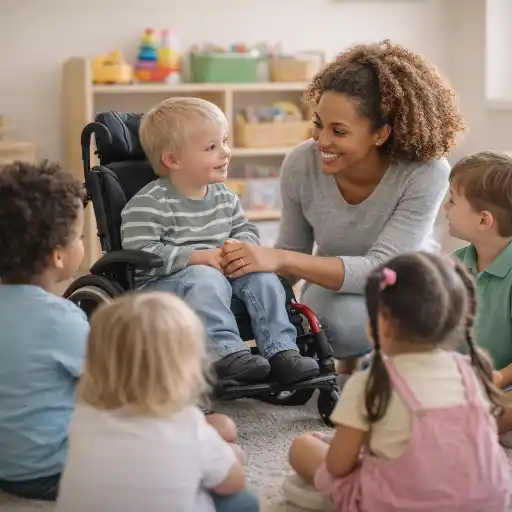
- 📚 Represent materials multiple ways: picture, gesture, and tactile object when introducing new vocabulary or a song (Inclusive circle time).
- 🧩 Break tasks into 1–3 picture steps and practice them with short role-play or songs.
- 🔈 Provide sensory breaks and movement options; schedule them into transitions so they become routine.
- 💬 Support communication: use simple words, sign cues, choice boards, and home language labels.
Quick classroom routine checklist:
- Post a visual daily schedule.
- Teach 3–5 simple rules with pictures and practice them.
- Offer one alternative participation option per group activity.
For daily strategies and activity ideas see ChildCareEd’s UDL starter content and circle-time guidance: Inclusive Practices and How to Make Your Circle Time More Inclusive.
How do we partner with families and specialists so supports fit each child?
Inclusion succeeds when families, teachers, and specialists form a practical team. Follow these numbered steps:
- 🤝 Start by listening: ask families "What helps your child?" and agree on 1–2 small classroom goals.
- 📣 Share daily, focused communication: one strength + one short note about the day.
- 🧩 Coordinate with specialists (with parent permission): align classroom routines with therapy goals and request simple strategies to try.
- 🔁 Meet briefly each month to review progress and revise small goals.
When referral is needed: note observations, give concrete examples, and guide families to local early intervention or school evaluation routes. ChildCareEd outlines family partnership and referral steps in How can we support children with special needs. Also use CDC resources on developmental monitoring and supports: Providing Support for Children with Disabilities and the Watch Me! resources.
Tip: keep notes short, factual, and strengths-based. Families are experts; their input makes classroom changes practical and lasting.
How can programs measure success, avoid common mistakes, and plan staff development?
Measure impact with simple, repeatable indicators and turn training into coaching and practice. Use this 1–2–3 plan:
- 📊 Track three indicators weekly: 1) child engagement/time-on-task, 2) number of successful transitions, 3) family-reported wins.
- ✅ Avoid common mistakes by following these fixes:
- ❌ Mistake: expecting the child to change to fit the room. ✅ Fix: adapt the task or materials first.
- ❌ Mistake: too many new visuals at once. ✅ Fix: add 1–2 consistent symbols and teach them.
- ❌ Mistake: leaving families out. ✅ Fix: ask one family-supported strategy and try it for 2 weeks.
- 🎓 Plan staff growth: combine short courses with on-site coaching. ChildCareEd offers targeted trainings like Mastering Inclusive Education and short modules you can use in staff meetings.
Staff coaching and practice are more effective than one-off workshops. Start with a 4-week trial of 1–2 strategies, collect simple data, and celebrate progress in staff meetings.
Conclusion — Summary and quick starter steps:
- ✨ Post a simple picture schedule for one routine and teach it.
- ✨ Create one calm corner and teach appropriate use.
- ✨ Offer two ways to join one group activity for two weeks and note changes.
FAQ (short):
- Q: How fast should changes happen? A: Try one change for 1–2 weeks and observe.
- Q: Who pays for adaptations? A: Many supports are low-cost; for bigger needs check local inclusion coaches or state grants.
- Q: How do I include home languages? A: Greet in the home language, label, and invite families to share words and songs.
- Q: Where to learn more? A: Start with ChildCareEd articles linked above and CDC resources on disability inclusion.
Thank you for the steady work you do. Small, practical, and consistent steps build classrooms where every #child and family feel a real sense of belonging. For tools, templates, and trainings, explore the ChildCareEd resource library linked throughout this article. Your actions matter — and they change lives.
- 45 Hour Child Growth and Development
- CDA Family Child Care Credential with Portfolio Review
- 45 Hour School Age Methods and Materials
- CDA Bridge Bundle: Family Child Care
- CDA Bridge Bundle: Family Child Care without Portfolio Review
- CDA Bridge Bundle: Infant/Toddler without Portfolio Review
- CDA Bridge Bundle: Preschool without Portfolio Review
- Texas Director Credential
- What Makes Me Special: An Overview of Autism and ADHD
- CDA Certification en Español: Recursos y Consejos para Educadores Bilingües
- How can we create truly inclusive classrooms for children of all abilities?
- How can North Dakota classrooms build toddler fine motor skills with simple activities?
- How can I build cultural awareness in my classroom?
- How can I support inclusion in Florida play and daily routines?
- How can we celebrate diversity and inclusion in California early childhood classrooms?
- What can the National Mall teach us about building a classroom where every child has a voice?
- Canciones, juegos y preguntas de círculo para niños
- How can I make my early childhood classroom truly inclusive?
- How can child care programs create inclusive classrooms for children of all abilities?
- Who Qualifies for a Crayola Donation Request? A Guide for Child Care Programs
- Including Every Child: What Child Care Providers Should Know About the ADA
- How Can You Design an Effective School-Age Classroom Setup?
- How Can Child Care Providers Teach Empathy and Kindness in the Classroom?
- How Can Child Care Providers Design Learning Centers That Support Play and Development?
- How Can Universal Design Make Every Classroom More Inclusive?
