When a child sees familiar words, pictures, and family experiences reflected in the classroom, print becomes an invitation to participate rather than a barrier. Explore Building Bridges for Dual Language Learners  Buy Now $16.00 to strengthen practical strategies for language development, culturally responsive teaching, and family partnerships; for continued professional learning, Classroom Tools for Emergent Literacy Buy Now $25.00 can help you connect printables to interactive literacy practice.
Why do bilingual printables matter for dual language learners?
Bilingual printables are most effective when they make children’s existing knowledge visible and usable. A picture card, routine chart, label, or mini-book can help a child connect a familiar home-language concept with new English vocabulary while participating in play, routines, and conversations.
Professional guidance from NAEYC’s dual language learner resources and Head Start’s Planned Language Approach emphasizes that home-language development supports communication, comprehension, literacy, and identity. A bilingual printable does not replace interaction; it gives interaction a visible, repeatable anchor.
This matters especially during transitions or unfamiliar activities. Children may understand more than they can express in English. Visuals and home-language print allow them to point, match, sequence, gesture, speak, draw, or listen before they are ready to respond in English.
- They connect new concepts with children’s prior knowledge.
- They support vocabulary, oral language, and emergent literacy.
- They communicate respect for families and cultural identity.
- They offer multiple ways to participate without requiring immediate English speech.
Which bilingual printables are most useful in child care?
Choose printables that serve a real purpose in the classroom. Materials should be clear, durable, developmentally appropriate, and placed where children can use them independently. The Multilingual Learning Toolkit recommends functional print in children’s home languages and equal visual status for home-language and English text.
- Picture-word cards: Pair photographs with words such as agua/water, mesa/table, or bloques/blocks.
- Routine cards: Show steps for washing hands, cleaning up, eating, resting, or preparing for outdoors.
- Family books: Include photographs, names, drawings, dictated sentences, and familiar routines.
- Emergent readers: Use repeated phrases that children can retell, sequence, act out, and revisit.
- Dramatic-play print: Add bilingual menus, signs, maps, labels, pretend-store materials, and appointment cards.
- Games: Adapt matching, sorting, bingo, and memory games for vocabulary practice.
Ask families to verify spelling, accents, pronunciation, and preferred terms. Spanish-speaking families represent many countries and communities, so one translation may not fit every family. Avoid stereotypes and select images that reflect the children actually enrolled.
You can also check out our ready-made resources to use in your classes
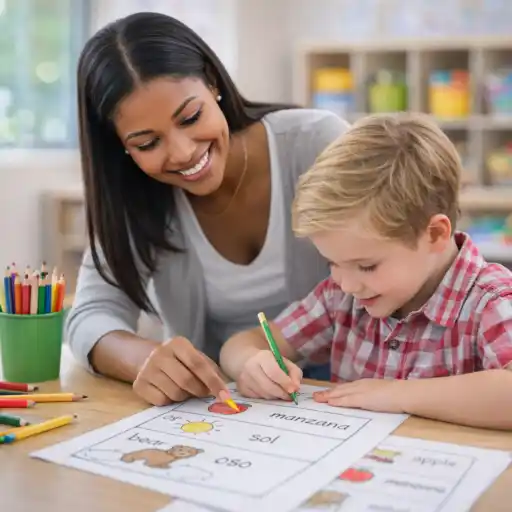
How can providers use printables without reducing learning to worksheets?
Young children develop language through relationships, movement, play, and meaningful conversation—not through isolated paper completion. A printable becomes instructionally valuable when an educator uses it to prompt thinking and interaction.
For example, a bilingual fruit card can lead children to sort fruit by color, count pieces, compare sizes, describe textures, create a pretend market, or dictate a shopping list. Encourage children to communicate in Spanish, English, gestures, drawings, signs, or combinations of these modes.
- Introduce one to three target words with an object, picture, gesture, and natural sentence.
- Pause so children have time to observe, process, and respond.
- Repeat vocabulary across meals, play, outdoor time, and transitions.
- Expand children’s messages: “Manzana” can become “Yes, a red apple.”
- Place the printable in a center where children can use it independently.
- Revisit it through songs, stories, movement, and dramatic play.
Printables can also strengthen print knowledge. Point out that print carries meaning, invite children to notice letters in their names, and compare familiar words across languages. Use the resource with real objects and experiences so children understand that print communicates something meaningful.
How can bilingual printables strengthen family partnerships?
A take-home printable should feel like an invitation, not homework. A simple card might encourage a family to name household objects, tell a story, sing a song, or create a mini-book together. The goal is reciprocal learning: families share knowledge, and educators gain insight into the child’s interests and language practices.
Ask families how they prefer to receive information. Some may prefer paper; others may appreciate a photograph, text message, or brief voice recording. Use qualified interpreters for health, developmental, enrollment, or safety discussions, and never require children to translate sensitive information.
- Ask which words, songs, stories, and routines are meaningful at home.
- Invite corrections and suggestions without treating families as unpaid translators.
- Use family photographs and dictated captions in classroom books.
- Share one manageable activity at a time and explain its purpose.
- Offer multiple ways to contribute, including a word, drawing, photograph, or audio recording.
Family participation should remain voluntary and respectful of time, privacy, literacy preferences, and individual circumstances. A family’s contribution does not need to be elaborate to be valuable.
How can directors evaluate bilingual printable materials?
Directors can establish a short review process before materials are posted, copied, or sent home. Check linguistic accuracy, developmental appropriateness, accessibility, cultural representation, and alignment with a genuine learning goal. Machine translation may produce awkward or inaccurate language, so important materials should be reviewed by a fluent speaker or qualified translator.
Use large, readable fonts, strong contrast, uncluttered layouts, and meaningful photographs. Offer alternatives for children who communicate through pointing, movement, sign language, home-language speech, English, drawing, or assistive communication.
- Accuracy: Are spelling, accents, grammar, and regional choices verified?
- Purpose: Does the material support a real routine, interaction, or learning goal?
- Representation: Are families shown respectfully and without stereotypes?
- Interaction: Does the resource invite talk, play, movement, or storytelling?
- Observation: Can educators document what children understand in either language?
Observe what children notice, say, point to, retell, or use independently. Do not interpret silence or a Spanish-language response as evidence of limited learning. Combine classroom observations with family reports, work samples, and progress over time. State requirements vary - check your state licensing agency before identifying specific materials as required curriculum or training.
What common mistakes should providers avoid?
Good intentions can still result in tokenism. A single Spanish book, bilingual bulletin board, or cultural celebration cannot substitute for consistent inclusion throughout the day. Home languages should appear in ordinary routines, learning centers, shared reading, and family communication—not only during heritage months.
- 😊 Avoid tokenism: Use bilingual print throughout the year, not only for special events.
- Avoid inaccurate translations: Verify language with families or qualified language partners.
- Avoid English-only assessment: Document understanding expressed through either language and multiple communication modes.
- Avoid stereotypes: Represent varied families, regions, abilities, and experiences.
- Avoid worksheet dependence: Pair printables with play, conversation, objects, and movement.
Also avoid asking one child to represent an entire language or culture. Children are individuals, and families who share a language may have different traditions, dialects, and preferences.
Conclusion: How can bilingual printables become meaningful bridges?
Bilingual printables support dual language learners when they are accurate, purposeful, interactive, accessible, and connected to family knowledge. They can clarify routines, strengthen vocabulary and print awareness, and communicate that children’s home languages are valued sources of knowledge.
Start small: add bilingual labels to one center, create a picture-supported routine, and send home one voluntary family activity. Observe how children participate, invite family feedback, and revise materials as needed. The strongest approach combines print with responsive adults, peer interaction, play, storytelling, and meaningful relationships.
For additional professional learning, consider Supporting Families and Caregivers in Language and Literacy Buy Now $16.00, Reading Aloud and Storytelling Buy Now $16.00, and Planning for Every Child: Responsive Strategies in Action Buy Now $55.00.
When print, conversation, play, and family partnership work together, bilingual resources become more than paper: they become daily invitations for children to belong, communicate, and grow in both languages.
- Building Bridges for Dual Language Learners
- Building Bridges for Dual Language Learners: For Workforce Solutions
- CDA Family Child Care Credential
- Birth to Five CDA Credential with Portfolio Review
- 24 Hour Texas Pre-Service
- CDA Bridge Bundle: Preschool without Portfolio Review
- Creating Environments that Nurture Growth and Community
- Texas Director Credential
- Building Bridges for Dual Language Learners
- Supporting Families and Caregivers in Language and Literacy
- CDA Certification en Español: Recursos y Consejos para Educadores Bilingües
- Apoyo en Español para Capacitaciones Grupales Presenciales y por Zoom en Cursos Selectos
- Apoyo en Preescolar para Retrasos del Habla: Estrategias Simples que Ayudan
- How can child care programs best support Dual Language Learners?
- How Can North Dakota Caregivers Help Toddlers with Speech Delays?
- How can I support English Language Learners in Michigan childcare classrooms?
- How can Minnesota child care settings support Dual Language Learners?
- Canciones, juegos y preguntas de círculo para niños
- How can North Dakota child care programs lay reading foundations the right way?
- How can bilingual music transform your early childhood classroom?
- How can child care programs best support Dual Language Learners?
- How Can Child Care Programs Celebrate Mexican Culture Beyond Stereotypes?
- Why Do Bilingual Classroom Activities Matter for Dual Language Learners?
- How Can Spanish Printable Resources Support Dual Language Learners?
- How Can Bilingual Printables Help Spanish-Speaking Families Feel Included?
- How Can Early Childhood Programs Respect and Strengthen Children’s Home Languages?
- How Can Printable Books Help Preschoolers Fall in Love With Reading?
- What Should You Ask Families When Screening Bilingual Toddlers?
