What can three ordinary objects reveal about a child’s ideas, interests, and growing language? A child-curated mini museum turns choosing and explaining into meaningful practice in observation, confidence, and vocabulary. For a fuller professional learning experience, explore ChildCareEd’s Building Vocabulary course  Buy Now $16.00 and Language Development in Early Childhood Buy Now $16.00; both can help you strengthen the language-rich interactions that make this activity valuable.
Why does a three-object museum matter for young children?
A classroom museum does not need rare artifacts, glass cases, or a field trip. A small collection chosen and presented by children offers an authentic reason to look closely, make decisions, communicate meaning, and listen to others. When a child selects three objects, the child is not simply filling a display; they are expressing what seems interesting, familiar, beautiful, useful, or important.
This process connects naturally with early learning. Children compare and classify objects, notice features, recall experiences, and practice explaining a point of view. They may use language such as “smooth,” “tiny,” “metal,” or “belongs with,” while peers hear those words in context. Repeated, meaningful exposure supports understanding of new vocabulary, as emphasized in guidance from The Hanen Centre on classroom activities and vocabulary.
A mini museum also gives educators a window into children’s thinking. Observing what a child chooses and how they describe it can suggest interests, knowledge, and questions to explore next. The Smithsonian’s early learner resources similarly emphasize active observation and questioning as ways to nurture curiosity and critical thinking.
- Children make purposeful choices and see their ideas valued.
- They practice speaking, listening, describing, and giving reasons.
- Peers encounter one another’s perspectives and learn to ask respectful questions.
How do you invite children to choose three meaningful objects?
Start with a clear, flexible invitation: “Choose three safe objects you would like visitors to notice. What makes them special to you?” Depending on your group, objects might come from the classroom, a nature walk, or family contributions. Use classroom materials or photographs when bringing personal belongings is difficult. Never require a child to share an item with financial, cultural, or sentimental significance.
Define “object” broadly: a block structure, a leaf, a toy, a picture, or a classroom-made creation can all belong in a child’s exhibit. Follow program policies for cleanliness, allergies, choking hazards, and safe handling. Avoid objects that could be sharp, breakable, valuable, or difficult to sanitize. For outdoor finds, check program procedures and local guidance before collecting or displaying them.
Give children time to explore before they decide. Rather than selecting for them, notice their attention and ask open prompts: “What caught your eye?” “Which three would you like to show?” or “What do these have in common?” Children can point, gesture, use a communication device, draw, or ask an adult to scribe their words. Choice is meaningful when multiple forms of participation are welcomed.
- Offer a small assortment of safe, varied materials as a starting point.
- Let children choose individually or with a partner, according to their preference.
- Use a tray or basket to help children gather and transport their selections.
- 😊 Celebrate each child’s reasoning without ranking one exhibit above another.
How can children explain what their objects mean to them?
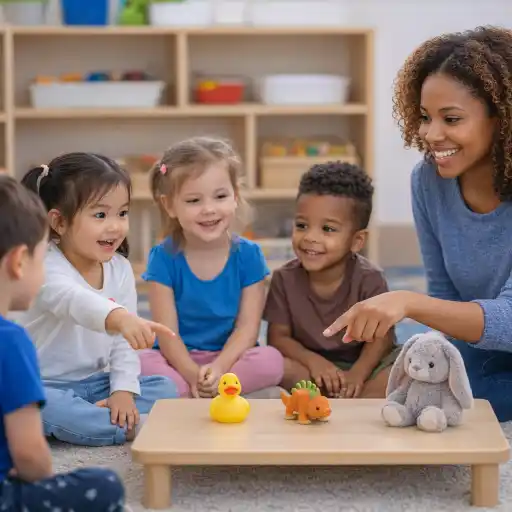
Support explanation through conversation, not a memorized presentation. Begin by giving the child time to inspect each object. Model a short description—“This stone is gray and rough”—then invite the child to add an idea: “What would you like visitors to know?” The aim is to help children connect what they see with what they think, remember, or wonder.
Use open-ended prompts and follow the child’s lead. “What do you notice about it?” encourages observation; “Why did you choose it?” invites a reason; and “What might someone wonder?” helps the child consider an audience. Pause after asking. Wait time communicates that children’s thoughts deserve attention, including when their response is a gesture, a few words, or a long story.
Expand language gently by repeating and adding detail to a child’s contribution. If a child says, “My shell,” you might respond, “Your shell is small and striped. You found it near the beach.” Choose useful words that fit the object—such as “collection,” “curator,” “texture,” “smooth,” “fragile,” or “display”—and use them naturally more than once. The Head Start resource on introducing novel words highlights conversations as an opportunity to build varied vocabulary.
- Ask one question at a time and allow children to answer in their own way.
- Offer sentence starters: “I chose this because…” or “I notice…”
- Write down a child’s words accurately; do not replace their meaning with an adult interpretation.
How can you plan a welcoming, child-led exhibit?
Work with children to decide where the exhibit will go, how the three objects will be arranged, and what visitors might need to know. A low table, shelf, or designated floor space can work. Provide enough room for visitors to see without crowding or handling items. The Tees Valley Museums’ exhibition toolkit describes how displays can give children ownership and a real audience for their learning; a small classroom exhibit can apply the same principle on a manageable scale.
Make simple labels together. A label could include the object’s name, a child-dictated sentence, and a drawing or photograph. Respect children’s privacy: follow program rules and family permissions before displaying names, images, or personal stories. Use home languages when families and children wish to contribute, and provide visuals or audio options where helpful. An exhibit should reflect children’s voices without asking them to reveal more than they choose.
Invite another class, families, or staff to visit, or hold a quiet gallery walk within the group. Prepare visitors to look carefully, listen, and ask friendly questions. Children may serve as guides, share a recorded explanation, point to a label, or simply observe. The activity can be brief and informal; the point is authentic sharing, not a polished performance.
- Place the exhibit at a child-accessible height and keep pathways clear.
- Agree together on respectful ways to view and handle each item.
- Offer different ways to participate: speak, point, draw, sign, or listen.
How can educators extend vocabulary, inclusion, and learning?
Use the exhibit as a starting point for related play and inquiry. Children might sort objects by material or shape, draw close observations, invent a story about the collection, or build a new display in the block area. Revisit the objects over several days so children can hear and use related words in more than one context. Vocabulary grows through meaningful interactions and repeated opportunities, not simply through a one-time list of terms.
Notice how each child communicates. Some children will offer detailed explanations; others may communicate through pointing, movement, facial expression, home language, or assistive communication. Provide accessible choices and avoid treating spoken English as the only evidence of understanding. The Victorian Government’s guidance on concept development and vocabulary describes how everyday and planned experiences can help children describe observations and express increasingly complex ideas.
Document learning lightly: record one child quote, a photo where permitted, or a note about a question the child raised. Use these observations to plan a next step, not to compare children. If a child is reluctant to share publicly, offer a private conversation, partner sharing, or the option to display an object without presenting it. Children’s comfort and agency come first.
For providers who want to deepen their teaching practice, ChildCareEd’s Science of Reading Foundations in the Pre-K Classroom Buy Now $16.00, Reading Aloud and Storytelling Buy Now $16.00, and Building Bridges for Dual Language Learners Buy Now $16.00 offer additional learning related to literacy, language, and supporting multilingual children. Course details and suitability depend on your professional needs; state requirements vary - check your state licensing agency.
Conclusion: What makes a three-object museum successful?
A successful three-object museum is a small, purposeful invitation for children to choose, notice, describe, and share. Keep the materials safe, the setup accessible, and the expectations flexible. Let the child decide what the objects mean, and make room for speech, gesture, home language, drawing, and quiet participation.
The central question—how can a three-object museum help children curate and explain their choices?—has a practical answer: give children meaningful control, listen closely, model rich but approachable language, and create an audience that responds with curiosity and respect. Their three objects can become a powerful learning experience because the story and reasoning belong to the child.
To build on this activity with more intentional vocabulary strategies, explore ChildCareEd’s Building Vocabulary course Buy Now $16.00 and Language Development in Early Childhood course Buy Now $16.00. For a ready-to-use planning support, consider the featured resource, My Mini Museum Exhibit Planning Kit.
- The ABCs of Behavior: Turning Challenges into Learning Opportunities
- Tracking Progress, Shaping Futures: Observation & Assessment Skills
- Children at the Wheel: Emergent Curriculum
- Setting the Stage: Story Time
- Creating Engaging and Meaningful Learning Experiences
- Creating Environments that Nurture Growth and Community
- Assessment of Language and Literacy Skills
- Texas Director Credential
- CDA Infants/Toddlers: Stages of Development
- Supporting Families and Caregivers in Language and Literacy
- CDA Certification en Español: Recursos y Consejos para Educadores Bilingües
- ¿Cuáles son los pasos, requisitos y opciones en línea para la certificación de 90 horas en cuidado de Infantes/Toddlers en Maryland?
- ¿Cómo empiezo mi certificación CDA en Florida en línea?
- 10 Ejemplos de Cómo la Cultura Influye en el Desarrollo Infantil
- ¿Qué Preguntas Vienen en el Examen CDA de Nacimiento a los Cinco Años?
- Reglas de Cuidado Infantil en Illinois
- Proporciones de Cuidado Infantil y Tamaños de Grupo por Edad en Nueva Jersey (Guía Rápida para Centros y Hogares)
- Proporciones de Cuidado Infantil y Tamaños de Grupo por Edad en Virginia (Guía Rápida para Centros y Hogares)
- Lista para Guardería en Casa en Illinois: Cómo Iniciar una Guardería en el Hogar
- Cómo Trabajar en el Cuidado Infantil en Carolina del Norte: Requisitos y Pasos
- Capacitación Previa al Servicio para Proveedores de Cuidado Infantil en Nevada
- Celebrando la amistad en el cuidado infantil durante el Día de los Mejores Amigos
- What can the National Mall teach us about building a classroom where every child has a voice?
- Canciones, juegos y preguntas de círculo para niños
- Cómo simplificar la capacitación para sus empleados de daycare
- What’s Happening Outside? Fall Science Adventures for Preschoolers
- Field Trips for Elementary Students: 15 Adventures That Bring Learning to Life
- How Can Child Care Providers Use Art and Creative Expression to Support Young Children?
- How Can Dinosaur Coloring Become a Science and Language Experience?
- How Can a Three-Object Museum Help Children Curate, Describe, and Explain Their Choices?
