Can a delivery game turn a familiar classroom into a lively investigation of maps, distance, and problem-solving? Plan a pretend route where children deliver parcels to every stop, then compare the paths they discover. For a deeper foundation in play-based math, explore Early Mathematics Through Play Buy Now $24.00, which offers strategies for integrating geometry, measurement, reasoning, and other math concepts into children’s everyday play.
Why does a pretend delivery route matter for early mathematics?
A delivery route gives purpose to ideas that can otherwise feel abstract. Children represent a familiar or imaginary place on a map, move a vehicle between destinations, and decide how to visit each stop. As they plan, they naturally encounter spatial relationships, sequence, distance, counting, and comparison—the foundations of meaningful mathematical thinking.
The activity also creates a rich context for communication and collaboration. Children explain their choices, listen to a partner’s proposed route, and revise plans when a road is blocked or a delivery is missing. These exchanges make reasoning visible: “I went past the park first because the library is next to it.” Adults can extend learning by naming the concepts children are already exploring.
Map activities connect two-dimensional representations with real spaces. NRICH’s mapping activity recommends noticing landmarks, recalling turns in sequence, and using position and direction words. The NAEYC discussion of preschoolers’ spatial thinking likewise highlights maps, diagrams, navigation, and directions as valuable learning experiences.
- Support #spatial reasoning and meaningful math vocabulary.
- Invite children to plan, compare, and explain multiple solutions.
- Build cooperation through shared roles and pretend-play storytelling.
What materials and setup make the route inviting?
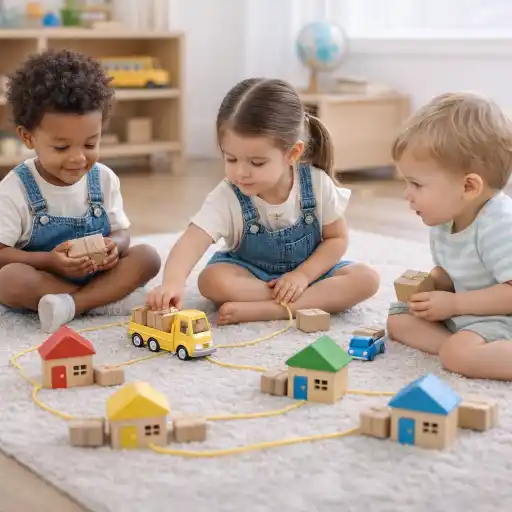
Keep the setup flexible and familiar. Use a large sheet of paper, floor space, blocks, or a rug as the map. Add simple landmarks—classroom centers, a garden, a mailbox, a shop, or an imaginary destination—and represent them with drawings, picture cards, blocks, or small toys. A vehicle can be a toy truck, cart, or even a child’s finger tracing the road.
Destination cards give each stop a clear purpose. The Classroom Delivery Route Maps and Destination Cards resource can help you set up a ready-to-use route experience; adapt the cards and map to match children’s interests, the classroom layout, and the level of challenge. Children can deliver pretend letters, books, food, or packages, making the activity feel connected to real community routines.
Before play, agree on a simple map key. For example, a blue line might represent a road and a star a delivery stop. Begin with a few locations and an obvious path. Children who are ready can add intersections, bridges, one-way paths, or new stops. Map-making can also start with a three-dimensional model using blocks before children draw a plan, as described in this Pre-K map-making example.
- Offer large paper, markers, blocks, toy vehicles, and destination cards.
- Make paths wide enough for toys and hands to move easily.
- Keep small loose parts away from children who may mouth them.
How can children plan and compare routes?
Introduce a simple mission: “The delivery truck needs to visit every stop. What route could it take?” Invite children to place destinations on the map, identify a starting point, and trace a path with a finger or vehicle. Resist solving the route for them; the learning lies in testing possibilities and talking through decisions.
After the first route, ask children to plan another way to reach all destinations. Compare the routes using language children can understand: shorter or longer, fewer or more turns, nearer or farther. For a concrete comparison, count blocks, steps, or road segments between stops. A route with fewer turns is not necessarily shorter, which offers an authentic opportunity to reconsider assumptions and check.
Useful prompts include:
- “Which stop comes first? Which one is next?”
- “Can you visit every stop another way?”
- “Which route has fewer turns? How can we check?”
- “What might happen if we start at the bakery instead?”
- “Can you explain your route so a friend can follow it?”
NRICH’s route-mapping guidance suggests using sequencing and positional language, and comparing distances or counting steps. These prompts encourage children to justify, not merely announce, a choice.
How can educators scaffold different ages and abilities?
Make the experience accessible by adjusting the map, the number of stops, the materials, and the language demands. Some children may be ready to follow a drawn map; others may benefit from walking a path physically or moving a toy from one clearly marked location to another. The goal is participation in shared thinking, not identical performance.
For children who need support, model one short route and use photographs or familiar symbols. Give one direction at a time—“Go to the garden, then stop”—and let children point, gesture, move a vehicle, or describe the route in a home language. Visual choices and partner play can help children stay involved without requiring them to speak in front of a group.
For children ready for more challenge, add a route constraint: visit the post office before the park, avoid a closed road, or find the path with the fewest segments. Children can record routes with lines, arrows, photos, or invented symbols. PBS KIDS’ map activities emphasize practicing directions and translating a two-dimensional map into a physical space—skills that can be explored in small, developmentally appropriate steps.
- Offer more time, fewer stops, and clear visual cues when needed.
- Use larger materials and accessible routes for varied motor abilities.
- Extend learning with a new rule, extra stop, or child-created map.
How can teachers observe learning and avoid common pitfalls?
Observe how children approach the problem rather than judging a map by its appearance. Notice whether a child recognizes that a symbol stands for a place, remembers the order of stops, uses direction words, or changes a plan after testing it. A brief note can capture useful evidence: “Jordan traced a route from the classroom to all four destinations and explained that the playground came after the mailbox.”
Ask open-ended questions, then allow wait time. If a route misses a stop, treat it as an opportunity to check the mission together: “Let’s look at the cards. Which destination has not received a delivery yet?” Avoid correcting every left-right confusion; young children may still be developing these concepts. Support meaning with arrows, landmarks, and repeated language rather than turning the game into a quiz.
Common pitfalls include making the map too complicated, insisting on one “correct” route, or focusing on craft products instead of children’s reasoning. Keep routes manageable and let children test multiple solutions. If the group becomes frustrated, reduce the number of destinations or create a shared route before inviting individual ideas.
To strengthen practice beyond this activity, Math Foundations in Early Childhood  Buy Now $16.00 and No Such Thing as Boring Math Buy Now $24.00 offer additional professional learning focused on playful early math. State requirements vary - check your state licensing agency.
How can you extend the delivery-route investigation?
Revisit the map over several days so children can build familiarity and complexity. Invite them to create new destinations based on classroom interests: a book return, a pretend bakery, a garden, or a veterinarian. They can draw delivery tickets, sort packages by destination, count how many deliveries each stop receives, or compare which destination is closest to the starting point.
Connect the map to a safe walk in the immediate environment when appropriate. Children and adults can notice landmarks, return to class, and represent the journey with photos or simple symbols. NRICH’s mapping resource describes recalling landmarks and route sequences before drawing and following a map. Keep outings within program policies and supervision requirements.
Finally, invite children to teach the route to a peer. Explaining instructions helps children organize their own thinking and gives the listener a meaningful reason to interpret the map. A delivery game can grow into storytelling, dramatic play, collaborative design, and practical mathematics without losing its playful spirit.
Summary: How can a pretend delivery route help children compare ways to reach every stop?
It turns map-making and route planning into a hands-on problem children can solve together. Provide familiar destinations, simple symbols, and a playful delivery purpose; invite children to trace more than one route; and compare paths with terms such as shorter, longer, nearer, and fewer turns. Observe children’s explanations, scaffold participation, and let experimentation—not a single perfect answer—guide the learning. This engaging activity supports spatial reasoning, mathematical language, collaboration, and the confidence to try another way.
For additional professional learning, explore Math Foundations in Early Childhood Buy Now $16.00, No Such Thing as Boring Math Buy Now $24.00, and Letter & Number Planning in Child Care Buy Now $24.00.
- CDA Home Visitor Subject Area 3 Part 3 Birth to 5
- CDA Home Visitor Subject Area 2 Part 3 Birth to 5
- Birth to Five CDA Credential with Portfolio Review
- Pediatric RSV First Aid & CPR/AED
- Emergent Learning & Development
- Creating Environments that Nurture Growth and Community
- Texas Director Credential
- Inclusive Montessori: Supporting Diverse Learners in the Classroom
- Environments That Inspire Independence and Exploration
- Every Moment Matters: Schedules and Transitions
- CDA Certification en Español: Recursos y Consejos para Educadores Bilingües
- 💛🧩 ¿Cómo puedo hacer que mi enseñanza sea inclusiva para los niños con autismo?
- ❄️ ¿Qué actividades al aire libre funcionan bien para los niños de Illinois en cada estación? 🌷🍂
- 10 Ejemplos de Cómo la Cultura Influye en el Desarrollo Infantil
- Proporciones de Cuidado Infantil y Tamaños de Grupo por Edad en Nueva Jersey (Guía Rápida para Centros y Hogares)
- Proporciones de Cuidado Infantil y Tamaños de Grupo por Edad en Virginia (Guía Rápida para Centros y Hogares)
- Lista para Guardería en Casa en Illinois: Cómo Iniciar una Guardería en el Hogar
- Consejos de Supervisión Activa para Salones de Preescolar y el Juego al Aire Libre
- Cómo Trabajar en el Cuidado Infantil en Carolina del Norte: Requisitos y Pasos
- Celebrando la amistad en el cuidado infantil durante el Día de los Mejores Amigos
- Canciones, juegos y preguntas de círculo para niños
- Cómo simplificar la capacitación para sus empleados de daycare
- Bring the Pumpkin Patch Inside: Dramatic Play Ideas for Preschool
- Fall Challenge Accepted! Hands-On Learning Games for Pre-K
- How Can Teachers Turn Everyday Play Into Learning Opportunities?
- How Can Montessori Shape Activities Welcome Different Learners?
- How Can Pretend Store Play Teach School-Age Children Money Skills?
- How Can School-Age Providers Build Vocabulary Beyond Word Search Puzzles?
- How Can a Pretend Delivery Route Help Children Compare Different Ways to Reach Every Stop?
