When the first cool breeze arrives, children may notice fewer birds at the feeder and ask a big question: Where did they go? Turn that wonder into active, developmentally appropriate learning with route mats, movement, and observation—and explore Creating the Natural Outdoor Classroom  Buy Now $16.00 for practical ideas on bringing nature into everyday care. The course can help you shape inviting outdoor experiences while children discover what migration means through play.
Why is fall migration a meaningful preschool topic?
Migration connects seasonal changes children can see—cooler weather, shorter days, and shifting bird activity—to the needs of living things. In simple terms, migration is a regular movement between habitats. Some birds travel to places where food is more available or conditions better suit them; routes, timing, and distances differ across species. Not every bird migrates, and “all birds fly south” is an oversimplification.
For preschoolers, the goal is not to memorize routes or explain complex navigation. It is to begin noticing that animals respond to changing conditions and that habitats provide resources such as food, water, shelter, and places to rest. Children can build early science thinking as they observe, ask questions, make predictions, and revise ideas.
Movement play also gives children a physical way to imagine a journey. A route mat makes distance and direction visible, while a group game creates opportunities for turn-taking, cooperation, language, and gross-motor practice. Connect the pretend journey to real birds with photos, books, recordings, or observations in your neighborhood. Audubon’s Birds on the Move introduces migration, flyways, stopovers, and the different ways birds find their way.
- Invite #curiosity with an open question: “What might a bird need when the weather changes?”
- Use #movement to make an abstract seasonal journey tangible.
- Build #observation by noticing birds, sounds, weather, and habitat features.
How can educators explain migration accurately and simply?
Start with familiar language: “Some birds travel to another place at certain times of the year. They may find food, suitable weather, or a place to raise their young.” Explain that birds may rest along the way and that they do not all follow the same route. Avoid suggesting that every bird leaves in fall, that every migrant travels south, or that cold alone is the reason for migration.
Use a small number of local or regionally relevant examples rather than trying to cover many species. A picture book, a photograph, or a short recording can help children connect a bird’s appearance and call with the idea of a journey. If you use a map, show a simplified route and describe it as an example—not a universal pattern. Audubon’s migration activity suggests exploring a species and its route with the Bird Migration Explorer, then inviting children to imagine the journey through a drawing or postcard.
Keep the distinction between pretend and fact clear without dampening play. You might say, “In our game, you are acting like migrating birds. Real birds have different routes, and scientists study where they go.” Invite children’s ideas before adding information. When a child asks, “Do they come back?” you can respond that many species make seasonal journeys, including return trips, while patterns vary.
- Use simple terms: migrate, habitat, route, rest stop, and food.
- Pair each new word with a picture, gesture, or concrete example.
- Say “some birds” and “many species” instead of making broad claims about all birds.
How do you set up a bird migration route mat and movement game?
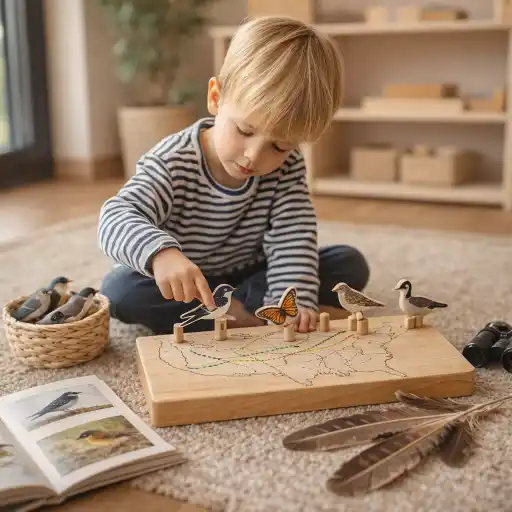
Make a route on a large floor mat, paper roll, or safe outdoor surface. Mark two or three areas as habitats, such as “summer place,” “rest stop,” and “winter place.” Add simple picture cues—trees, water, seeds, or insects—so children can recognize what a place may offer. Use a bird puppet or picture card, or invite children to represent birds with their bodies. The featured Bird Migration Activity Pack Buy Now $1.50 can offer a printable complement to hands-on learning.
Tell a short, flexible story: “The weather is changing, and this bird is looking for a place with what it needs. Where could it go? What might it find along the way?” Children can travel the route by flapping, walking, or moving a bird figure. Pause at a stopover to rest, look for pretend food, or listen to a bird call. Let children make choices and explain them; there is no need to turn the game into a race or a test of route recall.
- Begin with a short route and a clear boundary; model the movement before play.
- Invite children to take turns as the bird, map helper, storyteller, or observer.
- 🧭 Add a picture “rest stop” where children pause, refuel, and decide what comes next.
- Offer seated, pointing, or toy-bird participation alongside whole-body movement.
After playing, revisit the route together. Ask children what the bird needed, where it stopped, and what they wonder about next. Their answers can guide a second round or a related investigation.
How can you extend the play through outdoor observation and learning centers?
Migration play becomes richer when children connect it to the birds and habitats around them. Take a short, supervised listening walk or sit near a window and notice what is present. Children can point, sketch, count, or describe what they see without needing to identify every species. If birds are not visible, notice calls, feathers in books, habitat photographs, or changes in the landscape. The point is to investigate thoughtfully, not to promise a sighting.
Offer extensions that respect different interests and developmental levels:
- Science: Compare photos of two birds and notice similarities, differences, and possible habitat needs.
- Literacy: Read a migration story, introduce words such as route and stopover, then invite children to dictate a journey story.
- Math: Count route markers, compare “near” and “far,” or put picture cards in travel sequence.
- Creative arts: Make a class map with drawings, collage, or yarn showing an imagined journey.
- Dramatic play: Create a bird-watching station with child-safe binoculars, clipboards, and local bird pictures.
Outdoor experiences can also become a source of children’s questions and emergent curriculum. NAEYC’s A Natural Choice: Learning Outdoors describes how educators can follow children’s interests in nature and extend them through observation, discussion, reading, and representation. For providers planning nature-rich spaces, CDA: Creating the Outdoor Classroom Buy Now $16.00 offers a course focused on intentional outdoor classroom design.
How can providers keep migration activities inclusive, safe, and purposeful?
Plan the activity so every child has a meaningful role. Some children may enjoy flying along the route; others may prefer to move a toy bird, point to a picture, tell the story, or watch and comment. Use visual cues, repeated phrases, accessible pathways, and familiar materials. Offer the vocabulary in children’s home languages when possible, and welcome gestures, drawings, and single-word responses as ways to share thinking.
For outdoor observation, choose a bounded area, check the space for hazards, and maintain active supervision. Remind children to observe birds and nests from a respectful distance. Do not encourage touching nests, eggs, feathers, or unfamiliar plants. Avoid feeding wildlife unless your program has checked appropriate guidance and policies; feeding can be unsuitable in some settings. State requirements vary - check your state licensing agency.
Keep the learning purposeful but not over-directed. A few well-chosen questions are more productive than a long quiz: “What do you notice?” “What might the bird need?” “Where could it rest?” Record a child’s words or drawing to see how their ideas develop. Common pitfalls include presenting one route as true for all birds, overloading children with facts, and focusing so much on the game rules that the science idea disappears. Return to the central question and let children’s observations shape what happens next.
Conclusion: How can play help preschoolers explore where birds go?
Preschool play can make fall migration understandable by linking seasonal change to birds’ changing needs. A route mat and movement game let children imagine travel, rest stops, and destinations, while real photographs, stories, and respectful outdoor observation keep the experience grounded in science.
Keep the explanation accurate and simple: some birds make seasonal journeys, routes vary, and not every bird migrates. Give children multiple ways to participate, follow their questions, and extend discoveries through language, math, art, and nature observation. The central goal is not perfect recall; it is helping children wonder, notice, and build an early understanding of how living things relate to their habitats. For more ideas on designing nature-rich learning spaces, explore Creating the Natural Outdoor Classroom Buy Now $16.00.
Related ChildCareEd courses
- Creating the Natural Outdoor Classroom Buy Now $16.00 — Explore ways to create nature-rich outdoor environments for children.
- CDA: Creating the Outdoor Classroom Buy Now $16.00 — Learn about intentional outdoor classroom design and implementation.
- Basic Science in Early Childhood Buy Now $25.00 — Consider strategies for meaningful early science experiences and children’s scientific reasoning.
- Building Early Science Foundations Buy Now $16.00 — Explore play-based opportunities for young children’s inquiry and discovery.
- 1,2,3, Eyes on Me: Classroom Safety Buy Now $32.00 — Review safety and supervision practices for indoor and outdoor environments.
- 45 Hour Preschool Methods and Materials
- What Makes Me Special: An Overview of Autism and ADHD
- Pediatric RSV First Aid & CPR/AED
- The Best Promotion is Play
- Play, Learn, Grow
- Creating Engaging and Meaningful Learning Experiences
- Lesson Planning for Preschoolers
- Texas Director Credential
- Mind's Medicine: Music in Early Childhood
- Nature’s Classroom: Why Fall Is the Best Season for Sensory Learning Outdoors
- CDA Certification en Español: Recursos y Consejos para Educadores Bilingües
- 🥦✨ ¿Cómo apoyar a los niños selectivos a probar nuevos alimentos sin presión?
- Recursos en Español sobre el Sueño Seguro del Bebé
- Cómo ser director de cuidado infantil en Maryland
- Actividades de Motricidad Gruesa que Desarrollan el Equilibrio, la Coordinación y la Fuerza
- 10 Ejemplos de Cómo la Cultura Influye en el Desarrollo Infantil
- ¿Qué preguntas aparecen en el examen CDA para preescolar?
- Proporciones de Cuidado Infantil y Tamaños de Grupo por Edad en Nueva Jersey (Guía Rápida para Centros y Hogares)
- Actividades de Otoño Fáciles para Preescolares esta Temporada
- Consejos de Supervisión Activa para Salones de Preescolar y el Juego al Aire Libre
- Cómo Ser Maestra de Preescolar en Illinois
- Capacitación CDA gratuita en Illinois
- Calabazas, hojas y manzanas: actividades de otoño para preescolares
- Celebrando la amistad en el cuidado infantil durante el Día de los Mejores Amigos
- Canciones, juegos y preguntas de círculo para niños
- Fall Detectives: 10 Questions Pre-K Kids Can Investigate This Season
- How Can Play Help Children Understand How Animals Survive Winter?
- How Do Animals Prepare for Winter—and How Can Children Explore Their Strategies?
- Where Are the Birds Going? How Can Preschool Play Introduce Fall Migration?
