A child who suddenly becomes quiet, unusually irritable, or unable to participate may be communicating that something is wrong before obvious symptoms appear. Strengthen your observation, documentation, and family-communication practices with Illness, Medication, and Allergies in Child Care  Buy Now $32.00, a focused course that addresses signs and symptoms of illness, medication administration, and food allergies. It can help you build practical knowledge while pursuing relevant professional-development hours; review your program and state requirements before enrolling.
Why does recognizing illness matter in early care?
Recognizing illness is not about diagnosing children. It is about noticing meaningful changes, determining whether a child can participate safely, and following a consistent response plan. Young children may not be able to describe nausea, pain, breathing difficulty, or fatigue clearly, so providers often notice changes in behavior, appetite, sleep, play, or interaction first.
Early recognition supports the child’s comfort, protects the group, and helps families make informed decisions. It also strengthens continuity of care: a factual note about when symptoms began can be useful to parents, health professionals, administrators, and public-health officials. The ChildCareEd resource identifying signs of illness and exclusion emphasizes that providers need both observation skills and clear criteria for when a child should not remain in care.
Most importantly, a health check should feel relational rather than punitive. Welcome the child, speak calmly, protect privacy, and avoid language that shames children or families.
What signs of illness should providers observe?
A strong health check considers the child’s appearance, behavior, body, and ability to participate. Compare the child with their usual baseline rather than relying on a single symptom. A sudden and substantial change in mood or behavior can be an important warning sign, especially in infants and toddlers.
- 🩺 Behavior: unusual lethargy, inconsolable crying, confusion, irritability, difficulty waking, or reduced engagement.
- Breathing: persistent coughing, wheezing, rapid or labored breathing, color changes, or visible effort.
- Temperature and hydration: fever, flushed or unusually cool skin, dry mouth, reduced urination, or lack of tears when crying.
- Gastrointestinal symptoms: repeated vomiting, significant diarrhea, blood or mucus in stool, or persistent abdominal pain.
- Skin and eyes: rapidly spreading rash, rash with fever, draining sores, unusual bruising, eye redness, or thick drainage.
- Participation: inability to play, eat, rest, or engage comfortably in ordinary routines.
Use all your senses respectfully, but do not conduct an invasive examination. Observe, ask age-appropriate questions, and follow authorized procedures for temperature measurement or other vital signs. A symptom alone does not establish a diagnosis; allergies, chronic conditions, medication effects, injury, and environmental factors may look similar to infection.
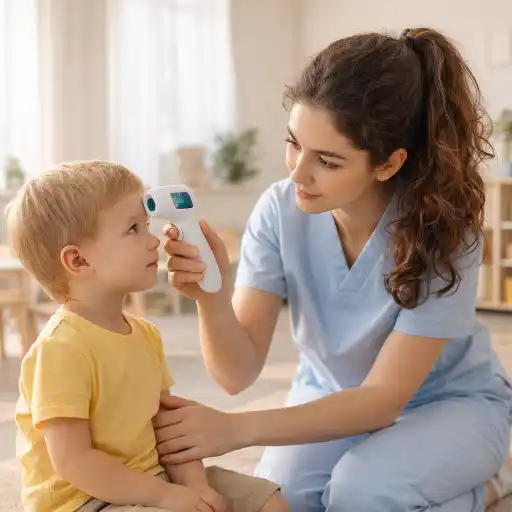
How should daily health checks be conducted?
Build health checks into arrival and ongoing supervision. The Virtual Lab School recommends a brief check at arrival, ideally before the family member leaves, followed by additional observation throughout the day because children’s health can change quickly. A welcoming question such as “How is everyone feeling today?” can invite useful information without creating alarm.
- Gather information. Ask families about changes in sleep, appetite, medication, symptoms, exposure, or chronic-health needs.
- Observe the baseline. Notice mood, movement, skin color, breathing, comfort, and participation.
- Measure when indicated. Follow program policy for temperature or other measurements, use approved equipment, and record the method.
- Compare and reassess. Continue observation after arrival and whenever behavior or appearance changes.
- Act according to policy. Notify the director or designated health lead when concerns arise.
Keep the process brief and consistent across classrooms. Staff should know who makes exclusion decisions, where forms are stored, how to supervise a child who is waiting for pickup, and when emergency services are required. Daily health and safety checks can also reveal injuries, developmental changes, or other concerns that require appropriate follow-up.
When should a child be excluded from care?
Exclusion decisions should be based on the child’s condition, the program’s written policy, applicable public-health guidance, and licensing rules. The Child Care Technical Assistance Network’s Caring for Our Children guidance identifies three practical questions: Can the child participate comfortably? Does the child need more care than staff can provide without compromising other children’s safety? Does the condition pose a meaningful risk of spreading harmful disease?
Common reasons to contact the family promptly include:
- Fever accompanied by behavior change or other concerning symptoms.
- Breathing difficulty, altered consciousness, seizure activity, or signs of severe illness.
- Repeated vomiting, uncontrolled diarrhea, dehydration concerns, or blood in stool.
- Rash with fever or behavior change, rapidly spreading rash, or draining skin lesions.
- A diagnosed or suspected communicable condition that requires exclusion under health-department guidance.
- An illness that prevents meaningful participation or requires one-to-one care the program cannot safely provide.
Some mild symptoms, such as a runny nose without fever or behavior change, may not require exclusion when the child can participate and staff can provide appropriate care. Do not rely on a universal “one-size-fits-all” rule. State requirements vary - check your state licensing agency, and keep your policy current.
How can providers respond, document, and communicate?
When a child is ill but does not require emergency care, move the child to a comfortable, supervised area away from close group activity. Maintain dignity and connection: offer reassurance, water when appropriate, quiet materials, and a familiar adult. Never leave a sick child unsupervised or isolate them in a way that feels frightening or punitive.
Documentation should be objective, timely, and concise. Include:
- Date, time, location, and staff member completing the note.
- Observable symptoms and measured information, including the method used.
- The child’s ability to participate and care provided.
- Notifications made, pickup arrangements, and the time the child left.
- Medication or first aid provided only under authorized procedures.
Use language such as, “At 10:15 a.m., Jordan vomited twice, appeared tired, and rested with a staff member. Parent contacted at 10:22 a.m.; pickup arranged.” Avoid statements such as “Jordan has the flu” unless a qualified professional has confirmed that diagnosis.
Communicate with empathy and clarity. State what you observed, explain the relevant policy, describe next steps, and provide return-to-care criteria. Exposure notices should protect confidentiality and should not identify the child who is ill.
How can programs prevent illness and avoid common mistakes?
Recognition works best within a broader infection-prevention system. The CDC recommends layered practices for early care programs, including hand hygiene, cleaning and disinfection, ventilation, separation of personal belongings, vaccination support, and a supervised area for children who become ill. Programs should also reinforce respiratory etiquette, safe diapering, food safety, and appropriate staff illness policies.
Common mistakes are usually system problems rather than individual failures. Directors can reduce them by making expectations visible and practicing responses during orientation and staff meetings.
- Inconsistent screening: use one short checklist and train substitutes to use it.
- Delayed documentation: complete the record during or immediately after the event.
- Overdiagnosing: describe observations instead of naming an illness.
- Unclear exclusion rules: provide families with a plain-language policy and return criteria.
- Insufficient infection control: audit handwashing, cleaning supplies, ventilation, and high-touch surfaces.
- Late escalation: contact leadership and public health promptly when several people develop similar symptoms or a reportable condition is suspected.
For additional preparation, consider How To Keep A Healthy Class: Six Tips for Germ Control Buy Now $35.00, which focuses on communicable-disease prevention and hygiene-focused procedures, and Prevention and Control of Infectious Diseases Buy Now $16.00, a concise course on reducing the spread of germs in child care.
Conclusion: What should providers remember about recognizing illness?
Recognizing signs of illness means observing the whole child, noticing changes from the child’s baseline, and responding with calm consistency. The essential sequence is: observe, assess participation and safety, provide supervised comfort, notify the appropriate people, document facts, and follow the program’s exclusion and return-to-care policy.
Providers are not expected to diagnose every cough, rash, or stomach complaint. They are expected to create a thoughtful system that protects children while treating families respectfully. Review your checklist, clarify staff roles, update your illness policy, and ensure that everyone knows when an observation becomes an emergency. For broader orientation and health-and-safety preparation, explore Health and Safety Orientation Buy Now $55.00. Strong #observation, accurate #documentation, respectful #communication, effective #prevention, and timely #response help children receive safer, more compassionate care.
- 45 Hour Child Growth and Development
- Professional Presence in Early Childhood
- 45 Hour Infant and Toddler Methods and Materials
- Recognize, Respond, Respect: Supporting Diverse Learners
- 45 Hour School Age Methods and Materials
- CDA Bridge Bundle: Family Child Care
- Texas Director Credential
- Trauma-Sensitive Care: Supporting Young Children with Empathy
- Ah-Choo!
- Childhood Neglect
- Capacitación en Salud y Seguridad Preventiva en Línea para Proveedores de Cuidado Infantil
- Proporciones de Cuidado Infantil y Tamaños de Grupo por Edad en Maryland (Guía Rápida para Centros y Hogares)
- Proporciones de Cuidado Infantil y Tamaños de Grupo por Edad en Virginia (Guía Rápida para Centros y Hogares)
- How can New York child care providers spot and respond to heat exhaustion and heatstroke in young children?
- How Can New York Child Care Providers Protect Children Now That Measles Is Back in 2026?
- How can North Dakota providers recognize and respond to heat stress in young children?
- How can child care programs prevent heat-related illness during outdoor play?
- Child Keeps Hitting Other Kids? Look for These 7 Patterns Before Reacting
- Active Supervision Examples: 10 Real Classroom Scenarios—Safe or Unsafe?
- How Can Child Care Providers Support Children with Sensory Processing Differences?
- What Should Providers Know About Measles and Immunization Records This Fall?
- How Can Child Care Providers Recognize Signs of Illness and Respond Safely?
- Can a Child Attend Daycare With a Cough or Runny Nose?
- When Should a Sick Child Be Sent Home From Daycare?
- How Long Should a Child Stay Home After Vomiting?
- How Can Preschool Teachers Recognize and Respond to Sensory Overload in the Classroom?
- What Should Be Included in an Infant Daily Schedule?
