Children may swipe a screen with ease, but the small, purposeful movements involved in turning pages, using utensils, building, drawing, and fastening clothes still matter every day. Child care providers can balance digital experiences with practical, engaging opportunities for children to use their hands; Lesson Planning for Preschoolers  Buy Now $24.00 can help you turn developmental goals into intentional classroom plans, while Playful Learning: Infant & Toddler Activities Buy Now $25.00 offers age-appropriate activity-planning support. Explore these courses as a next step, then use the ideas below to keep hands-on learning at the center of children’s daily experiences.
What are fine-motor skills, and why do they matter beyond handwriting?
Fine-motor skills involve the coordinated use of the small muscles in the hands and fingers, often working together with the eyes. Children rely on these abilities for far more than holding a pencil: they use them to eat, dress, open containers, turn book pages, manipulate toys, create art, and participate in classroom routines. These everyday actions build agency because children can do more for themselves and take a fuller role in play and learning.
Hand use also connects children to materials and ideas. A child who stacks blocks, presses playdough, sorts objects, or draws a map is exploring properties, testing possibilities, and expressing meaning through action. These experiences can support visual-motor coordination, planning, persistence, and communication. They are not a shortcut to academic achievement, nor should every activity be treated as a formal lesson; rather, they are part of a rich environment where learning happens through purposeful play and interaction.
Fine-motor development is also an equity and inclusion issue. Children need different tools, time, and levels of support to participate successfully. A thicker crayon, easy-to-open container, or adapted scissors can make a meaningful difference. The goal is not identical performance, but growing access, independence, and confidence.
Does screen use replace or harm fine-motor development?
The evidence does not support a simple claim that screens automatically weaken children’s fine-motor abilities. One study of children aged three to six found no significant association between reported digital-device use time and fine-motor scores, while also noting that additional research is needed. More broadly, the relationship between digital media and children’s development depends on factors such as age, content, context, duration, and adult involvement.
Digital experiences can invite children to tap, drag, draw, or make choices, and technology can provide creative and accessible ways to communicate. However, a touch gesture is not the same experience as squeezing dough, controlling scissors, turning a small object, or coordinating both hands to fasten clothing. Screen activities may be one part of a varied learning environment, but they should not crowd out hands-on exploration, movement, conversation, rest, and social play.
For providers, the useful question is not “screens or no screens?” but “What is this experience making possible, and what else does the child need?” The NAEYC guidance on technology and interactive media emphasizes developmentally appropriate, purposeful use that supports children’s creativity and learning. Consider using digital tools to document a child’s block structure or record their story, then return to the materials and conversation that inspired it.
How can providers build meaningful hand-use opportunities into the day?
Fine-motor learning does not need to be confined to a worksheet or a special activity period. Children benefit from repeated, varied chances to manipulate materials during play and ordinary routines. A daily schedule already contains many invitations: children can use utensils at meals, open lunch containers, help pour water, manage dress-up clothes, turn pages, and take responsibility for putting materials away.
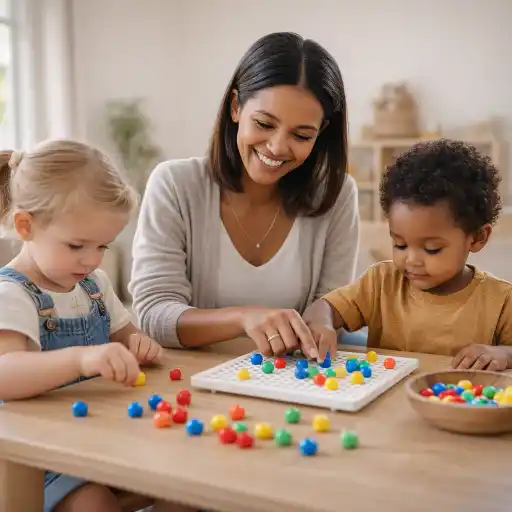
Offer open-ended materials that can be used in many ways. Playdough, chunky crayons, blocks, large beads, puzzles, child-safe scissors, paper, paintbrushes, and tongs invite children to practice grasping, releasing, pressing, pinching, and coordinating both hands. Follow children’s interests and allow enough uninterrupted time for them to repeat a movement, adjust a strategy, and see what happens.
- 🧵 Add large-bead threading, lacing cards, or linking toys to a supervised choice area.
- Invite children to pinch, roll, flatten, and stamp playdough, choosing their own designs.
- Set up a practical-life task, such as sorting clean socks, opening containers, or spreading soft food with an appropriate utensil.
- Place paper on an easel or vertical surface for drawing and painting with different tools.
- Pair hand activities with conversation: describe actions, ask what the child notices, and invite them to explain their plan.
How can digital tools complement hands-on learning?
Technology is most useful when it serves a clear purpose and connects children to active learning, relationships, and the physical world. For example, children might photograph a construction, then rebuild it with blocks; record a story about a drawing, then add details to the artwork; or use a guided drawing app briefly before experimenting with paper, markers, and paint. In each case, the screen is a tool for creating, documenting, or communicating—not a substitute for the broader experience.
When selecting a digital activity, consider whether children make choices, create or respond, and have an adult available to talk with them. Short, intentional use can support participation, including for some children who benefit from assistive technology. Make room for turn-taking, co-viewing, and conversation, and connect screen content to real objects or play whenever practical.
Directors can help staff by making a simple planning routine:
- Identify the developmental or learning purpose before choosing a device or app.
- Ask what hands-on, social, or movement-based experiences should accompany it.
- Plan adult participation, privacy protections, and a clear stopping point.
- Observe whether the tool supports children’s engagement and access, and adjust if it does not.
Professional development can help teams think critically about media choices. The ChildCareEd course Technology as a Classroom Tool Buy Now $16.00 addresses how providers can guide technology use and connect it with children’s growth and classroom learning.
How can providers observe progress without turning play into a test?
Observation is most useful when it happens during meaningful activity, not only when a child is asked to perform on demand. Notice how a child reaches, grasps, releases, turns, presses, draws, or uses tools. Does the child use both hands together? Do they stabilize paper with one hand while marking with the other? What materials invite persistence, and what adaptations make participation easier?
Record specific, neutral examples rather than judgments. For instance, “During art, held the paper with one hand and made several deliberate marks with a short crayon” gives a clearer picture than “has poor hand skills.” Review observations across time and contexts, and include the child’s interests, strengths, and supports that helped. Developmental milestones can provide broad reference points, but they are not diagnoses or pass-or-fail standards. The CDC’s three-year milestones, for example, include stringing items such as large beads, putting on some clothing, and using a fork among other areas of development.
If a child consistently has difficulty participating, loses a previously acquired skill, or concerns persist across settings, share concrete observations respectfully with the family and follow your program’s referral and communication procedures. Partner with families and, where appropriate, health or early-intervention professionals. State requirements vary - check your state licensing agency.
How can programs keep fine-motor learning inclusive and balanced?
Children’s strengths, experiences, abilities, and developmental timing differ. An inclusive program offers more than one way to participate and adjusts the challenge without taking over the task. Try larger or easier-to-grip tools, paper secured with tape, a stable work surface, fewer pieces, visual cues, or extra time. Demonstrate a movement, offer a concise prompt, then give the child space to try independently. Avoid insisting on one “correct” grip or comparing children with one another.
Balance matters at the program level, too. A thoughtful day includes active movement, conversation, sensory exploration, pretend play, outdoor experiences, quiet time, and purposeful technology use where appropriate. Digital media can contribute to children’s creativity and communication; it simply cannot provide every kind of feedback that comes from handling real materials, working alongside peers, or completing a self-care task.
Common pitfalls include treating screen taps as a replacement for varied hand use, relying heavily on tracing sheets, and offering tools that are too difficult or unsafe. Make the experience playful, supervise age-appropriate materials, and focus on a child’s strategy and participation rather than a polished product. The ChildCareEd guide to everyday fine-motor practice offers further routine-based ideas for planning purposeful opportunities.
Conclusion: Why do fine-motor skills still matter in a digital childhood?
Fine-motor skills still matter because children use their hands to explore, communicate, create, and manage daily life. Digital tools can be valuable when chosen with care, but they are only one part of a developmentally responsive environment. Children also need regular opportunities to manipulate real objects, coordinate both hands, practice self-care, and learn alongside attentive adults and peers.
For child care providers and directors, the practical path is a balanced one: plan varied hands-on experiences, use technology with a clear purpose, adapt materials for individual participation, and observe children in authentic routines. These small, consistent choices help children build skill and confidence while making room for the many ways they learn. Fine-motor practice does not require expensive equipment or a separate curriculum; it can begin with playdough, a fork, a block, a page to turn, or a child eager to do it themselves.
Explore relevant ChildCareEd courses
- Lesson Planning for Preschoolers Buy Now $24.00 — plan developmentally appropriate preschool experiences.
- Playful Learning: Infant & Toddler Activities Buy Now $25.00 — create age- and ability-appropriate activities for younger children.
- DAP for Preschool Buy Now $24.00 — strengthen developmentally appropriate preschool practices.
- Technology as a Classroom Tool Buy Now $16.00 — consider purposeful ways to guide technology use in early learning.
- 45 hour Growth and Development Birth-age 12 ONLINE Buy Now
$399.00$199.00 — deepen knowledge of child growth and development.
- Balancing Physically Active Play in Child Care
- What Makes Me Special: An Overview of Autism and ADHD
- Family Voices Matter: Tools for Meaningful Collaboration
- Money Matters in Medicine
- Privacy Matters: Documentation and Observation in Early Learning
- Texas Director Credential Renewal
- Texas Director Credential
- Balancing Active Play in Child Care
- Every Moment Matters: Schedules and Transitions
- Helping children develop Fine Motor Skills
- How to boost fine motor skills: Holiday Edition
- Increasing Fine Motor Skills in the Early Childhood Education Classroom
- How motor skills shape child development and creative ways educators can foster them.
- CDA Certification en Español: Recursos y Consejos para Educadores Bilingües
- 🌙 ¿Cómo afecta el tiempo frente a las pantallas el sueño y el comportamiento infantil? 😴
- Cuáles Son las Señales de Alerta en el Desarrollo Infantil que Todo Educador Debe Conocer?
- ¿Cómo puedo usar escenarios de juego de roles de primeros auxilios en mi aula?
- Cómo Ser Maestra de Preescolar en Dakota del Norte
- Capacitación Previa al Servicio para Proveedores de Cuidado Infantil en Dakota del Norte
- Cómo simplificar la capacitación para sus empleados de daycare
- What fun, practical activities help build fine and gross motor skills in early childhood classrooms?
- What Will the Future of Early Childhood Education and Care Look Like?
- How Should Lesson Plans for Infants 0–12 Months Change by Age?
- How Can Child Care Providers Strengthen Fine Motor Development Through Play and Daily Routines?
- What Should Child Care Providers Look For in Fine Motor Skills by Age?
- How Do Mazes Strengthen Pencil Control and Problem-Solving in Preschool?
- Why Do Fine-Motor Skills Still Matter in an Increasingly Digital Childhood?
