Repeated toy choices are more than preferences—they are invitations to understand children’s theories, strengths, relationships, and emerging skills. Use the Play Preference Observation Tracker to turn everyday choices into useful planning evidence, and strengthen your observation practice through Observing & Assessing in Child Care  Buy Now $16.00, which helps providers document development, select assessment methods, and plan responsive learning experiences.
For a deeper focus on selecting materials and interpreting how children use them, explore Using Toys to Support Learning Buy Now $16.00. Together, these resources can help you make classroom decisions grounded in children’s actual play rather than assumptions about what a toy is “supposed” to teach.
Why do repeated toy choices matter?
When a child returns to the same toy day after day, adults may wonder whether the child is stuck, avoiding challenge, or simply following a preference. Often, repetition reflects sustained inquiry. Children may be testing cause and effect, rehearsing a social role, refining motor control, developing a story, or seeking the confidence that comes with familiar mastery.
Head Start describes respectful observation as an effort to understand children’s goals and intentions before responding. That stance is especially valuable when a child’s play seems repetitive. Instead of asking, “How can I redirect this child?” begin with, “What question might this child be exploring?”
Repeated choices can reveal:
- interests that sustain attention and persistence;
- skills children already use with confidence;
- areas where a small scaffold could extend thinking;
- social roles children seek or avoid; and
- materials that make participation accessible and meaningful.
Research on toys also cautions providers not to judge quality by appearance, price, or adult appeal. The TIMPANI study found that simple, open-ended materials often supported rich intellectual, creative, social, and verbal play. A toy’s educational value depends partly on how children use it in a particular context—not simply on its label or marketing.
What can a child’s favorite toy reveal about development?
A repeated choice is best understood as a pattern of behavior rather than a fixed label. A child who repeatedly builds with blocks may be exploring balance, spatial relationships, planning, or symbolic representation. A child who chooses dolls or animal figures may be practicing caregiving, narrative language, perspective-taking, or peer negotiation. A child who repeatedly sorts small objects may be investigating classification, order, pattern, or sensory properties.
Consider the whole play episode. The toy is one piece of evidence; the child’s actions, language, persistence, and relationships provide the richer picture. Ask:
- What does the child do with the toy each time?
- What changes from one attempt to the next?
- Does the child use words, gestures, drawings, or movement to communicate an idea?
- Does the play remain solitary, or does the child invite peers?
- What happens when the toy does not work as expected?
These questions help providers notice #development across domains. A child repeatedly racing vehicles may be working on speed and trajectory, but may also be negotiating rules, using comparative language, or coordinating movement. A child who repeatedly dresses a doll may be developing sequencing, empathy, vocabulary, and identity-related narratives.
NAEYC emphasizes that children’s toy preferences reflect culture, family experiences, and individual interests. Therefore, providers should interpret choices with curiosity rather than stereotypes, including assumptions about gender or ability.
How should providers document repeated toy choices?
Documentation does not need to become lengthy or burdensome. A short, objective note can preserve the information needed for planning. Avoid phrases such as “loves cars” or “is obsessed with puzzles.” Instead, describe observable actions, words, context, and duration.
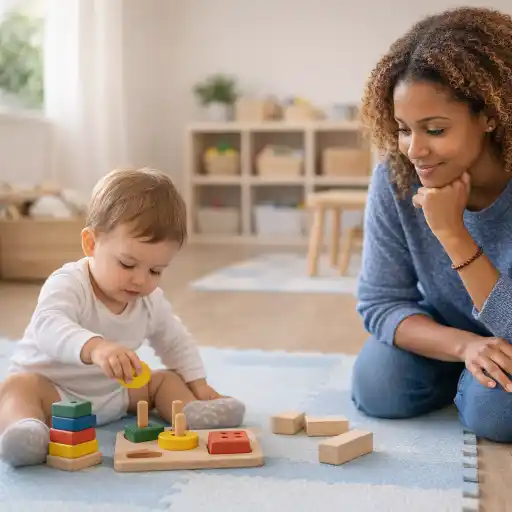
For example: “During free play, Maya selected the wooden vehicles for three consecutive mornings. She arranged four cars beside a block road, invited Leo to be the driver, and said, ‘This road goes to the hospital.’ When the road collapsed, she rebuilt it with wider blocks.” This note provides evidence of persistence, spatial planning, dramatic play, language, and peer interaction.
The Play Preference Observation Tracker can help teams look for patterns across days. Include fields such as:
- date, setting, and available materials;
- toy or material selected;
- length and frequency of engagement;
- actions, words, and strategies observed;
- peers or adults involved;
- possible interests or learning processes; and
- one reasonable extension or adaptation.
🎯 Keep interpretation tentative. Write “may be exploring balance” rather than treating an inference as fact. Review several observations before making a planning decision, and invite family perspectives when a pattern appears across settings.
NAEYC recommends ongoing, purposeful, culturally and linguistically responsive assessment. A tracker is useful when it supports that cycle: observe, document, reflect, plan, and revisit.
How can providers extend favorite toys without taking over?
The most effective extension is often small. Providers can preserve children’s agency while adding language, materials, social possibilities, or a manageable challenge. The goal is not to convert a favorite toy into an adult-directed lesson; it is to make children’s existing thinking more visible and expansive.
Try these responsive moves:
- Describe: “You placed the small animals inside the box and covered it with fabric.”
- Offer vocabulary: Introduce words such as “stable,” “route,” “compare,” “inside,” “heavier,” or “predict.”
- Add variation: Provide different sizes of containers, ramps, blocks, fabrics, or natural materials.
- Invite prediction: “What might happen if the ramp is higher?”
- Support representation: Add clipboards, maps, signs, drawing tools, books, or photographs.
- Create entry points: Offer roles such as builder, storyteller, recorder, customer, or observer.
Watch the child’s response. If the added material is ignored, remove pressure and allow the original investigation to continue. If peers join, observe whether the new arrangement supports equitable participation or creates competition for a scarce resource.
Open-ended toys are particularly useful because they can be transformed across play themes. Blocks may become homes, bridges, phones, or food. Replica figures may support elaborate narratives and shared attention. At the same time, puzzles and games can offer valuable opportunities for rule-following, turn-taking, and problem-solving. The key is matching the material and adult support to the child’s current purpose.
How can toy observations guide inclusion and classroom planning?
Repeated toy choices can help providers identify both strengths and barriers. A child may consistently select a material because it offers a comfortable way to participate, communicate, regulate sensory input, or connect with peers. Rather than removing the preferred toy, consider how to use it as a bridge to broader experiences.
Inclusive planning may involve:
- providing visual directions or picture-based choice cards;
- offering quiet spaces and sensory-friendly alternatives;
- adapting toy size, weight, texture, or accessibility;
- allowing communication through speech, gesture, sign, drawing, or assistive technology;
- including family languages, cultural meanings, and familiar play themes; and
- placing favorite materials near peers or complementary centers to invite connection.
NAEYC’s guidance on planning for individuality illustrates how a small environmental change—such as placing cars in the block area—can create new opportunities for communication and cooperative play. The same principle applies to repeated toy choices: use what motivates the child as an entry point, not as a reason to limit the child.
For children who repeatedly engage in a pattern accompanied by distress, safety concerns, loss of skills, or significant barriers to routines, document carefully and collaborate with families and specialists. Do not diagnose from toy preference alone. State requirements vary - check your state licensing agency, especially regarding documentation, referrals, inclusion, and confidentiality.
What common mistakes should providers avoid?
Observation is powerful, but interpretation can become distorted when adults move too quickly from preference to conclusion. A child’s repeated selection of a truck does not prove a particular developmental profile, and a child’s avoidance of a toy does not necessarily indicate a deficit.
- Assuming repetition means a problem: First consider practice, mastery, security, inquiry, or communication.
- Confusing the toy with the learning: Focus on what the child does, says, and changes.
- Using gender stereotypes: Observe whether materials support thinking, creativity, language, and social interaction for every child.
- Over-scaffolding: Do not replace the child’s idea with an adult-designed activity.
- Rotating materials too quickly: Sustained access may be necessary for deeper investigation.
- Collecting notes without acting: Use observations to adjust materials, interactions, and goals.
- Ignoring culture and family knowledge: Ask what a toy or play routine means at home.
A helpful team reflection is: “What evidence supports my interpretation, and what other explanations should we consider?” Directors can strengthen consistency by reviewing a few tracker entries during planning meetings and asking staff to identify one practical next step.
Conclusion: What can providers learn from repeated toy choices?
Children’s repeated toy choices can reveal sustained interests, working theories, communication strategies, social goals, sensory preferences, and emerging developmental strengths. They are not diagnostic answers, but they are meaningful observations that can guide responsive curriculum and environmental design.
Use the Play Preference Observation Tracker to record what children actually do over time. Combine those notes with family knowledge, culturally responsive reflection, and observations across settings. Then add small, intentional extensions—new vocabulary, flexible materials, peer roles, or accessible choices—while protecting children’s agency.
The central question is not, “Which toy should this child choose next?” It is, “What is this child learning through the toy they choose now, and how can I thoughtfully support that learning?”
Related ChildCareEd courses:
- Observing & Assessing in Child Care Buy Now $16.00
- Using Toys to Support Learning Buy Now $16.00
- Tracking Progress, Shaping Futures: Observation & Assessment Skills Buy Now $55.00
- From Play to Planning: Building Culturally Competent, Child-Centered Curriculum Buy Now $55.00
- The Best Promotion is Play Buy Now $24.00
Frequently asked questions
How long should I observe a repeated toy choice?
Begin with a focused five- to ten-minute observation and revisit the pattern across several days and contexts.
Does a favorite toy indicate a developmental delay?
No. Toy preference alone cannot diagnose a delay. Consider the child’s broader communication, relationships, participation, and development, and collaborate with families when concerns persist.
Should providers remove a toy if a child uses it repeatedly?
Usually not, unless safety, access, or group participation is affected. Repetition may support practice, security, and deeper learning.
How can families contribute?
Ask what toys, routines, stories, or play themes the child chooses at home and what those choices mean within the family’s culture.
How can directors use the tracker with staff?
Use selected entries during planning or coaching meetings to connect observation evidence with environmental changes, teaching strategies, and individual goals.
- CDA Home Visitor Subject Area 3 Part 3 Birth to 5
- Teacher-Child Interactions for Stronger CLASS® Outcomes
- CDA Home Visitor Subject Area 2 Part 3 Birth to 5
- From Play to Planning: Building Culturally Competent, Child-Centered Curriculum
- Using Toys to Support Learning
- Privacy Matters: Documentation and Observation in Early Learning
- Play with Purpose: Supporting Children with Autism
- CDA Certification en Español: Recursos y Consejos para Educadores Bilingües
- 🍑 ¿Qué capacitación requiere DECAL cada año para el personal de cuidado infantil en Georgia?
- ¿Cuáles son las mejores actividades del Día de la Tierra para niños en casa o en el aula?
- 10 Ejemplos de Cómo la Cultura Influye en el Desarrollo Infantil
- Capacitación en Salud y Seguridad Preventiva en Línea para Proveedores de Cuidado Infantil
- Regulaciones de Licenciamiento de Cuidado Infantil en California para Centros y Hogares de Cuidado Infantil Familiar
- Proporciones de Cuidado Infantil y Tamaños de Grupo por Edad en Maryland (Guía Rápida para Centros y Hogares)
- Proporciones de Cuidado Infantil y Tamaños de Grupo por Edad en Nueva Jersey (Guía Rápida para Centros y Hogares)
- Proporciones de Cuidado Infantil y Tamaños de Grupo por Edad en Virginia (Guía Rápida para Centros y Hogares)
- Cómo Ayudar a Niños con Retraso del Habla en el Cuidado Infantil
- Retraso del Habla en la Guardería: Cómo Pueden Ayudar los Proveedores
- Celebrando la amistad en el cuidado infantil durante el Día de los Mejores Amigos
- Canciones, juegos y preguntas de círculo para niños
- When Learning Feels Hard: Positive Discipline Strategies for Children Who Struggle
- How Can You Create a “Yes Space” Where Infants and Toddlers Explore Safely?
- What Can Providers Learn From the Toys Children Choose Repeatedly?
- Why Do Preschoolers Fight Over Toys—and How Can Teachers Help?
- Why Does a Toddler Need to Do It Again—and Again?
- When Do Too Many Materials Make a Learning Center Harder to Use?
- When Does Classroom Clutter Become a Safety Issue?
