Moving beyond a first set of consonant-vowel-consonant words is a meaningful step when children can hear, blend, and connect the sounds with growing confidence—not simply when they have finished a worksheet. Build your next steps around careful observation, playful practice, and each child’s readiness; ChildCareEd’s Assessment of Language and Literacy Skills  Buy Now $24.00 course can help you document progress objectively and turn it into useful learning goals. For a broader foundation in early reading development, consider Science of Reading Foundations in the Pre-K Classroom Buy Now $16.00 as well.
Use the Complete the Words - Mixed CVC Set 2 Buy Now $1.00 activity as a practical opportunity to notice what children can do, what still needs scaffolding, and how to make the next practice step engaging.
Why does readiness matter before introducing a second mixed CVC set?
CVC words—consonant-vowel-consonant words such as nap or hot—invite children to attend to three sounds and connect those sounds with letters. A mixed set introduces varied initial and final consonants and short vowels, asking children to apply their understanding beyond a single familiar word family. The goal is not to rush children through worksheets. It is to offer a suitable next challenge while protecting their confidence and curiosity.
Children develop at different rates, and one successful activity does not establish mastery. Look for a pattern across brief, low-pressure opportunities. Can a child hear the separate sounds in a spoken word? Can they blend those sounds into a whole word? When letters are included, can they use the relevant sound-letter knowledge, rather than relying only on the picture or guessing?
What skills suggest a child may be ready to try Set 2?
Readiness is better understood as a collection of observed skills than as a strict age or one-time score. Before offering a mixed CVC completion activity, notice whether the child can participate in some of these ways, with the level of support that is appropriate for them:
- Identifies or produces some initial, middle-vowel, and final sounds in simple spoken words.
- Blends three spoken sounds into a recognizable word, or is making steady progress with guided practice.
- Recognizes some letter-sound correspondences represented in the activity.
- Can use a picture as a meaning cue while also attending to the sounds and letters.
- Shows interest in trying, revising, or explaining a word rather than becoming distressed by errors.
Choose a small number of words to preview, then observe how the child approaches them. Children learning English may have different experiences with English sounds; invite their home-language knowledge and avoid interpreting language difference alone as lack of readiness.
How can providers use Mixed CVC Set 2 as an observation opportunity?
Set 2 includes twelve words—nap, mud, won, hot, cob, hop, red, net, sob, wig, fog, and pin—in a familiar picture-and-letter-bank format. Its varied vocabulary can extend practice after Set 1 or serve as review. Because the format is familiar, providers can focus on how a child reasons through each word rather than spending time explaining a new activity.
Before starting, briefly introduce any unfamiliar picture or word. Then invite the child to say the word, listen for its sounds, and identify the missing letter or letters. Use neutral prompts such as “What sound do you hear in the middle?” or “Let’s say it slowly together.” Avoid giving the answer too quickly; offer a model or sound cue when needed, then let the child try again.
- Record the date, word or target skill, the child’s response, and the prompt or support provided.
- Notice whether the child attends to each sound, uses letter-sound knowledge, or relies mainly on the image.
- Compare observations across different words and days instead of drawing conclusions from one attempt.
- 🧩 Keep the task brief, celebrate thoughtful effort, and stop or simplify if frustration rises.
For practical professional learning about objective observation and turning evidence into appropriate goals, explore ChildCareEd’s Assessment of Language and Literacy Skills Buy Now $24.00.
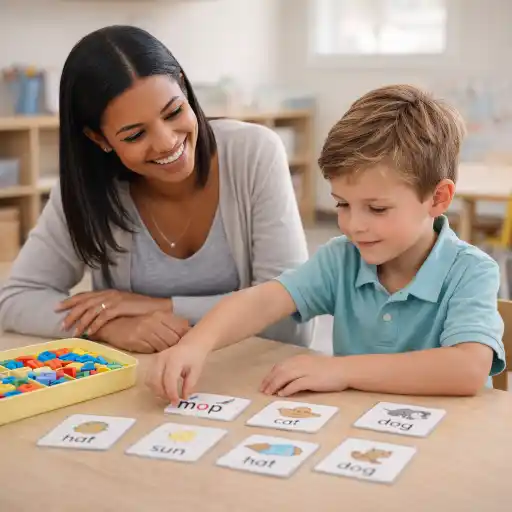
How can you scaffold practice without turning it into a test?
Think of Set 2 as one option within a responsive teaching sequence. Start with oral play: say a word such as hop, invite the child to stretch or tap its sounds, and blend them back together. Then connect sounds to letters using movable letter cards, sound boxes, or writing. A gradual release—adult models, adult and child practice together, then the child tries—keeps the task accessible while building independence.
Adjust the task to the child, not the other way around. If three-sound blending is difficult, return to oral sound identification or work with fewer choices. If the child is successful with support, reduce prompts gradually. If pictures make guessing too easy, ask the child to explain which sound or letter helped them decide. Pair reading with spelling or word-building when appropriate; encoding—a child’s attempt to represent sounds with letters—offers another view of what they understand.
Keep the experience playful and connected to communication. Children can build a word with magnetic letters, act out a familiar word, or find another object that starts with the same sound.
What common pitfalls should providers avoid?
A frequent pitfall is treating completion of Set 1 as proof that every child is ready for Set 2. A child might remember a specific picture-word pairing or answer correctly through guessing, while still needing support to segment or blend sounds. Use varied examples, listen to the child’s reasoning, and check skills in more than one setting.
Another mistake is making speed or independent completion the main measure of success. Early decoding takes practice. A slower response may reflect careful sound analysis, unfamiliar vocabulary, or a need for more processing time—not a lack of ability. Offer wait time, specific encouragement, and a chance to correct an answer without shame.
Also be mindful of language, access, and individual learning needs. Confirm that a child understands the pictured word before assessing its sounds. Use clear, accessible materials and provide verbal, visual, or hands-on support as appropriate. If progress concerns persist, document examples and talk with the family and relevant program supports; an activity sheet is not a developmental screening or diagnosis. When interpreting requirements for your setting, state requirements vary - check your state licensing agency.
How should providers decide what to teach next?
Use observations to choose the next small instructional step. If the child blends familiar CVC words but misses medial vowels, plan short activities that help hear and compare short-vowel sounds. If the child identifies sounds orally but struggles to connect them to letters, revisit a few sound-letter correspondences with manipulatives and modeling. If the child completes words reliably with support, offer more opportunities to read, build, and write the words in meaningful contexts.
Keep notes concise and actionable. For example: “During a small-group activity on Tuesday, the child identified the first and last sounds in three words and blended one word after a model; needed a prompt for the middle vowel.” This records observable behavior and points toward a useful next step without labeling the child.
Share progress with families in strengths-based language, including what the child is practicing and one simple way to play with sounds together. Continue to monitor participation and enjoyment as well as skill. A responsive plan treats readiness as an ongoing decision: offer a challenge, observe, adjust, and revisit when needed.
Conclusion: How do you know when a child is ready for Set 2?
Children may be ready to explore a second mixed CVC set when observations show developing sound awareness, blending, and relevant letter-sound knowledge—and when the activity can be offered with a comfortable level of support. Readiness is not determined by age, worksheet completion, or a single correct response.
Use Set 2 as both practice and a window into children’s thinking: preview vocabulary, invite sound-by-sound reasoning, scaffold without pressure, and document what you observe. Then select the next teaching step based on each child’s strengths and needs. For a deeper professional learning experience in documenting language and literacy growth, visit ChildCareEd’s Assessment of Language and Literacy Skills Buy Now $24.00 course.
- CDA Preschool Credential
- CDA Preschool Credential with Portfolio Review
- CDA Infant/Toddler Credential
- CDA Family Child Care Credential with Portfolio Review
- CDA Bridge Bundle: Preschool
- Pediatric RSV First Aid & CPR/AED
- CDA Infant/Toddler Credential with Portfolio Review
- CDA Bridge Bundle: Family Child Care
- CDA Bridge Bundle: Infant/Toddler
- Texas Director Credential
- CDA Certification en Español: Recursos y Consejos para Educadores Bilingües
- 🚌 ¿Qué Significan las Regulaciones de Transporte de Illinois para las Excursiones Infantiles? 🚦
- Recursos en Español sobre el Sueño Seguro del Bebé
- ¿Cómo pueden los equipos de cuidado infantil practicar habilidades rápidas de primeros auxilios en situaciones reales?
- ¿Cómo obtengo la certificación CDA en línea en Florida?
- ¿Qué Preguntas Hay en el Examen CDA de Cuidado Infantil Familiar?
- Proporciones de Cuidado Infantil y Tamaños de Grupo por Edad en Maryland (Guía Rápida para Centros y Hogares)
- Proporciones de Cuidado Infantil y Tamaños de Grupo por Edad en Nueva Jersey (Guía Rápida para Centros y Hogares)
- Proporciones de Cuidado Infantil y Tamaños de Grupo por Edad en Virginia (Guía Rápida para Centros y Hogares)
- Cómo Celebrar el Día Nacional del Kindergarten
- Lista para Guardería en Casa en Illinois: Cómo Iniciar una Guardería en el Hogar
- Temas y Actividades para el Día Nacional del Kindergarten para Proveedores
- Por Qué la Supervisión Activa Es Clave para la Seguridad en el Cuidado Infantil
- Retraso del Habla en la Guardería: Cómo Pueden Ayudar los Proveedores
- How Can Picture and Color Cues Help Children Decode CVC Words?
- How Can Familiar Household Words Help Children Complete CVC Words?
- How Can Animal Words Strengthen CVC Decoding?
- How Does Mixed CVC Practice Build Flexible Decoding Skills?
- When Are Children Ready for a Second Set of Mixed CVC Words?
