When a child sees a picture, sounds out the letters, and recognizes a word, a small literacy breakthrough is taking place. Pairing picture and color cues with purposeful sound-by-sound practice can make CVC decoding more approachable; the Classroom Tools for Emergent Literacy course  Buy Now $16.00 offers providers strategies for building literacy into everyday classroom experiences. Read on for practical ways to use visual prompts without letting children rely on guessing.
Why use picture and color cues to support CVC decoding?
CVC words follow a consonant-vowel-consonant pattern, as in cat, bed, and sun. Each letter represents a sound, and children practice connecting those sounds and blending them into a spoken word. This work draws on phonemic awareness and letter-sound knowledge—building blocks that support later reading and spelling.
A picture can make a word’s meaning concrete and inviting. Color can add a manageable hands-on element, helping children stay engaged while they attend to a word or select an answer. But a visual cue should support decoding, not replace it. If a child names a picture and immediately chooses a matching word without looking at its letters, the child may be practicing picture matching rather than reading.
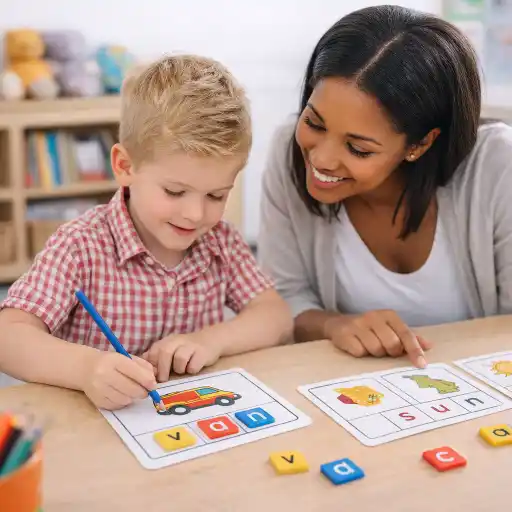
Use a predictable routine: name the picture, look closely at the letters, say each sound, blend the sounds, and then check whether the spoken word matches the picture. A resource such as CVC Color the Word Buy Now $0.99 includes 18 picture-word challenges across two worksheets, giving children a structured opportunity to choose and color a CVC answer.
- Keep the goal on #decoding: connect print to speech rather than guess from context alone.
- Use a small set of familiar, decodable words before adding new ones.
- Invite children to explain how the sounds led them to an answer.
How can educators guide children through a picture-and-color activity?
Before children begin, briefly model one example aloud. Point to the picture and say its name clearly. Then move through the word’s letters from left to right, producing each sound without adding extra vowel sounds. Blend the sounds together—/c/ /a/ /t/, “cat”—and ask whether the result names the pictured object. This think-aloud shows children the strategy rather than simply telling them which option to select.
For independent or small-group work, give children time to attempt the word before offering help. If a child hesitates, return to the first sound or use counters to represent each phoneme. After the child identifies the correct word, coloring can serve as a brief celebration and fine-motor activity, not as the main evidence of reading success.
- Ask, “What do you see in the picture?” to establish meaning.
- Ask, “What sound does this letter make?” to direct attention to print.
- Prompt blending: “Say the sounds slowly, then say them closer together.”
- After decoding, invite the child to color the selected word or response as directed.
- 🌟 Praise the strategy: “You checked each sound and blended them together.”
Keep the tone low-pressure. If the child chooses incorrectly, respond with curiosity: “Let’s check the middle sound together.” This communicates that rereading and correcting are normal parts of learning.
How should picture cues and color choices be introduced?
Pictures are useful meaning supports, especially when a word is unfamiliar, but they can also encourage guessing if they dominate the task. Choose clear, culturally familiar images that have one likely label. Say the word together before decoding, and be alert to vocabulary differences: children may use a different name for the pictured object and still understand it perfectly well. For multilingual learners, welcome home-language connections while making the English word and its sounds explicit when that is the instructional target.
Color can organize attention, but it does not teach a sound-letter relationship by itself. Keep color directions simple and consistent. For example, children might color the selected response after reading it, or use one color to mark the vowel while sounding through a word. Avoid changing the color code frequently or suggesting that a color itself tells a child what a letter sounds like.
Offer a mix of picture-supported and picture-free turns. A child might first decode a word with a picture, then read the same word on a plain card, build it with letter tiles, or find it in a familiar book. These shifts help determine whether the child is attending to letters instead of depending on the illustration. A broader range of literacy routines—such as interactive read-alouds, labeling, and vocabulary play—is covered in Classroom Tools for Emergent Literacy Buy Now $16.00.
How can educators adapt practice to children’s readiness and progress?
Children develop letter knowledge and sound awareness at different rates, so one worksheet should not become a measure of readiness for every child. Begin with a brief observation: Can the child name the pictured item? Recognize the relevant letters? Produce their sounds? Blend a few spoken sounds? The answers help you choose an appropriate starting point and support each learner without pressure.
If a child is still building letter-sound knowledge, focus on a few known consonants and one short vowel. Say and play with the sounds orally, use letter tiles, and model blending before asking the child to select from printed options. Children who are ready for more complexity can compare words that differ by one sound—such as cat and hat—or read a CVC word without a picture prompt.
- For additional support: reduce the number of choices, repeat the word aloud, or use sound counters.
- For language support: discuss picture names, invite home-language knowledge, and clarify the target English word.
- For an extension: ask the child to build, write, or use the decoded word in a short phrase.
Notice what the child does, not only whether the final choice is correct. Record whether the child attends to each letter, blends independently, or needs a prompt. These observations can guide the next small-group activity and help you share concrete progress with families. Keep instruction playful, brief, and responsive to children’s interests.
What common pitfalls should providers avoid?
The most common pitfall is allowing the picture to become the answer key. When children can complete a page by identifying the illustration and choosing the closest-looking word, they may not practice decoding. Ask them to point to the letters and say the sounds before coloring. Once the routine is familiar, occasionally cover the picture or present the word on a plain card to see whether the child can use print independently.
Another pitfall is moving too quickly from one correct response to a long series of similar worksheet items. Repetition helps, but children also need chances to hear, say, build, read, and use words in meaningful settings. Keep coloring optional or brief for children who are more engaged by letter tiles, movement, or oral word games. Ensure that the activity remains developmentally appropriate and does not feel like a high-stakes test.
- Do not treat coloring neatly as proof of reading progress.
- Do not correct a child harshly; model how to check the sounds and try again.
- Do not assume that every child will name an image the same way; clarify vocabulary respectfully.
- Do not rely on worksheets alone—include read-alouds, sound play, and print-rich classroom routines.
Short, frequent, supportive practice is more useful than pushing through a page when a child is tired or frustrated. State requirements vary—check your state licensing agency for applicable training or program expectations.
Conclusion: What should providers remember about picture and color cues?
Picture and color cues can make CVC practice welcoming and engaging when they are used to support—not substitute for—attention to letters and sounds. Guide children to name the image, examine each letter, produce the sounds, blend them, and check the result. Then use coloring as a satisfying finish, while offering other ways to practice for children whose interests or needs differ.
Remember the central question: How can visual cues help children decode CVC words? They help most when educators pair them with explicit sound-letter connections, responsive prompts, and opportunities to read words beyond the picture. Observe each child’s process, celebrate effort and self-correction, and build practice into playful classroom routines. For a deeper exploration of practical literacy strategies, consider the Classroom Tools for Emergent Literacy course Buy Now $16.00.
- Creating the Natural Outdoor Classroom
- Many Colors, One Canvas: MD ECE Conference
- Safe and Sound: Creating Healthy Environments for Every Child
- Power of Art: Bldg Self-Esteem & Positive Behavior for ALL Abilities
- The Subtle Teacher: Nonverbal Communication in the Classroom
- CDA Bridge Bundle: Family Child Care without Portfolio Review
- CDA Bridge Bundle: Infant/Toddler without Portfolio Review
- CDA Bridge Bundle: Preschool without Portfolio Review
- Texas Director Credential
- The Right Kind of Influence for Young Children
- CDA Certification en Español: Recursos y Consejos para Educadores Bilingües
- 💛🧩 ¿Cómo puedo hacer que mi enseñanza sea inclusiva para los niños con autismo?
- ¿Cómo explicar los colores a un niño ciego? Actividades con tacto, sonido y emociones
- Recursos en Español sobre el Sueño Seguro del Bebé
- ¿Cómo empiezo mi certificación CDA en Florida en línea?
- 10 Ejemplos de Cómo la Cultura Influye en el Desarrollo Infantil
- Proporciones de Cuidado Infantil y Tamaños de Grupo por Edad en Maryland (Guía Rápida para Centros y Hogares)
- Proporciones de Cuidado Infantil y Tamaños de Grupo por Edad en Nueva Jersey (Guía Rápida para Centros y Hogares)
- Proporciones de Cuidado Infantil y Tamaños de Grupo por Edad en Virginia (Guía Rápida para Centros y Hogares)
- Lista para Guardería en Casa en Illinois: Cómo Iniciar una Guardería en el Hogar
- Cómo Trabajar en el Cuidado Infantil en Carolina del Norte: Requisitos y Pasos
- Celebrando la amistad en el cuidado infantil durante el Día de los Mejores Amigos
- Canciones, juegos y preguntas de círculo para niños
- Cómo simplificar la capacitación para sus empleados de daycare
- How Can Picture and Color Cues Help Children Decode CVC Words?
- How Can Familiar Household Words Help Children Complete CVC Words?
- How Can Animal Words Strengthen CVC Decoding?
- How Does Mixed CVC Practice Build Flexible Decoding Skills?
- When Are Children Ready for a Second Set of Mixed CVC Words?
