A toddler who keeps hitting can leave providers worried, frustrated, and unsure what to try next. The most effective response protects children immediately while teaching the missing communication and self-regulation skills; ChildCareEd’s Ouch! Biting & Hitting Hurts  Buy Now $24.00 offers focused professional learning on developmental causes and positive guidance strategies. For a deeper framework for identifying triggers and consequences, explore The ABCs of Behavior: Turning Challenges into Learning Opportunities Buy Now $55.00, which can strengthen observation, classroom planning, and staff consistency.
Why does repeated hitting require teaching rather than shame?
Hitting is serious because another child may be hurt, but it does not automatically mean that a toddler is malicious or “bad.” Between approximately 18 months and 3 years, children are developing language, empathy, impulse control, and emotional regulation at the same time. When those systems are overwhelmed, behavior may communicate “my turn,” “move,” “help,” “stop,” or “I need a break.” ZERO TO THREE explains that toddlers often use physical actions when they do not yet have the words or self-control to express strong feelings.
This developmental perspective does not excuse harm. It helps the adult respond to both parts of the problem: the immediate safety concern and the underlying skill gap. A calm, predictable limit communicates that the classroom is #safe while preserving the child’s dignity.
Repeated incidents also affect the whole group. Children observe whether adults respond with panic, humiliation, or steady leadership. A regulated adult models the social-emotional skill children are still learning. State requirements vary - check your state licensing agency, especially regarding injury documentation, family notification, supervision, and behavior-support procedures.
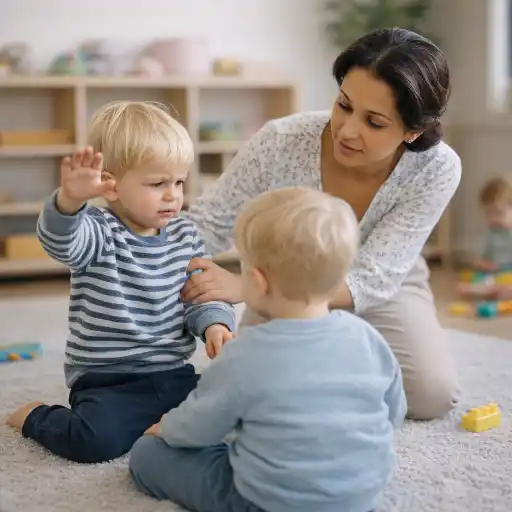
What should a provider do immediately after a toddler hits?
Use a short sequence that prioritizes safety, connection, and one clear lesson. Long explanations rarely work while a toddler is highly upset.
- 🛡️ Block and separate safely. Move close and place your body or hand between the children. Remove the immediate opportunity to hit without grabbing, threatening, or looming over the child.
- State the limit. Use a calm, firm sentence: “I won’t let you hit. Hitting hurts.”
- Attend to the injured child. Check for injury, offer comfort, and follow your program’s first-aid and incident-reporting policy.
- Support the child who hit. Say, “You are having a hard time. I will help you keep hands safe.” Stay nearby and co-regulate.
- Prompt one replacement. Offer a concrete alternative: “Say ‘my turn,’” “Show me ‘help,’” or “Squeeze this pillow.”
Once everyone is calm, briefly revisit the event: “You wanted the truck. You hit. Next time, tap me and say, ‘My turn.’” A repair may involve checking on the peer, bringing a tissue, or helping rebuild a structure. Do not force an apology before the child understands what happened; authentic repair is more meaningful than a rehearsed word.
How can the team identify what is triggering the hitting?
When hitting repeats, observation is more useful than guessing. Record the antecedent—what happened before; the exact behavior; and the consequence—what happened afterward. This ABC approach can reveal whether hitting is connected to access to toys, adult attention, escape from a task, sensory overload, fatigue, hunger, or a transition.
- Note the time, activity, location, group size, nearby children, and adult positioning.
- Describe actions objectively: “Struck peer’s shoulder twice with an open hand,” rather than “was aggressive.”
- Record early cues such as grabbing, stiffening, crying, pacing, vocalizing, or moving into crowded space.
- Include successful moments: waiting, asking for help, using gentle touch, or recovering with support.
Look for patterns across several days rather than treating one incident as proof. If hitting clusters before lunch, review hunger, waiting, and schedule demands. If it occurs during block play, examine crowding and access to popular materials. If it follows cleanup directions, provide advance warnings, a visual sequence, and a transition job.
Documentation should support reflection, not surveillance or labeling. Review notes as a team and ask, “What condition can we change, and what skill can we teach?” This shifts the conversation from “How do we stop this child?” to “How can we make success more likely?”
Which prevention strategies reduce hitting before it starts?
Prevention is thoughtful classroom design. Toddlers use emerging skills more successfully when routines, materials, expectations, and adult support are predictable.
- Reduce competition: Add duplicates of highly desired toys, use turn-taking visuals, and limit the number of children in crowded centers.
- Make transitions visible: Give one- and two-minute warnings, use a picture schedule or song, and assign meaningful jobs such as carrying a book.
- Teach accessible communication: Practice “stop,” “help,” “my turn,” “all done,” and “space” with words, gestures, signs, or pictures.
- Offer regulated movement: Provide supervised wall pushes, carrying tasks, stretching, stomping in an approved place, or squeezing a soft object.
- Increase proximity: Position adults near known hot spots and intervene when early warning signs appear.
- Reinforce specifically: Say, “You waited and asked for a turn. That kept your friend safe.”
Practice replacement skills during calm moments through puppets, role-play, books, and brief rehearsal games. Teach one priority skill first rather than presenting a long list.
Use a calm area as a supportive reset, not a punishment. A toddler may need an adult’s presence, reduced stimulation, and time to regain control before learning can occur. Prevention does not mean removing every frustration; it means making expectations and coping options developmentally accessible.
How should providers communicate with families and coordinate a plan?
Families deserve timely, private, factual communication without blame. Begin with a strength, describe the observable incident, explain how staff responded, and invite the family’s knowledge. For example: “Jordan was deeply engaged in block play today. When another child picked up the truck, Jordan hit twice. We separated the children, comforted the peer, practiced ‘my turn,’ and will add a turn-taking visual tomorrow. What helps Jordan manage waiting at home?”
Do not identify the other child. Avoid labels such as “bully,” “aggressive,” or “out of control.” Ask about sleep, hunger, recent changes, communication preferences, stressors, and strategies that work in other settings. Cultural and family perspectives should inform the plan rather than being treated as obstacles.
Create a brief shared plan containing:
- one replacement skill, such as requesting help;
- two prevention changes, such as increased proximity and shorter waits;
- the consistent adult script;
- documentation responsibilities; and
- a review date within one or two weeks.
The ChildCareEd course Heart-to-Heart Communication: Challenging Behaviors Buy Now $16.00 can help providers strengthen observation, documentation, and family conversations while building a more collaborative response. Directors can support consistency by scheduling short team check-ins, coaching language, and ensuring that substitute staff know the plan.
When should a program seek additional support, and which mistakes should it avoid?
Seek additional support when hitting is frequent, escalating, unusually intense, causes repeated injuries, includes self-injury, prevents participation, or does not improve after a consistently implemented plan. Involve the director and family, follow program policy, and consider developmental screening, early intervention, mental-health consultation, or a function-based behavior-support plan when appropriate. Providers should describe observable patterns and avoid diagnosing the child themselves.
Common mistakes are understandable, especially when staff are tired or incidents are frequent:
- Shaming or labeling: Describe the action and teach the next skill.
- Lecturing: Use one short limit during the incident and teach later.
- Forcing an apology: Guide authentic repair when the child is regulated.
- Using isolation as discipline: Provide supervised co-regulation instead.
- Changing strategies constantly: Implement one plan long enough to review patterns.
- Ignoring the injured child: Make care and safety visible while coaching the child who hit.
Also remember to care for staff. Repeated hitting is emotionally demanding. A five-minute weekly review—What happened before? What worked? What will we adjust?—can replace blame with professional problem-solving and help the team notice progress.
Conclusion: What should you do when a toddler keeps hitting at daycare?
Respond with a coordinated teaching plan, not a stronger punishment. First, block the hit and protect the injured child. Next, state a brief limit, help the toddler regulate, and teach one replacement skill. Then use ABC observations to identify patterns, adjust the environment, reinforce successful communication, and partner with the family.
Toddler hitting is challenging, but it is often a sign of an emerging skill rather than a fixed character trait. Calm consistency, respectful boundaries, and intentional practice help children develop safer ways to express frustration, seek help, and participate in relationships. For additional professional learning, ChildCareEd’s Mysteries of Challenging Behavior Solved Buy Now $24.00$18.00 provides a broader toolkit for understanding behavior and creating calmer classrooms.
- 45 Hour Child Growth and Development
- Bienvenido! Welcoming All Families
- 45 Hour Infant and Toddler Methods and Materials
- CDA Bridge Bundle: Preschool
- Pediatric RSV First Aid & CPR/AED
- CDA Bridge Bundle: Infant/Toddler without Portfolio Review
- CDA Bridge Bundle: Infant/Toddler
- Texas Director Credential Renewal
- Texas Director Credential
- Baby Steps to Milestones ONLINE
- 😫🧸 ¿Qué hacer cuando un bebé no quiere dormir la siesta en el aula?
- 👧 ¿Cómo iniciar y abrir una guardería en Texas? Lo que necesitas saber
- 🚨 Reporte Obligatorio en Nevada
- Qué capacitación se requiere para ser director de cuidado infantil en Texas?
- Recursos en Español sobre el Sueño Seguro del Bebé
- Lista para Guardería en Casa en Illinois: Cómo Iniciar una Guardería en el Hogar
- Lista para Guardería en Casa en California: Cómo Iniciar una Guardería en el Hogar
- Lista para Guardería en Casa en Texas: Cómo Iniciar una Guardería en el Hogar
- Retraso del Habla en la Guardería: Cómo Pueden Ayudar los Proveedores
- Cómo Ser Maestra de Preescolar en Dakota del Norte
- Capacitación Previa al Servicio para Proveedores de Cuidado Infantil en Dakota del Norte
- Supporting Children With Behavioral Challenges in Daycare
- How Can North Dakota Providers Respond to Toddler Biting Without Shaming?
- Child Keeps Hitting Other Kids? Look for These 7 Patterns Before Reacting
- When a Child Hits Again and Again: What Should Daycare Teachers Try Next?
- What Should Child Care Providers Do When a Child Keeps Hitting, Biting, or Pushing?
- What Should You Do When a Toddler Keeps Hitting at Daycare?
- How Can Daycare Providers Stop Children From Hitting Each Other?
- What Should a Teacher Do When a Child Keeps Hitting Other Children?
- Why Do Toddlers Bite, and How Should Child Care Providers Respond?
