When children hit at daycare, educators must protect everyone while teaching a safer way to communicate. The Ouch! Biting & Hitting Hurts Buy Now $35.00 course offers focused professional learning on child development, positive guidance, and practical responses that can strengthen classroom practice and support relevant training-hour goals.
Hitting is stressful for children, families, and educators, especially when incidents happen repeatedly. A thoughtful response does not minimize the harm; it recognizes that young children are still developing language, impulse control, emotional regulation, and conflict-resolution skills. The goal is to stop the immediate danger, understand the pattern, and teach a replacement behavior that children can use with support.
Why does stopping hitting require teaching rather than shame?
Young children may hit to communicate “my turn,” “stop,” “move,” “help,” or “I am overwhelmed.” Fatigue, hunger, sensory overload, crowding, transitions, limited language, imitation, and stress can also contribute. Illinois Early Learning Project describes challenging behavior as communication and emphasizes examining what happens before and after an incident rather than labeling the child.
This perspective does not excuse hitting. It helps providers separate the behavior from the child’s identity. Saying “You hit, and hitting hurts” establishes a firm boundary; saying “You are bad” creates shame without teaching what to do next. NAEYC similarly emphasizes positive guidance, relationships, and co-regulation as foundations for children’s developing self-regulation.
It matters because children learn from adult responses. A calm, predictable intervention communicates that the classroom is #safe, adults will protect them, and strong feelings can be handled without hurting others. It also protects the dignity of the child who hit and the child who was injured.
- Prioritize immediate physical safety.
- Use brief, neutral language.
- Teach one concrete replacement skill.
- Look for environmental and developmental triggers.
- Partner with families without blame.
What should teachers do immediately after a child hits?
In the moment, use fewer words and purposeful action. A dysregulated child is unlikely to process a lecture, negotiate a consequence, or demonstrate empathy on demand.
- 🛡️ Block and separate: Move close, place your body or hand between the children, and create space. Protect without threatening, humiliating, or using unnecessary force.
- State one limit: “I won’t let you hit. Hitting hurts.”
- Attend to the injured child: Check for injury, offer comfort, provide first aid according to policy, and complete required documentation.
- Support the child who hit: “You are having a hard time. I will help you keep your hands safe.” Stay nearby and co-regulate.
- Offer one alternative: “Say ‘my turn,’” “Show me ‘help,’” or “Use gentle hands.” Avoid presenting several choices at once.
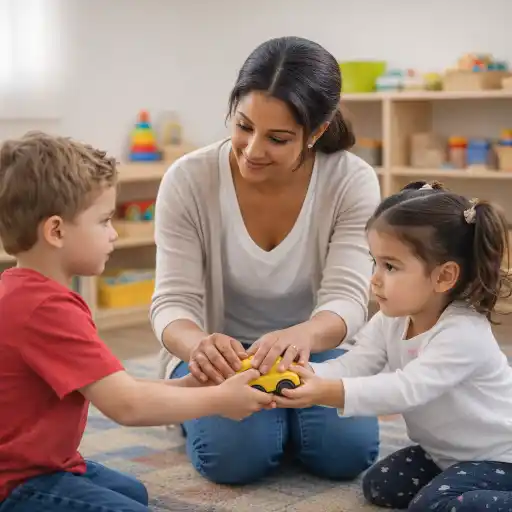
After the children are calm, briefly revisit the event: “You wanted the truck. You hit. Next time, say ‘my turn’ or ask me for help.” Guide a meaningful repair, such as checking on the peer, bringing a tissue, or helping rebuild a tower. Do not force an apology before the child is regulated and able to understand the situation.
How can providers identify why the hitting keeps happening?
Repeated hitting deserves observation rather than guesswork. Use a simple ABC record: Antecedent, what happened before; Behavior, the observable action; and Consequence, what happened immediately afterward. Record facts rather than assumptions about intent.
- Time of day, activity, location, group size, and nearby peers
- What material, demand, transition, or interaction preceded the hit
- The exact action, such as “hit peer’s shoulder twice”
- Adult and peer responses afterward
- Early warning signs, such as grabbing, pacing, yelling, stiffening, or moving into a crowded space
- Successful moments when the child waited, asked for help, or used gentle touch
Patterns often suggest practical changes. If hitting occurs before lunch, consider hunger or fatigue. If it occurs during cleanup, add a visual warning, a transition job, or first-then language. If it happens at blocks, reduce crowding, add duplicate materials, or position an adult nearby. The ABC framework is also emphasized in ChildCareEd’s ABCs of Behavior  Buy Now $55.00 course.
Directors can support this process by providing observation time, reviewing documentation with staff, and ensuring that all educators use the same response. Consistency does not mean every incident will disappear immediately; it means adults respond with a shared plan.
Which classroom changes prevent hitting before it starts?
Prevention is an essential part of supervision and curriculum design. Children are more likely to use emerging social skills when the environment reduces unnecessary competition and makes expectations predictable.
- Provide duplicates of highly desired toys whenever possible.
- Limit the number of children in crowded centers.
- Use picture schedules, timers, songs, and transition warnings.
- Offer meaningful jobs during transitions, such as carrying a book or collecting blocks.
- Teach and display phrases such as “stop,” “help,” “my turn,” “all done,” and “space.”
- Create a supervised cozy area for co-regulation, not punishment or isolation.
- Increase adult proximity during known hot spots and intervene at early warning signs.
- Build movement, sensory, and quiet opportunities into the daily schedule.
Teach replacement skills during calm periods through puppets, books, role-play, photographs, and short rehearsals. For a toddler, “Use your words” is too vague; “Say ‘my turn’” is actionable. Children with limited speech may benefit from gestures, picture cards, signs, or an individualized communication system.
Reinforce specifically: “You waited and used ‘help.’ That kept your friend safe.” Specific feedback tells children exactly which behavior to repeat. NAEYC’s three-step conflict approach—state the behavior and emotion, explain its impact, and offer an alternative—can help educators integrate language development with #prevention.
How should educators respond when stress or trauma may be involved?
Some children react intensely because their nervous systems are overwhelmed by stress, change, fear, or sensory demands. Trauma-informed care does not remove boundaries. Instead, it emphasizes a sequence of regulate, relate, and reason.
- Regulate: Lower your voice, slow your movements, reduce stimulation, and offer a familiar calming routine.
- Relate: Communicate connection: “I’m here. You are safe. I will help you.”
- Reason: Once the child is calm, explain the limit and practice the replacement skill.
Providers should avoid diagnosing trauma or assuming that every incident has the same cause. Observe whether hitting follows separation, loud noise, unexpected changes, crowded play, or a difficult demand. Predictable routines and warm relationships can reduce stress and support co-regulation. ZERO TO THREE describes co-regulation as the adult’s responsive support while children are still developing independent regulation.
If hitting is frequent, severe, injurious, accompanied by self-injury, or resistant to consistent intervention, involve the director and family. Additional support may include a mental-health consultant, early-intervention provider, developmental screening, or function-based behavior-support plan. State requirements vary - check your state licensing agency.
Educator self-regulation matters too. If you feel close to yelling, ensure the children are safe, ask a colleague for assistance when possible, take one slow breath, and return to the prepared script. A calm adult response is a professional skill, not evidence that the situation is easy.
How can daycare teams partner with families and avoid common mistakes?
Families need timely information, privacy, and a clear plan. Share what happened, where and when it occurred, how staff protected the children, and what skill will be taught next. Begin with a strength when appropriate: “Maya was deeply engaged in block play. Today she hit twice when another child reached for her materials. We stayed close, comforted the injured child, and practiced ‘my turn.’”
- Ask what words and calming strategies work at home.
- Agree on one replacement skill and two or three prevention steps.
- Use the same brief script across home and school.
- Set a review date within several days or one week.
- Protect confidentiality; never identify another child in family communication.
The Heart-to-Heart Communication: Challenging Behaviors Buy Now $16.00 course can help providers strengthen observation, documentation, and family conversations.
Common mistakes include long lectures, public shaming, forced apologies, inconsistent responses, ignoring the injured child, and using a calm-down space as exile. Replace these with a short limit, calm support, meaningful repair, and a consistent team plan.
Seek additional support when hitting is daily or escalating, causes repeated injuries, interferes substantially with participation, occurs across settings, or does not improve after consistent prevention and teaching. Directors should coordinate staff coaching, family meetings, documentation, and referrals as appropriate.
Conclusion: What is the most effective way to stop children from hitting?
Daycare providers reduce hitting most effectively by combining immediate safety with ongoing instruction. Block the behavior, comfort the injured child, state a brief limit, help the child regulate, and teach one replacement skill. Then use ABC observations to identify triggers, redesign predictable routines and crowded spaces, reinforce success, and collaborate with families.
The central question is not only, “How do we stop the hit?” It is also, “What skill does this child need to communicate, wait, cope, or solve the problem?” When adults respond with warmth, clarity, and consistency, children learn that feelings are acceptable, hurting others is not, and safer communication can be practiced. Helpful professional learning options include:
- CDA Home Visitor Subject Area 3 Part 3 Birth to 5
- CDA Home Visitor Subject Area 2 Part 3 Birth to 5
- Birth to Five CDA Credential with Portfolio Review
- Ouch! Biting & Hitting Hurts
- CDA Bridge Bundle: Family Child Care without Portfolio Review
- CDA Bridge Bundle: Infant/Toddler without Portfolio Review
- CDA Bridge Bundle: Preschool without Portfolio Review
- Creating Environments that Nurture Growth and Community
- Texas Director Credential
- Ouch! Biting & Hitting Hurts
- CDA Certification en Español: Recursos y Consejos para Educadores Bilingües
- 😤💬 ¿Qué Le Digo a un Niño que Acaba de Morder a Otro?
- 10 Ejemplos de Cómo la Cultura Influye en el Desarrollo Infantil
- Regulaciones de Licenciamiento de Cuidado Infantil en California para Centros y Hogares de Cuidado Infantil Familiar
- Proporciones de Cuidado Infantil y Tamaños de Grupo por Edad en Maryland (Guía Rápida para Centros y Hogares)
- Proporciones de Cuidado Infantil y Tamaños de Grupo por Edad en Nueva Jersey (Guía Rápida para Centros y Hogares)
- Proporciones de Cuidado Infantil y Tamaños de Grupo por Edad en Virginia (Guía Rápida para Centros y Hogares)
- Lista para Guardería en Casa en Illinois: Cómo Iniciar una Guardería en el Hogar
- Lista para Guardería en Casa en Texas: Cómo Iniciar una Guardería en el Hogar
- Cómo Trabajar en el Cuidado Infantil en Wisconsin: Requisitos y Pasos
- Celebrando la amistad en el cuidado infantil durante el Día de los Mejores Amigos
- Canciones, juegos y preguntas de círculo para niños
- Cómo simplificar la capacitación para sus empleados de daycare
- How to Stop a Child From Hitting Others Without Yelling or Shaming
- Child Keeps Hitting Other Kids? Look for These 7 Patterns Before Reacting
- When a Child Hits Again and Again: What Should Daycare Teachers Try Next?
- What Should You Do When a Toddler Keeps Hitting at Daycare?
- Why Is My Preschooler Suddenly Aggressive, and How Can Child Care Providers Help?
- How Can Daycare Providers Stop Children From Hitting Each Other?
- What Should a Teacher Do When a Child Keeps Hitting Other Children?
