A toddler’s “bibi” for a bandage or “choo-choo” for a train is more than a charming classroom moment—it is a child making meaning and reaching out to communicate. Learn how to respond without shutting down that effort, then build your listening practice with Open Ears: Listening in Child Care  Buy Now $16.00, a focused course on active, empathetic listening that can strengthen everyday interactions with children and families. For a deeper foundation in young children’s communication, explore Language Development in Early Childhood Buy Now $16.00, which offers practical strategies for supporting verbal and nonverbal language growth.
When toddlers name familiar classroom objects in unexpected ways, providers have a valuable opportunity to notice what the child understands, respond warmly, and enrich the conversation. A simple recording practice can help the team remember these discoveries and use them to guide responsive care.
Why do toddlers invent names for familiar objects?
Toddlers are actively connecting sounds, experiences, and meanings. A child may use a familiar sound, shorten a word that is difficult to pronounce, borrow a family expression, or create a completely personal label. When a child consistently uses a particular sound to mean a particular object, that sound is meaningful communication—even if it is not the conventional name adults use.
These individual labels are different from strings of speech-like sounds that do not appear to refer consistently to a person, object, or idea. The distinction matters: attend to what the child is communicating, not just whether the pronunciation matches an adult version. The child’s gestures, gaze, actions, and the situation often help clarify meaning.
Object exploration also creates fertile ground for naming. As the Hanen Centre explains in its guidance on exploring objects and language learning, children learn about features, categories, and actions by handling and investigating materials. Naming an object while a child is already focused on it helps connect the word with the experience.
- Notice whether the child uses the name consistently for the same object or type of object.
- Look at the child’s expression, pointing, gaze, and actions for additional clues.
- Remember that one unexpected word, by itself, does not establish a developmental concern.
How can providers respond without correcting or discouraging the child?
The goal is to keep communication successful while offering a clear, useful model. Avoid telling the toddler that their word is “wrong,” demanding repetition, or turning a playful discovery into a quiz. Such responses can interrupt the exchange and make a child less willing to communicate. Instead, acknowledge the meaning and naturally say the conventional word in a warm sentence.
For example, if a toddler points to a classroom bus and says “bubu,” you might answer, “Yes, the bus is ready to roll.” If a child calls a blanket “bop,” respond, “You found your soft blanket.” This approach accepts the child’s message, confirms that you are listening, and supplies language without pressure. You can expand the conversation with one extra idea: “The red bus is going fast.”
Children may communicate through speech, approximations, signs, gestures, pictures, or a device. Respond to the communication available to the child, and allow time for their next turn. The Head Start guidance on engaging children in conversations emphasizes attending to verbal and nonverbal communication and responding in ways that extend children’s ideas.
- 😊 Reflect the child’s meaning: “You mean the spoon.”
- Model the conventional word in a natural phrase rather than demanding an imitation.
- Pause and give the child room to look, gesture, vocalize, or respond.
- Follow the child’s interest instead of asking a string of “What’s this?” questions.
How can a Toddler Word Discoveries Recording Book support classroom practice?
A brief, consistent record helps educators notice patterns that can be easy to miss in a busy room. The Toddler Word Discoveries Recording Book can be used to capture a child’s own labels, the objects or experiences they refer to, and the context in which the words occur. It is not a diagnostic tool; it is a practical way to preserve everyday observations and support thoughtful planning.
Keep notes factual and concise. Record what the child said or did as closely as possible, rather than interpreting the child’s intention as a certainty. Include the date, setting, object, the child’s exact word or sound, and useful context such as pointing, looking, or acting. For example: “At snack, Sam pointed to the cup and said ‘gaga’ twice; reached for it when the adult asked, ‘Would you like your cup?’”
Over time, staff can review records to see what the child is naming, which interests invite communication, and whether new words or communication forms are emerging. As Head Start’s guidance on documenting observations illustrates, brief notes about children’s actions and words can help educators reflect and share meaningful information with families.
- Write the child’s word in quotation marks and describe the observable context.
- Note gestures or actions that help clarify the child’s meaning.
- Store records according to program privacy practices and share them only with appropriate people.
How can educators turn invented names into language-learning moments?
Use the object the child is already exploring as the starting point. Say its conventional name clearly, add a descriptive word or action, and repeat naturally during play and routines. If a child calls a toy dog “woof,” you might say, “The dog says woof. The brown dog is sleeping.” This links the child’s chosen label to the standard word without making the interaction feel like a lesson.
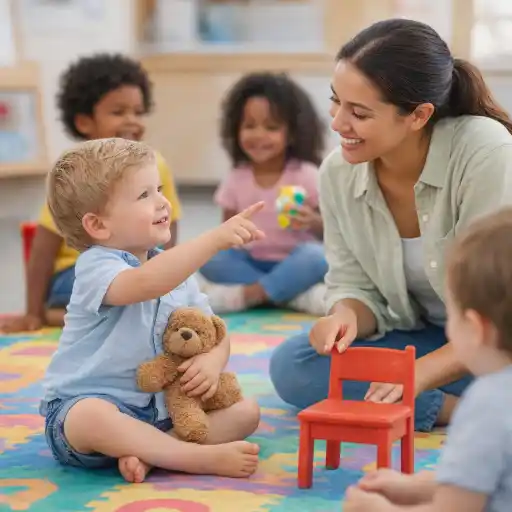
Offer varied, meaningful experiences with the object. A toy cup can be filled, emptied, washed, and shared; each action provides related words. Books, songs, dramatic play, and real classroom routines offer repeated encounters with vocabulary. Keep language responsive and manageable: follow attention, speak clearly, and leave pauses for the toddler to take a turn. NAEYC’s language-support suggestions for infants and toddlers likewise encourage naming what a child notices, taking turns, singing, reading, and allowing time to explore.
Include children’s home languages and family expressions. A word that sounds unusual to one educator may be a meaningful word in the child’s home language or a family’s shared vocabulary. Ask families what the child calls familiar objects and how they pronounce the word. Use that knowledge respectfully alongside the words used in the classroom language.
- Pair labels with gestures, pointing, and hands-on exploration.
- Expand the child’s message with a short phrase: “Ball” becomes “The ball bounced.”
- Accept words in the child’s home language and invite family contributions.
- Use songs and repeated books to make familiar words enjoyable and memorable.
When should providers share observations or suggest further support?
Invented names are often part of toddlers’ efforts to communicate, but the broader pattern of communication matters. Notice whether a child is adding ways to express ideas over time, responding to communication, using gestures or other means intentionally, and engaging with people and objects. Consider the child’s age, opportunities, languages, hearing, and individual development; milestones are guides, not a diagnosis.
If communication seems limited or is not progressing, if the child appears persistently frustrated because others cannot understand, or if a child loses communication skills they previously used, document specific examples and speak with the family sensitively. Share observations without labeling the child or making a diagnosis. Families may wish to discuss concerns with the child’s health care provider or a speech-language professional. ASHA notes that its communication milestones are intended to support conversations with professionals, not to serve as a screening or diagnostic tool.
Use a strengths-based approach: begin with what the child communicates successfully, describe what staff have observed, and invite the family’s perspective. If a concern persists, follow program procedures and applicable referral pathways. State requirements vary - check your state licensing agency.
- ✅ Share concrete examples across different routines and settings.
- Avoid comparing children or treating one invented word as proof of a delay.
- Consult families and appropriate professionals when a pattern raises questions.
Conclusion: What is the best response when a toddler invents a name?
When a toddler invents a name for a classroom object, treat it as an invitation to connect. Attend to the child’s meaning, acknowledge the word, and offer the conventional label in a natural, encouraging response. Then use the moment to follow the child’s interest, model a little more language, and leave space for another turn.
A simple recording routine can help educators preserve these discoveries, see patterns over time, plan engaging experiences, and share meaningful examples with families. The key takeaways are straightforward:
- Listen for meaning, including gestures and context—not pronunciation alone.
- Model rather than criticize: accept the child’s word and add the familiar label.
- Document objective examples and use them to guide responsive conversations and planning.
- Discuss ongoing concerns collaboratively, and seek appropriate professional guidance when needed.
Every “bubu,” “gaga,” and “woof” is a chance to show a toddler that their communication matters. Your attentive response helps turn a small classroom discovery into a warm, language-rich interaction.
Courses for continued professional learning
- Open Ears: Listening in Child Care Buy Now $16.00 — practice active and empathetic listening in early care settings.
- Language Development in Early Childhood Buy Now $16.00 — explore strategies for supporting young children’s verbal and nonverbal communication.
- Observations and Goal Setting in Childcare Buy Now $24.00 — connect observation to planning and children’s individual needs.
- Building Bridges for Dual Language Learners Buy Now $25.00 — support language diversity and family partnership.
- A Guide to Effective Communication Buy Now $16.00 — strengthen communication and listening with families and colleagues.
- 45 Hour Child Growth and Development
- CDA Infant/Toddler Credential
- Birth to Five CDA Credential with Portfolio Review
- CDA Bridge Bundle: Preschool
- Pediatric RSV First Aid & CPR/AED
- CDA Bridge Bundle: Family Child Care
- CDA Bridge Bundle: Infant/Toddler without Portfolio Review
- CDA Bridge Bundle: Infant/Toddler
- Texas Director Credential
- Every Moment Matters: Schedules and Transitions
- CDA Certification en Español: Recursos y Consejos para Educadores Bilingües
- 💛🧩 ¿Cómo puedo hacer que mi enseñanza sea inclusiva para los niños con autismo?
- 😫🧸 ¿Qué hacer cuando un bebé no quiere dormir la siesta en el aula?
- 👧 ¿Cómo iniciar y abrir una guardería en Texas? Lo que necesitas saber
- 🚨 Reporte Obligatorio en Nevada
- Qué capacitación se requiere para ser director de cuidado infantil en Texas?
- Recursos en Español sobre el Sueño Seguro del Bebé
- Cómo usar tu certificación de 90 horas en Maryland para completar tu CDA
- ¿Cuáles son los pasos, requisitos y opciones en línea para la certificación de 90 horas en cuidado de Infantes/Toddlers en Maryland?
- Capacitación en Salud y Seguridad Preventiva en Línea para Proveedores de Cuidado Infantil
- Lista para Guardería en Casa en Illinois: Cómo Iniciar una Guardería en el Hogar
- Lista para Guardería en Casa en Texas: Cómo Iniciar una Guardería en el Hogar
- Retraso del Habla en la Guardería: Cómo Pueden Ayudar los Proveedores
- Cómo Ser Maestra de Preescolar en Dakota del Norte
- Capacitación Previa al Servicio para Proveedores de Cuidado Infantil en Dakota del Norte
- Canciones, juegos y preguntas de círculo para niños
- How Can Child Care Providers Create Print-Rich Early Childhood Environments?
- How Do Classroom Labels Support Toddler Independence and Vocabulary?
- Can Every Toddler Reach and Recognize Their Own Storage Space?
- What Should You Do When a Toddler Invents Their Own Names for Classroom Objects?
