When toddlers can see where materials belong and hear the words that name them, everyday classroom moments become chances to act and communicate with confidence. Explore ChildCareEd’s Toddler Room Labels Buy Now $0.75 to make classroom organization more accessible, and consider the practical strategies in Moving About the Classroom: Effective Transitions for Everyday  Buy Now $24.00 to strengthen the routines that help children use those labels. Thoughtful labels can support self-help skills, meaningful language, and smoother classroom flow.
Why do classroom labels matter for toddlers?
Toddlers are learning to make choices, communicate needs, and participate in familiar routines, often before they can read or follow lengthy directions. Picture-and-word labels make parts of the environment easier to understand: a photo of blocks on a basket, for example, offers a visible clue about what belongs there. When adults consistently refer to these cues, children can begin to use them to find materials and help return them.
This is not simply about keeping shelves tidy. Labels can make routines more predictable and give children concrete information they can revisit. The Head Start guidance on infant and toddler teaching practices emphasizes responsive relationships and environments that support children’s interests and needs. Labels work best as part of that relationship-based practice: an adult notices, names, models, and then gives a child time to try.
For providers, the payoff can be meaningful. A child who recognizes the picture for cups may help prepare for snack; a child who sees a familiar book label may make an independent choice. Small, repeated moments can nurture #independence without expecting toddlers to manage everything alone.
How do labels nurture independence and self-help?
A label gives a toddler a visual point of reference. It can answer practical questions—where a material is stored, what belongs in a bin, or where personal items go—without requiring an adult to repeat directions each time. This supports participation while leaving the educator available to observe, encourage, and help when needed.
Start with a few high-use locations, such as toy baskets, book storage, personal cubbies, and simple care-routine areas. Pair a clear image with a short word, and place it where children can see it from their height. If the room’s contents change, update the labels so the visual information remains accurate.
- Model one action at a time: “The cars go in the basket with the car picture.”
- Pause after giving a cue so the toddler has time to respond.
- Invite participation without demanding perfection: “Would you like to put one block away?”
- Notice effort specifically: “You found the book basket and put the book back.”
Labels should invite—not pressure—participation. Toddlers differ in motor skills, attention, communication, and readiness, so some may need adult support or a different kind of cue. Visual information can complement warm interaction; it does not replace responsive caregiving or appropriate supervision.
How can labels build vocabulary during everyday routines?
Labels connect what toddlers see with the words adults use. A photo of a spoon next to the written word “spoon” can become a natural prompt during meals: “Here is your spoon. Let’s put the spoon in the basket.” Repeated, meaningful exposure helps children hear and encounter vocabulary in context rather than as a disconnected list of terms.
Use labels as conversation starters throughout the day. During play, name familiar objects and describe their features or actions: “The soft bear is beside the basket,” or “You put the big ball in.” Keep the language clear and responsive; follow the child’s focus and allow time for a gesture, sound, word, or look to become part of the exchange.
Labels can also reflect the languages children use at home. A study indexed by ERIC, Classroom Labels That Young Children Can Use, describes classroom labeling as a way to connect spoken and written language, including in dual-language settings. Ask families for help with accurate translations and familiar names for objects. Respecting home languages reinforces belonging while giving all children opportunities to hear words across languages.
- Use consistent, accurate names for familiar materials.
- Pair words with real photographs or recognizable pictures.
- Repeat new vocabulary during play, care routines, and cleanup.
- Respond positively to children’s home-language words, gestures, and attempts to communicate.
Where should toddler labels go, and what should they look like?
Place labels where they help children use the room: on the front of a basket, near a shelf space, or beside a familiar classroom area. Check placement from a toddler’s perspective—standing, sitting, or moving through the space. A label that adults can easily see from across the room may be too high or difficult for a child to notice.
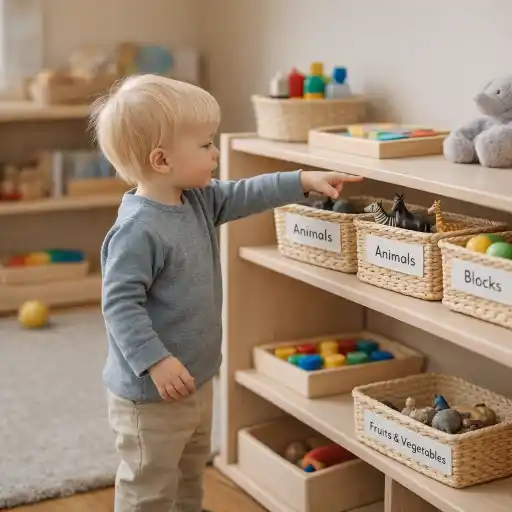
Choose a limited set of clear, durable labels and keep them visually simple. Photographs of the actual classroom materials can be easier to interpret than decorative images that look different from the real objects. Use readable print, uncluttered backgrounds, and words that match the vocabulary staff use with children. ChildCareEd’s Toddler Room Labels Buy Now $0.75 resource offers a convenient starting point for organizing common toddler-room essentials.
Consider identity and access as you plan. Include children’s names and meaningful images, and consult families about home-language words or symbols. Some children may benefit from larger images, tactile cues, or individualized visual supports. As Head Start notes in its overview of infant and toddler learning environments, welcoming spaces invite safe exploration and can reflect children’s home cultures.
Do not label every surface. A calm, purposeful environment makes the most useful cues easier to notice. Keep pathways open and maintain clear sight lines so children can explore while educators supervise effectively.
How can teams introduce labels and avoid common pitfalls?
Labels work best when adults teach children what they mean. Introduce a small group of labels in context rather than posting many at once. Point to the image, name the object, show where it belongs, and invite children to participate. Use the same words and routines across the team so the labels remain reliable cues.
Common pitfalls are usually easy to correct:
- Labels are too high: move key cues to children’s line of sight.
- Pictures do not match the contents: update labels when materials change.
- Only written words are used: add recognizable images, especially for toddlers and multilingual groups.
- Adults expect immediate independent cleanup: model, practice, and offer age-appropriate help.
- Too many labels compete for attention: prioritize the locations children use most.
Observe how children respond. Do they look toward the label, find a familiar item, or attempt to return it? Use these observations to adjust the system, not to judge a child’s ability. If labels are part of a broader effort to smooth room changes, ChildCareEd’s Moving About the Classroom: Effective Transitions for Everyday Buy Now $24.00 explores ways to make transition times purposeful. For related professional learning, explore Environments That Inspire Independence and Exploration Buy Now $55.00, Classroom Tools for Emergent Literacy Buy Now $25.00, and Language Development in Early Childhood Buy Now $16.00.
Conclusion: How can labels support toddler independence and vocabulary?
Classroom labels support toddlers when they make the environment understandable, usable, and rich with meaningful language. Picture-and-word cues can help children locate and return materials, participate in routines, and connect spoken vocabulary with familiar objects. Their value grows through adult modeling, consistent language, repeated practice, and respect for each child’s pace and communication style.
Begin with one shelf or routine. Place a clear image and word at toddler height, teach its meaning during a real activity, and observe what children do with the cue. Adjust as needed, include family languages where relevant, and maintain active supervision. Labels are not a shortcut to instant independence; they are one thoughtful way to make everyday classroom life more accessible and supportive.
When changing room arrangements or materials, state requirements vary - check your state licensing agency.
- 45 Hour Child Growth and Development
- 45 Hour Infant and Toddler Methods and Materials
- Pediatric RSV First Aid & CPR/AED
- CDA Infant/Toddler Credential with Portfolio Review
- How to Manage Chronic Illness with Infants/Toddlers
- CDA Bridge Bundle: Infant/Toddler without Portfolio Review
- 45-Hour Infant and Toddler Curriculum
- Texas Director Credential
- Classroom Tools for Emergent Literacy
- CDA Certification en Español: Recursos y Consejos para Educadores Bilingües
- 🔍 ¿Qué ves cuando observas a un niño aprender?
- 💛🧩 ¿Cómo puedo hacer que mi enseñanza sea inclusiva para los niños con autismo?
- 🤔 ¿Cómo hablo con los padres cuando un niño no está avanzando en el entrenamiento para ir al baño?
- Curso Gratis De Cuidado Infantil Con Certificado
- Recursos en Español sobre el Sueño Seguro del Bebé
- ¿Cuáles son los pasos, requisitos y opciones en línea para la certificación de 90 horas en cuidado de Infantes/Toddlers en Maryland?
- Capacitación en Salud y Seguridad Preventiva en Línea para Proveedores de Cuidado Infantil
- Proporciones de Cuidado Infantil y Tamaños de Grupo por Edad en Nueva Jersey (Guía Rápida para Centros y Hogares)
- Proporciones de Cuidado Infantil y Tamaños de Grupo por Edad en Virginia (Guía Rápida para Centros y Hogares)
- Lista para Guardería en Casa en Illinois: Cómo Iniciar una Guardería en el Hogar
- Lista para Guardería en Casa en Texas: Cómo Iniciar una Guardería en el Hogar
- Apoyo en Preescolar para Retrasos del Habla: Estrategias Simples que Ayudan
- Retraso del Habla en la Guardería: Cómo Pueden Ayudar los Proveedores
- Cómo simplificar la capacitación para sus empleados de daycare
- What Printables Should Every Preschool Classroom Have on Hand?
- Which Printable Activities Belong in Every Preschool Classroom?
- How Do Classroom Labels Support Toddler Independence and Vocabulary?
- Can Every Toddler Reach and Recognize Their Own Storage Space?
- Why Do Toddlers Keep Asking Where Their Belongings Go?
