A calm arrival can transform the tone of the entire day, yet young children often enter carrying big emotions, unfinished home routines, and uncertainty about what comes next. A clear, visual sequence helps children participate with greater confidence while giving teachers more time for connection and learning. For deeper professional development, explore Moving About the Classroom: Effective Transitions for Everyday  Buy Now $24.00, a 3-hour training that can strengthen transition planning and help you earn useful training hours.
Why does a predictable morning arrival routine matter?
Arrival is more than a logistical exchange of backpacks and attendance information. It is a major transition from home to group care, requiring children to separate from family, regulate emotions, remember steps, and enter a social learning environment. A predictable routine communicates three powerful messages: “You belong here,” “You are safe,” and “You know what happens next.”
Head Start explains that familiar schedules and step-by-step routines help children feel secure, understand what is happening, and engage in learning. NAEYC similarly identifies routines and transitions as essential components of a supportive classroom. Predictability does not mean rigidity; it creates a dependable framework that allows teachers to respond flexibly when a child needs extra time or support.
- Reduces uncertainty and unnecessary waiting.
- Supports #selfregulation and independence.
- Protects time for meaningful play and instruction.
- Strengthens communication between families and staff.
- Helps children anticipate the next activity without relying on repeated adult reminders.
Morning Arrival Routine Cards are especially useful because they make the sequence visible. The ChildCareEd resource includes cards for greeting, putting away belongings, washing hands, using the bathroom, completing morning work, choosing a center, reading, and joining circle time. Providers can customize the sequence to two to four steps for an individual child or expand it for a group routine.
What should the arrival routine include?
Begin with observation rather than assumptions. Watch the first 20 to 30 minutes of the day and identify where children hesitate, wait, or need repeated prompts. A practical preschool routine might include:
- Greet the child and acknowledge the family.
- Put away a backpack, coat, lunchbox, or comfort item.
- Complete handwashing or another required hygiene step.
- Check the visual schedule or move a “now” marker.
- Choose a calm, prepared activity.
- Join a morning gathering or the next scheduled experience.
Each step should represent a meaningful action. Avoid creating a checklist so detailed that children cannot remember it. For toddlers, photographs, objects, or gestures may be more accessible than written labels. Preschoolers may benefit from a photograph paired with one or two familiar words. Place cues where the action occurs: belongings cards near cubbies, handwashing cards near the sink, and activity choices near the shelves.
Include flexibility in the design. A “change” card can show that the playground is unavailable or that a substitute teacher is present. State requirements vary - check your state licensing agency before adapting cards related to attendance, health checks, supervision, or required documentation.
A useful resource is the Morning Arrival Routine Cards Buy Now $1.99, which provide a ready-to-customize visual sequence for common arrival tasks. The goal is not to make every child complete an identical process; it is to provide a clear path that can be adapted to developmental, cultural, linguistic, and individual needs.
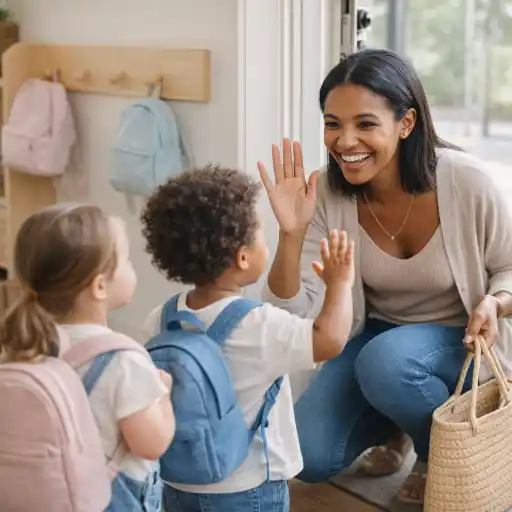
How can teachers introduce and teach the routine?
Visual cards are not self-explanatory. Children need explicit modeling, practice, and consistent language before the routine can support independence. Introduce the cards during a calm part of the day, not during the busiest arrival period. Point to each image, name the action, demonstrate it, and invite children to practice.
Use brief phrases such as “First backpack, then hands,” or “Check your card; what comes next?” Pause after giving a direction so children have time to process. When a child completes a step, provide specific feedback: “You looked at your picture and put your lunchbox on the shelf.” This acknowledges competence more effectively than general praise alone.
Practice through role-play. Staff can pretend to arrive with a backpack while children identify the next step. Children can also help a puppet or stuffed animal follow the cards. Repetition should feel playful, not punitive. Once children understand the sequence, gradually reduce verbal prompts and let the visual system carry more of the routine.
- Model the routine one step at a time.
- Practice when children are calm and attentive.
- Use the same words and gestures across staff members.
- Allow extra processing time before repeating a direction.
- Celebrate attempts, not only perfect completion.
- Invite children to move, flip, or check cards as they finish.
Family communication also matters. Share the arrival sequence during orientation and explain the purpose of brief, consistent goodbyes. Families may use similar language at home, while still preserving their own cultural rituals and relationships.
How can visual cards support separation and individual needs?
Some children enter happily; others need additional emotional support after separation. A predictable sequence can help, but it should never be used to dismiss a child’s feelings. Teachers can acknowledge distress while offering a concrete next step: “You are sad that your grown-up left. I will stay with you. First we wave, then we choose a book.”
Consider individualized adaptations:
- Use a two-step “first–then” card for children overwhelmed by a full sequence.
- Offer a photograph of the child completing a familiar task.
- Provide a portable mini-schedule or flip book.
- Pair images with the child’s home-language words when appropriate.
- Offer a choice between two greeting gestures, such as a wave or high-five.
- Assign a meaningful arrival job, such as carrying the attendance folder.
- Provide a quiet entry option for children sensitive to noise, light, or crowds.
🔔 Moving a card or selecting the first activity is more than compliance; it gives children practice with sequencing, communication, decision-making, and independence.
Never sneak away from a child. A short, reliable goodbye ritual—such as a hug, family phrase, or window wave—builds trust. After the goodbye, connect the child with a familiar adult, peer, book, or activity. NAEYC guidance on separation emphasizes that warm proximity and predictable rituals can help children cope with difficult transitions.
Observe patterns rather than labeling behavior. If a child continues to struggle, consider sleep, family changes, sensory demands, language access, staffing, and classroom noise. Collaborate with families and relevant specialists when additional support is needed.
What common mistakes should providers avoid?
Arrival challenges are often signs that the system needs adjustment, not evidence that children are being defiant. Several common mistakes can make a routine less effective:
- Too many steps: Start with the essential actions and add detail gradually.
- Decorative visuals: Every card should show an action, location, or sequence.
- Inconsistent adult language: Agree on shared phrases and completion signals.
- Unrealistic timing: Allow time for family communication, hygiene, coats, and emotional support.
- Punitive use: Never remove visual supports because a child is upset or needs help.
- Ignoring accessibility: Adjust size, contrast, language, texture, placement, and sensory load.
- Changing the system without observation: Revise one feature at a time and monitor its effect.
Directors can improve consistency by creating a one-page staff guide. Include who greets families, who receives messages, where children begin, how staff respond to separation distress, and what happens when the schedule changes. Floaters and substitutes should be shown the system before the room becomes busy.
Use a short improvement cycle: identify one bottleneck, revise one part of the routine, teach the change, and review observations after several days. A calm arrival does not require silence or the absence of tears. Success means children have a clearer path and adults have greater capacity to respond with empathy.
How can programs implement the routine this week?
Start small. Choose one recurring difficulty, such as crowded cubbies or children wandering after goodbye. Create a three- to six-step sequence that addresses that problem, then introduce it consistently.
- Observe the arrival period and identify one pressure point.
- Write the actual routine in concrete, child-friendly steps.
- Choose photographs, icons, objects, or words that match children’s understanding.
- Print, laminate, and place the cards at children’s eye level.
- Teach and practice the sequence before using it during live arrival.
- Review progress with staff and families, then revise as needed.
Prepare the environment before doors open. Clear pathways, organize cubbies, stage two or three calm activities, post the daily schedule, and clarify staff roles. A small morning meeting can follow the arrival period with a welcome song, attendance, a review of the schedule, and a brief plan for the day.
For additional professional learning, consider Every Moment Matters: Schedules and Transitions Buy Now $55.00. The course focuses on designing schedules, routines, and transitions that support positive behavior, different temperaments, and a nurturing classroom climate. Together, the training and Morning Arrival Routine Cards can help your team move from repeated reminders to a more visible, teachable system.
Conclusion
How can child care providers create a predictable morning arrival routine? Build a short, visible sequence; teach it explicitly; use consistent language; adapt it for individual children; and review it through observation. Morning Arrival Routine Cards can make the next step concrete while preserving the warmth and flexibility children need during separation and entry.
When arrival is predictable, children gain confidence, families receive clearer communication, and teachers can devote more energy to relationships and learning. Small, consistent changes—greeting by name, showing “now and next,” offering a calm choice, and practicing the routine—can create a more welcoming beginning for everyone.
Frequently asked questions
How many steps should a morning routine include?
Begin with two to four steps for children who need a simple sequence. Preschool groups may use five or six essential steps, provided the visuals remain clear.
What if a child refuses to follow the cards?
Acknowledge the feeling, reduce the number of visible steps, offer a choice, and provide co-regulation. Avoid turning the cards into a compliance test.
Should families use the same routine at home?
Families do not need to duplicate the classroom routine. Sharing the classroom sequence and key phrases can create helpful continuity while respecting home practices.
Can visual cards replace teacher interaction?
No. Cards support communication and independence, but children still need warm greetings, responsive supervision, modeling, and emotional connection.
How long does it take for a routine to become familiar?
Many children show progress after several days of consistent practice, but the timeline varies. Continue reviewing and adapting the routine as children develop and classroom conditions change.
Additional course options
- Moving About the Classroom: Effective Transitions for Everyday Buy Now $35.00
- Every Moment Matters: Schedules and Transitions Buy Now $55.00
- Self-Regulation & Change: Helping Children Cope Buy Now $16.00
- Classroom Setup for Child Care Buy Now $24.00
- Teacher-Child Interactions for Stronger CLASS® Outcomes Buy Now $24.00
- Behind the Scenes: Baby Routines ONLINE
- Moving About the Classroom: Effective Transitions for Everyday
- 45 Hour Infant and Toddler Methods and Materials
- CDA Bridge Bundle: Family Child Care without Portfolio Review
- CDA Bridge Bundle: Infant/Toddler without Portfolio Review
- Positive Attention: Interactions & Supervision for Infants & Toddlers
- Self-Regulation & Change: Helping Children Cope
- Texas Director Credential
- Professional Integrity in Child Care
- Drop-Off Drama? Not with Great Communication
- Proporciones de Cuidado Infantil y Tamaños de Grupo por Edad en Maryland (Guía Rápida para Centros y Hogares)
- Proporciones de Cuidado Infantil y Tamaños de Grupo por Edad en Virginia (Guía Rápida para Centros y Hogares)
- Canciones, juegos y preguntas de círculo para niños
- How can I build a daily music routine that calms and focuses children?
- How can the first 30 minutes set your classroom up for a successful day?
- Why Do the First Five Minutes with a Child Matter Most?
- How Can I Manage Time and Responsibilities in a Busy Classroom?
- How Do the First Ten Minutes of Morning Arrival Shape the Rest of the Day?
- How Can Printable Routines Turn Morning Chaos into Classroom Calm?
- How Can Emotional Check-Ins Become a Meaningful Part of the Daily Child Care Routine?
- How Can Child Care Providers Create a Predictable Morning Arrival Routine?
- How Can Child Care Providers and Families Agree on a Goodbye Routine for a Preschooler?
- How Can Order Help Children Become Independent During a Montessori Arrival Routine?
- What Does a New Preschool Teacher Need Before Their First Solo Morning?
- How Can Child Care Providers Help a Child Put the Phone Away at Drop-Off?
- How Can Family Child Care Providers Adapt Arrival Routines for an IEP or IFSP?
- How Can Family Child Care Providers Adapt Arrival Routines for an IEP or IFSP?
- How Can Child Care Providers Support Children with Fetal Alcohol Syndrome Who Need Repeated Directions?
- How Can Child Care Providers Help Families Adjust Sleep and Arrival Routines This Fall?
