When families ask, “How was my child’s day?” they deserve more than a checklist—they deserve a clear, respectful connection to their child’s care and learning. A consistent communication log can strengthen family partnerships while helping educators notice patterns and plan responsive care; CDA: Essential Tools for Record Keeping  Buy Now $16.00 offers practical training in documenting development and sharing information appropriately.
For broader support with family conversations, Let’s Talk: Effective Communication Buy Now $24.00 can help providers build communication routines that are responsive, professional, and useful.
Why Do Daily Communication Logs Matter in Infant and Toddler Care?
Infants and toddlers cannot reliably describe their experiences, needs, or emotions. A well-designed log gives families a meaningful window into feeding, sleep, diapering, comfort, play, relationships, and emerging skills. It also gives caregivers information that supports continuity between home and the program.
Daily reporting is more than administrative work. When educators record timely observations, they are better positioned to recognize patterns, respond to individual cues, and reflect on whether routines are meeting each child’s needs. Head Start describes responsive caregiving as individualized, nurturing, respectful care in which adults notice, understand, and respond to infants’ and toddlers’ cues.
Communication logs also support trust. Families can share information about a difficult night, a change in appetite, a new word, or a familiar comfort strategy. Educators can then adapt the day with greater sensitivity. The goal is not to document every second; it is to communicate the information that matters most for health, safety, relationships, and learning.
The strongest logs are:
- Accurate and completed close to the time of the event
- Specific to the individual child
- Strengths-based without minimizing concerns
- Easy for busy families to scan
- Protected according to privacy policies
State requirements vary - check your state licensing agency.
What Information Should an Infant and Toddler Communication Log Include?
A shared template creates consistency, but age and individual routines should guide the details. Infant logs generally require closer attention to biological rhythms, while toddler logs increasingly include autonomy, language, peer interaction, and problem solving.
- Child’s name, date, attendance, and caregiver
- 🍼 Feeding: bottle or breast milk times, amounts, foods offered, appetite, and new foods tried
- Diapering or toileting: times, wet or bowel movements, and relevant concerns
- Sleep and rest: start and end times, settling, waking, and unusual difficulty resting
- Mood and regulation: alert, calm, tired, joyful, fussy, or seeking additional comfort
- Activities: floor play, tummy time, books, music, sensory exploration, outdoor play, or movement
- Developmental highlights: a new sound, gesture, movement, self-help attempt, or social exchange
- Family communication: supplies needed, a question, or a home-to-school connection
The Sesame Workshop “All About My Day” approach similarly recommends sharing one enjoyable learning moment, meals, bathroom routines, rest times, additional notes, and needed supplies. These categories are practical because they connect directly to a child’s evening routine and family decision-making.
Personalization matters more than volume. “Had a good day” communicates very little. “Smiled and reached toward the musical shaker during group music” gives the family a concrete, memorable picture of the child’s participation.
How Can Providers Write Objective and Meaningful Observations?
Objective documentation describes what the educator directly sees or hears rather than assigning a label. “Difficult,” “lazy,” or “bad” are interpretations that can hide context and unintentionally bias future interactions. Specific language protects children’s dignity and helps families understand what actually occurred.
A useful structure is: who, when, where, what happened, and what happened next. For example: “During floor play at 10:15 a.m., Mateo pushed two cars together, watched them roll, and said ‘go’ three times. The teacher modeled ‘fast car,’ and Mateo smiled and repeated the action.” This brief note documents communication, motor coordination, engagement, and adult support.
Record short notes during or soon after routines whenever possible. Exact times, direct quotes, and observable actions are easier to recall than a lengthy end-of-day reconstruction. Observe across different contexts because a child may communicate differently during feeding, transitions, outdoor play, or one-to-one interaction.
When a challenge occurs, include context and the support provided:
- Instead of: “Sofia was aggressive.”
- Write: “Sofia cried and pushed the basket when another child reached for the blocks. The teacher acknowledged her feelings, offered two choices, and Sofia selected the book area.”
This approach communicates both the difficulty and the child’s capacity to recover with support. It also gives families useful information without turning one incident into a fixed judgment.
How Should Logs Differ for Infants and Toddlers?
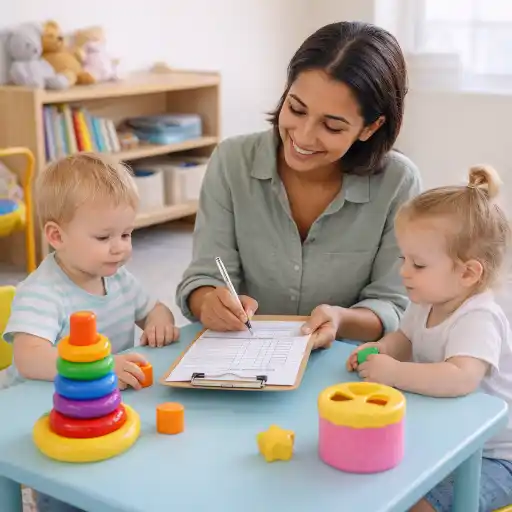
Infant communication logs should prioritize individualized care rhythms. Feeding may occur on demand, naps may vary, and diapering information may be essential for understanding comfort and health. Notes may also describe responses to sounds, faces, objects, positioning according to program policy, and emerging movement.
Toddler logs should continue documenting meals, rest, and toileting while adding attention to growing independence and social communication. Meaningful entries might describe attempts to use a spoon, indicate a toileting need, combine words, follow a simple direction, help with cleanup, or seek assistance from a peer.
- Infants: feeding, sleep, diapering, comfort, sensory responses, movement, and early communication
- Toddlers: self-help attempts, expressive language, choices, peer interaction, emotional regulation, and purposeful play
- All children: interests, strengths, routines, changes, family-relevant context, and meaningful participation
Development should not be treated as a rigid timetable. Children develop unevenly, and culture, language, temperament, disability, relationships, and experience all matter. A daily log is not a diagnostic instrument. It can reveal patterns worth discussing, but screening and referral decisions should follow program procedures and appropriate professional guidance.
Use the log to support responsive care rather than comparison. A precise sentence about a child’s authentic experience is more valuable than a series of generic checkmarks.
How Can Programs Make Communication Logs Efficient, Confidential, and Sustainable?
Documentation becomes manageable when it is designed into the daily rhythm of the room. Directors should select a simple template, define staff responsibilities, establish review routines, and provide time for completion. Staff should never sacrifice active supervision to write a report; brief notes can be finalized during an appropriate transition or planning period.
- Use one consistent template with age-appropriate fields.
- Record routine events in real time when feasible.
- Use agreed-upon abbreviations and train all staff to apply them consistently.
- Offer paper and secure digital options when families have different access needs.
- Review entries for accuracy, respectful language, and completeness.
- Limit access to authorized personnel and secure digital accounts.
- Obtain required permission before sharing photographs or videos.
- Keep routine notes separate from formal incident documentation when policy requires it.
Confidentiality is essential. Logs may contain health information, family details, and developmental observations. Keep paper records secured and use password-protected systems with role-based access. Avoid discussing children in hallways, group messages, or public spaces.
Directors can support quality by reviewing a small sample of logs, coaching staff with concrete examples, and asking families which details are most useful. A monthly review can identify recurring concerns—such as difficult transitions or missed supplies—and lead to practical program improvements.
What Common Mistakes Should Providers Avoid?
Even experienced educators can fall into predictable habits. The first is vagueness: “She had a nice day” does not help a family understand the child’s experience. Replace general statements with one observable moment. The second is documenting only logistics. Meals, naps, and diapering are essential, but families also want to know how their child explored, communicated, connected, and participated.
Another mistake is using judgmental or alarming language. Describe behavior and context rather than assigning a character label. Avoid comparing children, presenting a single observation as proof of a delay, or promising that a milestone will occur by a specific date.
Other pitfalls include completing reports long after events occurred, copying identical sentences for every child, placing sensitive information in unsecured channels, and sending only negative messages. Consistent positive communication helps families remain open to partnership when concerns need to be addressed.
Use this brief quality check:
- Is the information accurate and child-specific?
- Did I include care information and a meaningful experience?
- Is my language factual, respectful, and understandable?
- Did I document concerns according to program policy?
- Does the message invite partnership rather than prescribe parenting?
When a concern persists, bring documented observations to the appropriate supervisor and follow referral procedures. Begin with strengths, share concrete examples, listen to the family’s perspective, and agree on a reasonable next step.
Conclusion: What Makes a Daily Communication Log Effective?
An effective daily communication log for an infant or toddler room is accurate, individualized, concise, strengths-based, and useful. It combines essential care information—feeding, diapering, sleep, mood, and health-related notes—with specific examples of play, communication, relationships, and emerging skills.
The best systems make documentation part of responsive caregiving. Educators record brief observations promptly, use a consistent structure, protect confidentiality, and review patterns without making assumptions. Families contribute valuable knowledge about their children, so communication should remain reciprocal rather than one-directional.
Start with one manageable improvement: choose a shared template, teach objective language, and ask families which details help them most. When daily logs become a genuine bridge between home and care, small notes can strengthen trust, improve planning, and help every young child feel understood.
Additional ChildCareEd Courses
- CDA: Essential Tools for Record Keeping Buy Now $16.00—develop documentation and family communication skills.
- Let’s Talk: Effective Communication Buy Now $24.00—strengthen responsive communication with families.
- Privacy Matters: Documentation and Observation in Early Learning Buy Now $55.00—explore objective observation and confidentiality.
- CDA Infants/Toddlers: Benefits to Observing Buy Now $16.00—learn how observation can guide individualized care.
- Culture, Communication, and Collaboration in Assessment—build culturally and linguistically responsive documentation practices.
- Beyond the Classroom: Connecting Families to Essential Services
- Bienvenido! Welcoming All Families
- Teacher Mentoring in ECE
- Pediatric RSV First Aid & CPR/AED
- CDA Bridge Bundle: Infant/Toddler without Portfolio Review
- CDA Home Visitor Credential Birth to 5
- Texas Director Credential
- Bridging Cultures: Family Communication & Collaboration
- Let’s Talk: Effective Communication
- Recursos en Español sobre el Sueño Seguro del Bebé
- ¡Obtén Tu Certificación de Cuidado Infantil de 90 Horas En Línea!
- Curso de Comunicación de 9 Horas de Maryland
- Cómo usar tu certificación de 90 horas en Maryland para completar tu CDA
- 45 horas para infantes y niños pequeños: cómo certificarse en línea
- ¿Cuáles son los pasos, requisitos y opciones en línea para la certificación de 90 horas en cuidado de Infantes/Toddlers en Maryland?
- Capacitación en Salud y Seguridad Preventiva en Línea para Proveedores de Cuidado Infantil
- Proporciones de Cuidado Infantil y Tamaños de Grupo por Edad en Maryland (Guía Rápida para Centros y Hogares)
- Proporciones de Cuidado Infantil y Tamaños de Grupo por Edad en Nueva Jersey (Guía Rápida para Centros y Hogares)
- Proporciones de Cuidado Infantil y Tamaños de Grupo por Edad en Virginia (Guía Rápida para Centros y Hogares)
- Lista para Abrir una Guardería en Casa en Dakota del Norte: Cómo Empezar
- Capacitación Previa al Servicio para Proveedores de Cuidado Infantil en Maryland
- What is the Infant & Toddler Bonus and how can ND providers use it to improve care?
- What are the infant care best practices Minnesota child care providers should follow?
- Celebrando la amistad en el cuidado infantil durante el Día de los Mejores Amigos
- Canciones, juegos y preguntas de círculo para niños
- Cómo simplificar la capacitación para sus empleados de daycare
- How to Become Certified to Work in Infant Care
- How Can Infant and Toddler Rooms Use Daily Communication Logs Effectively?
- How Can Child Care Teams Keep Feeding Communication Clear for a Breastfed Baby?
