When a preschooler melts down, grabs a toy, or resists cleanup, punishment may stop the moment without teaching what to do next. Washington educators can build calmer classrooms by pairing clear limits with predictable routines, emotional coaching, and environments that make success easier; [Social Foundations and Responsive Classrooms] Buy Now $24.00 offers practical learning on relationships, positive guidance, and social-emotional development. For another focused next step, explore [Turning Behavior Around for Toddlers and Preschoolers Buy Now $25.00], which examines challenging behavior and classroom strategies educators can apply thoughtfully.
Why is positive guidance more effective than punishment?
Challenging behavior is information, not proof that a child is “bad” or deliberately difficult. A preschooler may lack the words, regulation skills, or experience to manage disappointment, wait for a turn, or shift away from a favorite activity. Responding with punishment or shame can intensify distress and does not necessarily teach the missing skill. Positive guidance protects safety while helping children understand expectations and practice more useful responses.
This approach is not permissive. Adults still set firm, consistent limits—especially when someone may get hurt—and follow through calmly. The difference is that the response focuses on teaching rather than making a child feel bad. NAEYC’s guidance on guidance and challenging behaviors and the Center on PBIS practice guide both emphasize proactive, positive strategies and responsive support.
Relationships are the foundation. A child who trusts an adult is more likely to accept help, recover from frustration, and try a new strategy. When a behavior repeats, ask: What happened before it? What might the child be communicating? What support or skill could help next time? That curiosity shifts the focus from blame to problem-solving.
- Set a clear safety limit: “I won’t let you hit.”
- Name the feeling without judgment: “You’re upset that play is ending.”
- Teach an achievable alternative: “You can ask for one more minute or help put the blocks away.”
Positive guidance also supports children’s emerging #emotions, communication, and sense of belonging. It helps make the room safer and more welcoming for everyone.
How can routines and the classroom environment prevent difficult moments?
Prevention begins before a conflict or meltdown. A well-organized, predictable day helps children anticipate what comes next and reduces the cognitive load of repeated uncertainty. Predictability need not mean rigidity: a schedule can provide dependable anchors while leaving room for play, choice, and unexpected changes.
Post a simple picture schedule at children’s eye level and review it at arrival. Use consistent cues before transitions—a song, chime, visual timer, or short countdown—and explain both what is ending and what comes next. Prepare materials in advance so children are not left waiting. Organize centers clearly, make popular materials accessible, and consider whether crowding, long group times, noise, or too many directions are setting children up for frustration. NAEYC’s preschool behavior support self-assessment highlights predictable environments, explicit expectations, consistent responses, and using observation to guide decisions.
Teach expectations rather than assuming children already know them. Use a few positive, observable phrases such as “Walking feet indoors,” “Blocks stay on the floor,” and “Ask before taking a toy.” Model and practice these skills during calm moments, with pictures or role-play as useful. CSEFEL’s resource on routines and classroom schedules explains how visual schedules and consistent routines help children anticipate the day and participate more independently.
- Offer meaningful choices within necessary routines: “Would you like to put away the cars or the blocks first?”
- Use short directions and allow time to respond.
- Notice and describe success: “You checked the schedule and came to the rug.”
- 🤝 Coordinate staff roles before high-stress routines so each adult knows how to support the group.
These adjustments improve access and make the #classroom feel more predictable without demanding that every child respond identically.
What can emotional coaching look like in the moment?
When a child is highly upset, long explanations and repeated questions are rarely useful. Start by regulating yourself: pause, soften your voice, and use a few calm words. Move close enough to support safety without crowding the child. Acknowledge the feeling, hold the limit, and offer one small next step. The National Center for Pyramid Model Innovations describes social-emotional teaching as including emotional literacy, friendship skills, behavior regulation, and problem-solving.
Try a simple sequence: connect, name, limit, and coach. For example: “I’m here. You’re angry because the truck is being used. I won’t let you hit. You can ask for a turn or ask me for help.” If the child is too distressed to engage, focus on safety and co-regulation first; revisit the problem after the child is calmer. A voluntary quiet area may help, but it should not be used to isolate or punish a child.
Teach emotional and social skills when children are regulated. Use books, puppets, pictures, and play to identify feelings and practice useful words: “Stop,” “Help, please,” “My turn next,” or “I need space.” Demonstrate breathing or other calming strategies without insisting that one technique works for everyone. Specific encouragement helps children understand what they can repeat: “You were frustrated and asked me for help instead of throwing the puzzle.”
These everyday interactions support #SEL by building emotional vocabulary, co-regulation, empathy, and problem-solving. The goal is not to eliminate all frustration; it is to help children move through it safely and develop skills for the next challenge.
How can educators respond to five common preschool scenarios?
Real classroom moments call for simple, consistent responses. The strategies below protect safety while teaching skills; adapt the wording to the child’s age, language, communication style, and support needs.
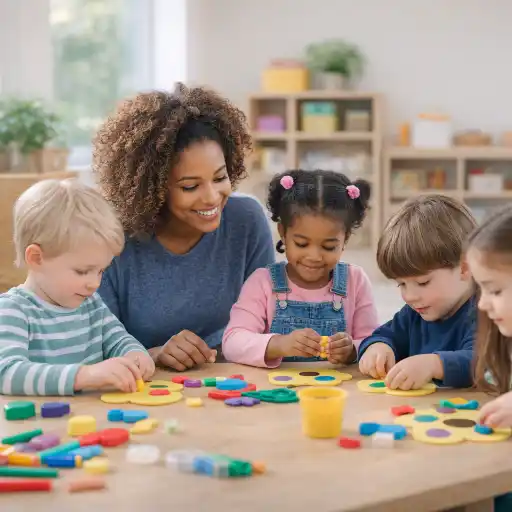
- Tantrum when play ends: A child cries and drops to the floor at cleanup. Stay nearby and keep others safe. Say, “You wanted more time. Play is finished; I’ll help you put away the blocks.” Use a countdown and visual cue next time, and offer a manageable job. Talk about the feeling after the child is calm.
- Sharing conflict: Two children reach for the same truck and one grabs it. Block unsafe behavior if needed: “I won’t let you grab.” Acknowledge both children’s intentions and guide a solution: “You both want the truck. Let’s use a timer or choose who goes first.” Do not force an apology before a child is ready to understand repair.
- Transition resistance: A child refuses to leave the playground. Give a warning before the transition, point to the schedule, and offer a real choice: “Would you like to walk beside me or carry the ball to the basket?” If resistance continues, stay calm and follow through with the routine while supporting the child.
- Frustration with a hard task: A child sweeps a puzzle onto the floor. Name the frustration and make the task more manageable: “That piece is tricky. Would you like a hint or a short break?” Model asking for help and offer another attempt when the child is ready.
- Upset during a peer’s turn: A child shouts when another child uses a favored toy. Validate the disappointment, keep the toy with the current user, and show a concrete way to wait: “You want the blue shovel. Maya has a turn now. You can use the timer or choose another shovel.” Praise waiting, asking, or choosing an alternative.
For recurring patterns, make brief, objective notes about what happened before and after the behavior. Discuss patterns with colleagues and families, then adjust prevention and teaching strategies. For persistent or unsafe concerns, seek appropriate program consultation and develop an individualized, team-based plan rather than relying on escalating consequences.
How can programs make positive guidance consistent?
Children benefit when adults share a dependable approach. Directors can support consistency by agreeing on a few common phrases, clarifying safety procedures, and planning who supports a child and who supervises the rest of the group. Brief staff reflection after a challenging moment can identify what worked, what the environment contributed, and what to try next. The purpose is learning, not criticism.
Work with families as partners. Begin with a strength, describe observations factually, and invite the family’s perspective. For example: “Sam is persistent with building projects. We noticed cleanup has been hard this week, especially when blocks are still in use. A picture cue and a two-minute warning helped yesterday. What have you found helpful?” Family knowledge can offer important context about a child’s communication, routines, culture, and successful calming strategies.
Avoid common pitfalls: giving long lectures during distress, using vague directions like “Be good,” making choices that are not genuine, labeling a child, or responding differently from one adult to another. Instead, prioritize safety, keep language brief, teach the desired behavior, and follow up when the child is ready. Document repeated behavior objectively and protect confidentiality. If a pattern persists or affects safety and participation, partner with families, program leadership, and relevant specialists to consider additional supports. State requirements vary - check your state licensing agency.
Providers seeking a ready-to-use starting point can explore ChildCareEd’s Calm Climate Kit: Quick-Start Practices for a Positive Classroom Buy Now $1.99. It includes free printable tools such as calm-down checklists and visual cue cards; introduce materials thoughtfully and adapt them to each child and program.
Conclusion: What helps Washington preschool classrooms become calmer?
Calmer classrooms grow from relationships, prevention, and teaching—not punishment. Predictable routines and supportive room arrangements reduce avoidable stress; emotional coaching gives children language and a safe adult to lean on; and consistent, respectful limits help children learn what to do instead. Five familiar scenarios—from tantrums and sharing conflicts to transitions and frustration—show how educators can respond in ways that protect dignity and support social-emotional learning.
Start small: choose one challenging routine, observe what tends to happen, agree on a team response, and teach one replacement skill during calm moments. Notice progress in attempts to wait, ask for help, recover, or solve a problem. With steady adult support, preschoolers can build the skills that make future interactions more successful. To develop your practice further, review [Social Foundations and Responsive Classrooms](https://www.childcareed.com/courses-social-foundations-and-responsive-classrooms_4154.html) and [Turning Behavior Around for Toddlers and Preschoolers](https://www.childcareed.com/courses-turning-behavior-around-for-toddlers-and-preschoolers.html) as relevant professional learning options.
- Solutions NOT Punishments
- What Makes Me Special: An Overview of Autism and ADHD
- From Tantrums to Triumphs: Equipping Preschoolers with Self-Regulation Skills
- From Tantrums to Triumphs: Equipping Preschoolers with Self-Regulation Skills
- CDA Bridge Bundle: Preschool
- CDA Bridge Bundle: Family Child Care without Portfolio Review
- Art from the Heart for Preschoolers: Open Ended Art Projects that Build Self-Esteem
- CDA Bridge Bundle: Infant/Toddler without Portfolio Review
- CDA Bridge Bundle: Preschool without Portfolio Review
- Every Moment Matters: Schedules and Transitions
- 👶 ¿Cuáles son las proporciones y grupos requeridos en Dakota del Norte? 🏫
- 10 Ejemplos de Cómo la Cultura Influye en el Desarrollo Infantil
- Proporciones de Cuidado Infantil y Tamaños de Grupo por Edad en Virginia (Guía Rápida para Centros y Hogares)
- ¿Cuál es la Diferencia Entre la Crianza Respetuosa y la Crianza Permisiva?
- Cómo Celebrar el Día Nacional del Kindergarten
- How can DC early learning programs improve teacher-child interactions?
- What Should DC Early Childhood Teachers Know About Pay Equity Right Now?
- How can positive guidance make indoor transitions calm in California early childhood classrooms?
- How can preschool teachers use simple classroom management techniques that really work?
- How can Washington early childhood educators manage classrooms with routines, calm transitions, and choice?
- How can Washington classrooms be more inclusive using nature, play, and community?
- How can I become a teacher in Washington and build confidence in my early childhood classroom?
- Did Washington’s Infant and Early Childhood Conference Put Inclusion and Family Partnerships in Focus?
- Celebrando la amistad en el cuidado infantil durante el Día de los Mejores Amigos
- Canciones, juegos y preguntas de círculo para niños
- How Can Preschool Routines Create Calmer, More Independent Classrooms?
- How Can District of Columbia Child Care Providers Create Calmer, More Organized Classrooms?
- How Can Washington Preschool Teachers Document Children’s Development Without Extra Stress?
- How Can Washington Child Care Programs Support Children’s Emotional Development?
- How Can Washington Preschool Teachers Build Calmer Classrooms Without Punishment?
