A child may confidently name the first letter on a cubby yet hesitate when asked to find its lowercase partner. Understanding the difference between recognition and matching can help you choose supportive, purposeful activities. ChildCareEd’s Science of Reading Foundations in the Pre-K Classroom Buy Now $16.00 offers providers a broader grounding in alphabet knowledge and practical ways to build print-rich learning experiences. For additional strategies to strengthen early literacy development, explore Language and Literacy Foundations in Pre-K  Buy Now $16.00, which focuses on supporting children's communication and emerging literacy skills through everyday learning experiences. To put these concepts into practice, use ChildCareEd’s Letter Recognition Worksheets | Find & Circle | Uppercase Lowercase Match Buy Now $2.49, which provides engaging activities that help children identify letters, distinguish uppercase and lowercase forms, and strengthen visual discrimination and letter-matching skills.
Why are recognizing a letter and matching its cases different skills?
Letter recognition means noticing or identifying a letter form—for example, seeing a familiar capital M and naming it. Matching asks for an additional connection: understanding that uppercase M and lowercase m are two visual forms of the same letter. A child may know one form well because it appears often in a name, classroom label, or favorite book, while the other form is less familiar.
It helps to separate several related skills that can look similar during an activity:
- Visual recognition: noticing or identifying a letter shape.
- Letter naming: saying the letter’s name when shown its form.
- Case matching: pairing uppercase and lowercase forms that share a letter identity.
- Letter-sound knowledge: connecting a letter with one or more sounds.
These skills develop in relation to one another, but success in one does not guarantee mastery of all the others. A worksheet answer alone cannot tell you everything a child knows. Alphabet knowledge includes familiarity with letter forms, names, and sounds, as described in research on alphabet learning and instruction. Observe the particular task the child can do, and use that information to plan the next step.
Why can uppercase-to-lowercase matching be challenging?
Matching cases is a visual comparison and categorization task. Some pairs look similar, such as S and s; others differ substantially, such as G and g. A child who has learned one particular shape may need repeated opportunities to understand that a different-looking form can belong to the same letter category. English print also gives children uneven exposure: capitals often stand out in names, headings, and signs, while lowercase forms appear frequently in sentences and books.
Attention, visual discrimination, language experience, and familiarity with print all shape how children approach this task. Letters such as b and d may add another challenge because their orientation matters. Confusion in an early learning activity is a cue to offer support—not a reason to label a child or assume a learning problem. Children’s alphabet knowledge follows different growth patterns, as reported in research on profiles and predictors of alphabet knowledge growth.
Keep the first practice focused and welcoming:
- Begin with two or three familiar pairs rather than the entire alphabet.
- Use clear, high-contrast forms and a tidy work surface.
- Use consistent language: “uppercase,” “lowercase,” and “partner.”
- Let children point, choose, or place a card; handwriting is not required to demonstrate a match.
Uneven progress is ordinary. Calm modeling and time to compare are more helpful than speed or pressure.
How can providers teach case matching through playful visual comparison?
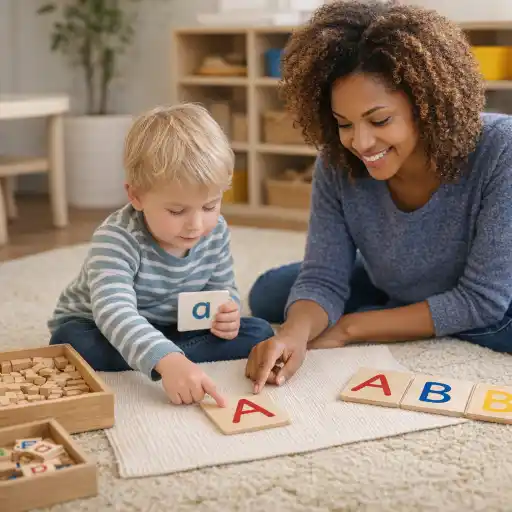
Turn matching into a short investigation instead of a test. Model the thinking aloud: “Here is uppercase M. I’m looking for its lowercase partner. I’ll compare these cards and decide which one belongs with M.” For some pairs, forms share noticeable features; for others, they look quite different. Explain the letter identity clearly without suggesting every pair has the same shape.
Use a gradual “I do, we do, you do” sequence: demonstrate one match, complete a few together, and then invite the child to try independently. A simple set of matching cards, magnetic letters, or the Monster Letter Pairs matching cards Buy Now $2.00 can support a brief center or small-group activity.
- 🔤 Set out two or three uppercase cards and a small selection of lowercase cards; invite the child to find a partner.
- Say the name as the pair is matched: “Uppercase S and lowercase s are both the letter S.”
- Offer two possible matches when a larger choice set feels overwhelming.
- Repeat familiar pairs with a new format—cards one day, magnetic letters another—while keeping the goal the same.
Ask open prompts such as “What do you notice?” or “Which could be the partner?” Avoid turning the activity into a speed challenge. Careful looking, even with a pause or a prompt, is meaningful practice.
How can matching connect to inclusive, meaningful literacy experiences?
Focused card practice has a place, but letter learning becomes more meaningful when children encounter forms in everyday print. After matching M and m, look for both on a name card, classroom label, sign, or page in a familiar book. A child might find the uppercase form at the start of a name and notice lowercase forms elsewhere. These brief connections show that case forms are part of real reading and writing, not just a classroom game.
Add hands-on ways to explore a selected letter: build it with play dough, trace it in sand, or point to its partner while saying its name. Keep the purpose on noticing and connecting forms; perfect letter formation is not a prerequisite. Head Start’s guidance on alphabet knowledge and early writing describes children’s growing knowledge of letter names and forms alongside their awareness of sounds and writing.
- Use larger cards, strong contrast, and a defined workspace when these supports help access.
- Reduce the choices or provide a model pair for children who benefit from added structure.
- Allow pointing, eye gaze, or partner-assisted placement when handling cards is difficult.
- Use familiar words, gestures, and home-language connections where helpful.
Keep shared vocabulary consistent across staff, and invite families to notice letters in books or signs without assigning drills. Print experiences should reflect children’s names, languages, and interests. A warm, accessible approach helps each child participate in developing #literacy knowledge.
How can providers observe progress and avoid common mistakes?
Notice how a child approaches the task, not only whether every card is placed correctly. Record which forms are recognized independently, which pairs prompt hesitation, and whether a model or two-choice prompt helps. These observations can guide what to do next: revisit a small set, demonstrate a visual feature, or reduce the number of choices. Objective observation can help providers translate evidence into responsive learning goals; the ChildCareEd Assessment of Language and Literacy Skills Buy Now $24.00 course explores approaches to literacy assessment and documentation.
Common pitfalls are preventable:
- Too many cards at once: start small and add choices as the child becomes ready.
- Treating cases as separate alphabets: consistently explain that two forms can share one letter identity.
- Correcting every pause: give the child time to compare; model calmly when needed.
- Relying only on worksheets: include hands-on materials, books, labels, and everyday print.
- Confusing matching with writing: accept pointing or placing as evidence of a visual match.
Use brief notes rather than repeatedly testing the entire alphabet. Share observations with colleagues and, when appropriate, families so practice can remain consistent and encouraging. State requirements vary - check your state licensing agency for applicable training or documentation expectations.
Conclusion: What helps preschoolers connect uppercase and lowercase letters?
Some preschoolers recognize letters but struggle to match uppercase and lowercase forms because recognizing one familiar shape is different from connecting two forms to a shared letter identity. Case matching asks children to compare visual features, recall a letter name, and make a category decision. Differences in exposure and experience help explain why a child may know a capital but not yet identify its lowercase partner.
Start with a few familiar pairs, model how to compare them, and give children repeated, playful opportunities to match forms in cards and meaningful print. Adapt the materials so children can respond in different ways, and use observations to decide what to revisit. Patient, practical support helps make alphabet learning a positive part of children’s emerging #reading and writing.
Five relevant ChildCareEd courses for providers
- Science of Reading Foundations in the Pre-K Classroom Buy Now $16.00 — alphabet knowledge and other early literacy foundations.
- Assessment of Language and Literacy Skills Buy Now $24.00 — observation and documentation to inform learning goals.
- Understanding Print Knowledge in Preschool Buy Now $16.00 — practical grounding in preschool print knowledge.
- Classroom Tools for Emergent Literacy Buy Now $25.00 — strategies and materials for supporting emergent literacy.
- Letter & Number Planning in Child Care Buy Now $24.00 — planning developmentally appropriate literacy activities with individual needs in mind.
- 45 Hour Child Growth and Development
- What Makes Me Special: An Overview of Autism and ADHD
- CDA Bridge Bundle: Preschool
- CDA Bridge Bundle: Family Child Care
- CDA Bridge Bundle: Family Child Care without Portfolio Review
- CDA Bridge Bundle: Infant/Toddler without Portfolio Review
- CDA Bridge Bundle: Preschool without Portfolio Review
- Texas Director Credential Renewal
- Texas Director Credential
- CDA Certification en Español: Recursos y Consejos para Educadores Bilingües
- 🚨 Reporte Obligatorio en Nevada
- Actividades de Motricidad Gruesa que Desarrollan el Equilibrio, la Coordinación y la Fuerza
- Capacitación en Salud y Seguridad Preventiva en Línea para Proveedores de Cuidado Infantil
- Actividades de Otoño Fáciles para Preescolares esta Temporada
- Lista para Guardería en Casa en Illinois: Cómo Iniciar una Guardería en el Hogar
- Lista para Guardería en Casa en Texas: Cómo Iniciar una Guardería en el Hogar
- Capacitación Previa al Servicio para Proveedores de Cuidado Infantil en Dakota del Norte
- Cómo simplificar la capacitación para sus empleados de daycare
- What Are the Best Print-and-Play Activities for Substitute Teachers?
- How Can Clip Cards Prepare Little Hands for Writing?
- Why Is Upper- versus Lowercase Sorting Great for Letter Recognition?
- How Can Child Care Providers Help Children Recognize Letters Through Play?
- How Can Play Help Children Distinguish Uppercase and Lowercase Letters?
- How Can Child Care Providers Teach Beginning Sounds with Tracing, Pictures, and Repetition?
- How Can Child Care Providers Teach Less-Frequent Letters Without Relying on Worksheets Alone?
- ¿Todos los niños deben participar en el tiempo de círculo?
- Why Do Some Preschoolers Recognize Letters but Struggle to Match Uppercase and Lowercase?
- How Can Teachers Help Children Who Know Letter Names but Struggle With Letter Sounds?
- Why Do Some Preschoolers Recognize Letters but Struggle to Match Uppercase and Lowercase?
